




























Proven Piecewise Continuity Worksheet | Grade 12 Calculus
Paste this activity's link or code into your existing LMS (Google Classroom, Canvas, Teams, Schoology, Moodle, etc.).
Students can open and work on the activity right away, with no student login required.
You'll still be able to track student progress and results from your teacher account.
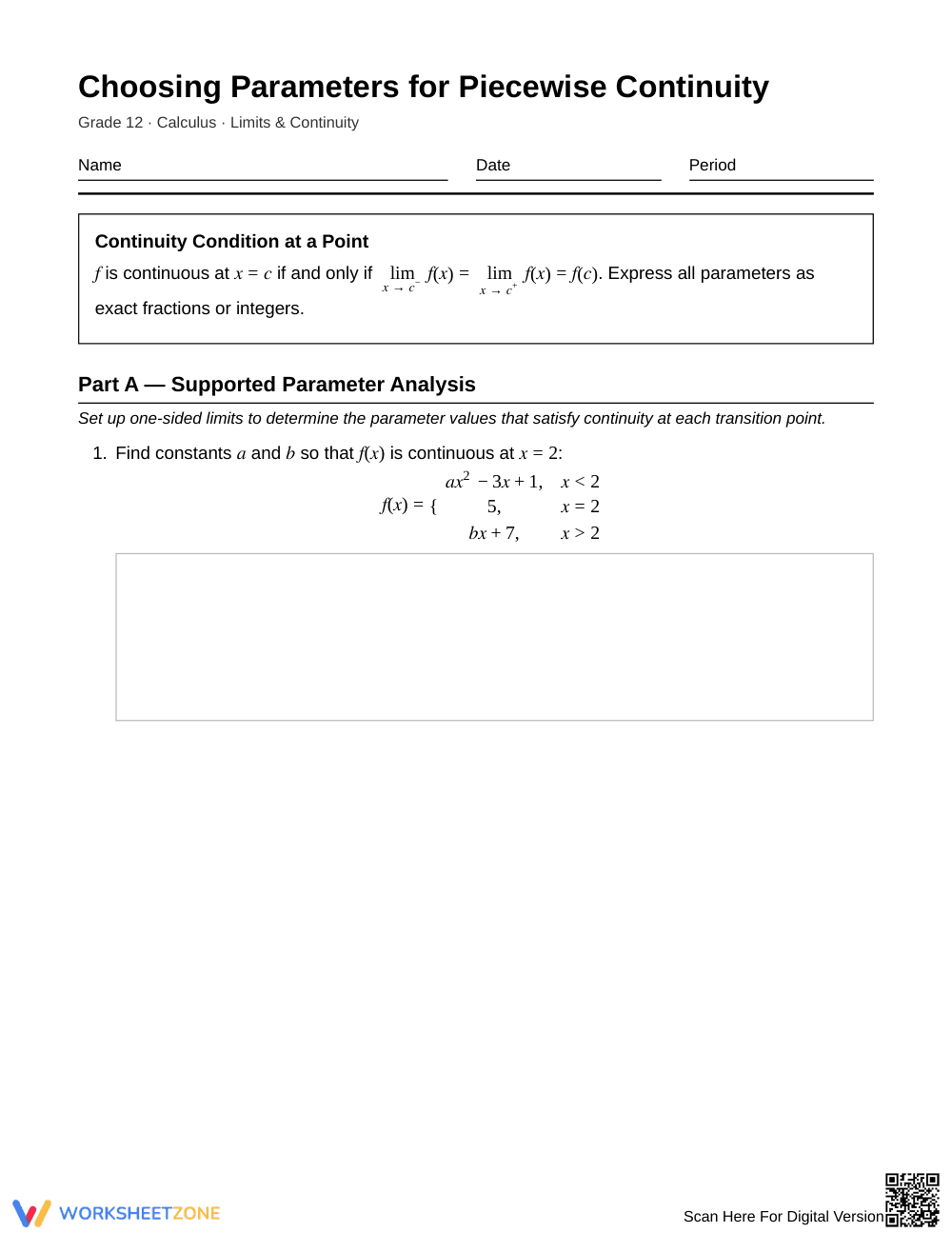
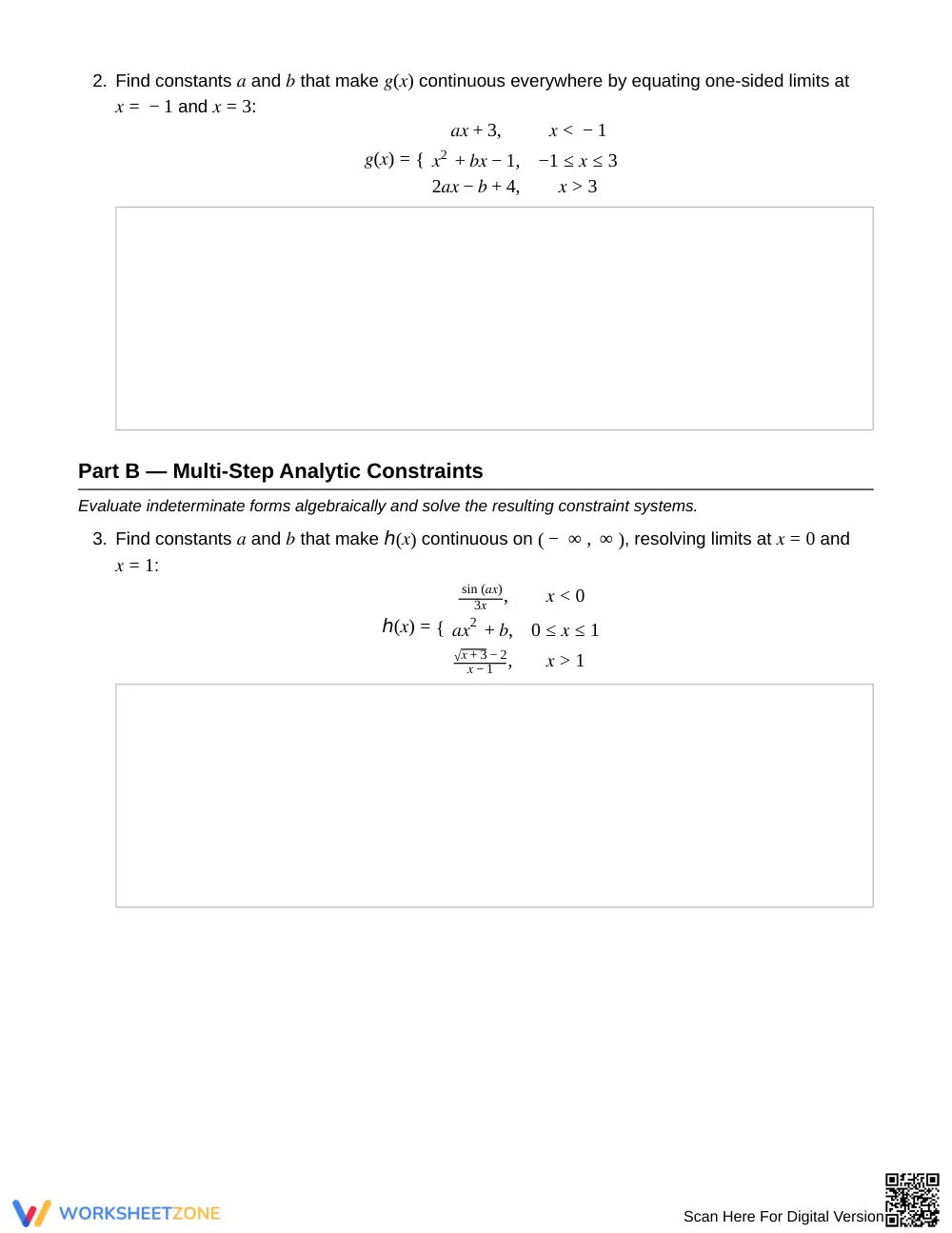
This calculus worksheet equips grade 12 students to calculate unknown parameters that guarantee piecewise function continuity across interior domain boundaries. Learners evaluate one-sided limits, resolve indeterminate algebraic and trigonometric forms, and justify continuity at critical transition points using the formal three-part limit definition.
At a Glance
- Grade: 12 · Subject: Calculus
- Standard: Limits & Continuity — Solve for unknown parameters to guarantee piecewise function continuity at interior domain boundary points
- Skill Focus: Choose Parameters That Make a Piecewise Function Continuous
- Format: 4 pages · 6 multi-step problems · Complete answer key included · PDF
- Best For: AP Calculus exam preparation and review
- Time: 45–60 instructional minutes
What's Inside
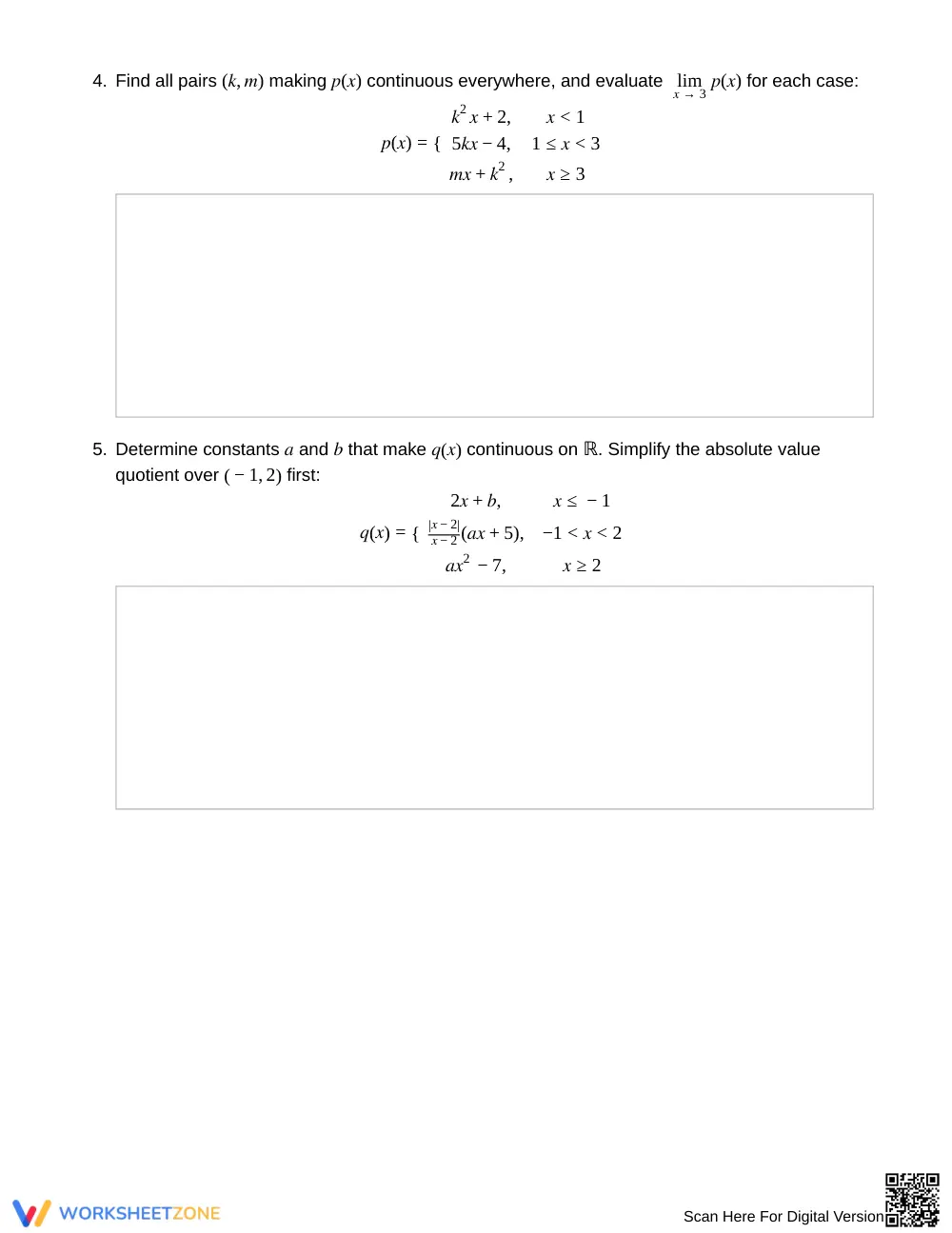
This four-page resource contains six rigorous problems accompanied by a complete two-page answer key. A reference box at the top establishes the three-part continuity criterion, requiring students to equate one-sided limits with evaluated function values. Tasks feature linear systems, trigonometric indeterminate limits, radical rationalization, absolute value quotients, and applied piecewise curve construction.
Skill Progression
- Guided practice (Part A, 2 problems): Students analyze piecewise boundaries with quadratic and linear branches, setting up one-sided limits and solving two-variable linear systems with direct scaffolding.
- Supported practice (Part B, 3 problems): Students evaluate indeterminate forms—including trigonometric limits, radical rationalization, and absolute value expressions—to solve parameter systems with minimal cues.
- Independent practice (Part C, 1 problem): Students construct an interpolating quadratic elevation profile through a benchmark point and complete an unassisted three-part continuity justification.
This sequence follows the gradual-release model, guiding students toward autonomous analytic justification.
Standards Alignment
This worksheet aligns with calculus standards for limits and continuity: a function f is continuous at x = c if and only if the limit exists, f(c) is defined, and both values agree. Supporting objectives address solving algebraic systems produced by boundary conditions. Both standard codes can be copied directly into lesson plans, IEP goals, or district curriculum mapping tools.
How to Use It
Use this worksheet after direct instruction on limit laws and continuity definitions. Assign Part A during guided practice to ensure students equate one-sided limits accurately. Alternatively, deploy Parts B and C for collaborative partner review before a unit exam. Formatively observe whether students verify point existence or simply equate boundary expressions. Expected completion time is 45 to 60 minutes.
Who It's For
This resource supports Grade 12 Calculus and AP Calculus AB/BC students mastering piecewise functions. For differentiated support, pair learners with a limit evaluation anchor chart detailing indeterminate strategies before tackling Part B. Advanced students can extend Part C by analyzing differentiability at boundary nodes.
Targeting piecewise continuity parameter analysis in Grade 12 Calculus, this instructional resource guides students to determine unknown constants that make piecewise functions continuous across transition boundaries. Learners systematically equate left-hand limits, right-hand limits, and defined function values, resolving indeterminate algebraic forms and trigonometric limits to establish continuity. Grounded in the gradual-release instructional architecture described by Fisher & Frey (2014), the six-problem sequence transitions from structured two-variable linear parameter systems to independent quadratic curve construction and rigorous limit justifications. By requiring learners to verify all three components of the formal continuity definition rather than simply equating expressions, the worksheet builds deep procedural precision and conceptual understanding. High school instructors and AP Calculus teachers can utilize this verified four-page PDF resource, complete with two student-facing pages and a detailed two-page answer key, to deliver focused intervention, partner practice, or summative unit exam review.


