
































Proven Paragraph Cohesion Worksheet | Grade 12 English IV

Paste this activity's link or code into your existing LMS (Google Classroom, Canvas, Teams, Schoology, Moodle, etc.).
Students can open and work on the activity right away, with no student login required.
You'll still be able to track student progress and results from your teacher account.
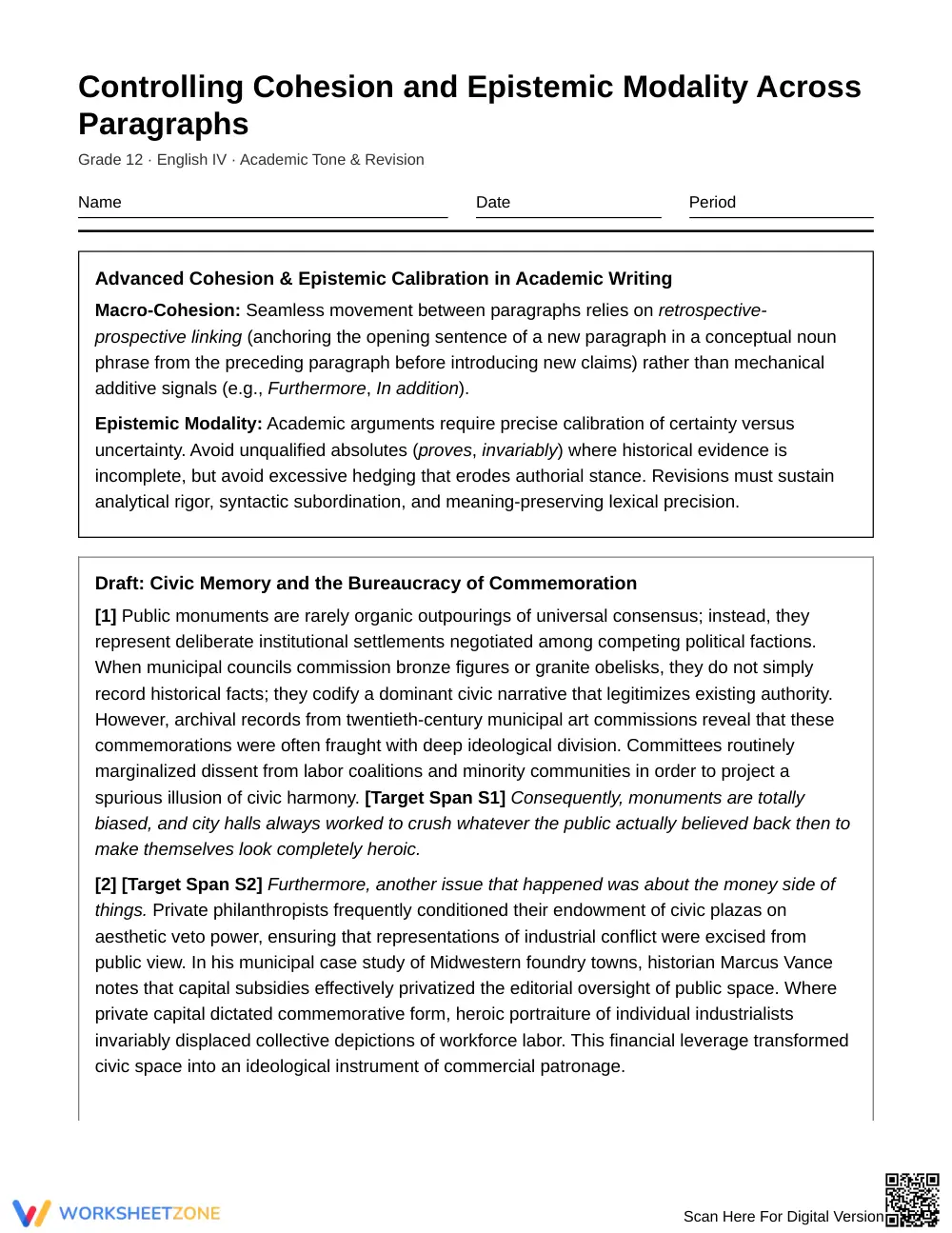
This advanced writing worksheet equips Grade 12 students to establish sophisticated macro-cohesion and calibrate epistemic modality across complex analytical drafts. Working through high-level text revisions, learners replace mechanical transitions and absolute assertions with precise retrospective-prospective links and scholarly qualifications. The result is authentic mastery of academic tone and syntactic maturity in college-preparatory prose.
At a Glance
- Grade: 12 · Subject: English IV
- Standard:
W.11-12.5— Develop and strengthen writing by revising, editing, and recalibrating tone- Skill Focus: Cross-paragraph macro-cohesion and epistemic modality
- Format: 6 pages · 12 problems · Answer key included · PDF
- Best For: Advanced drafting and revision workshops
- Time: 45–60 minutes
What's Inside
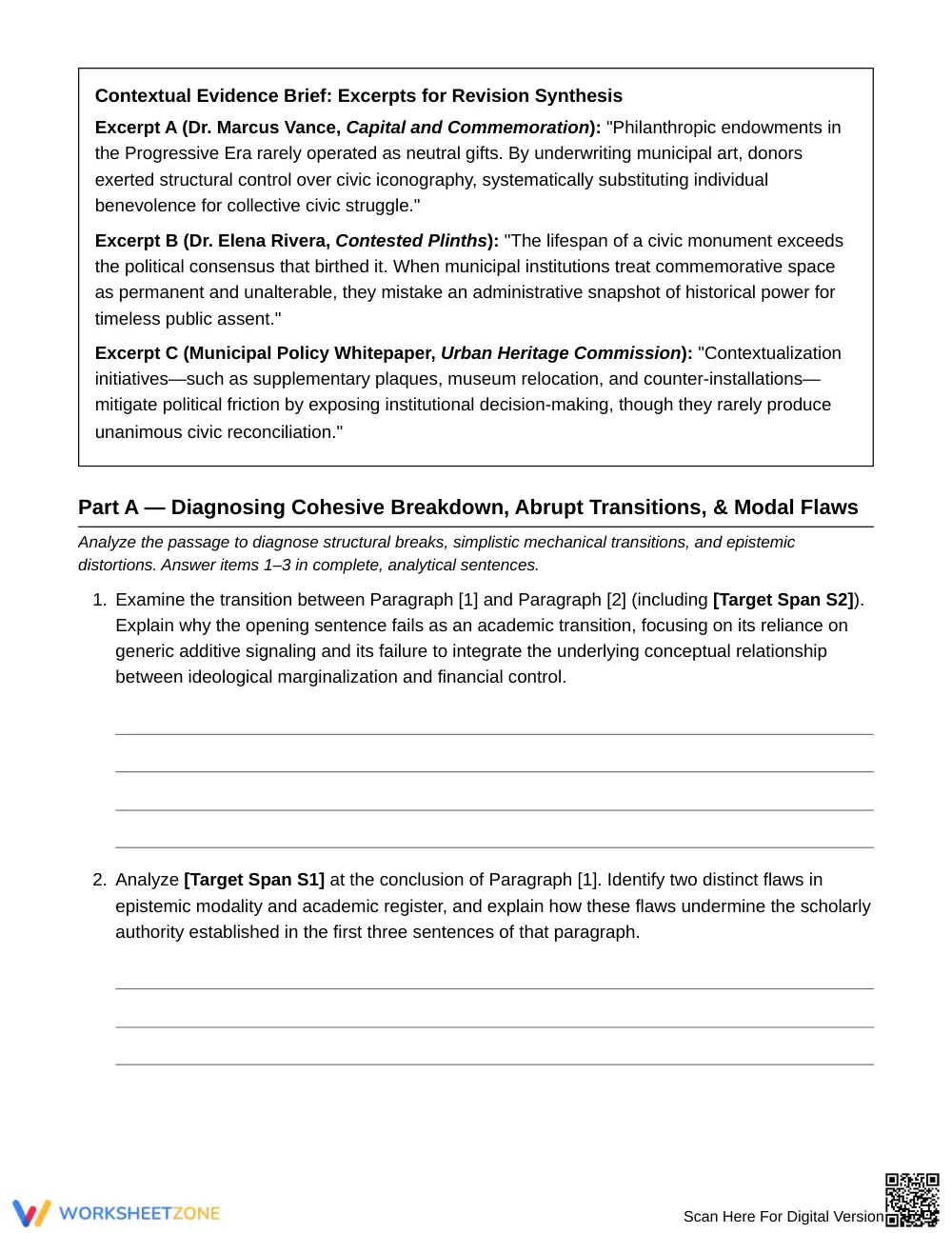
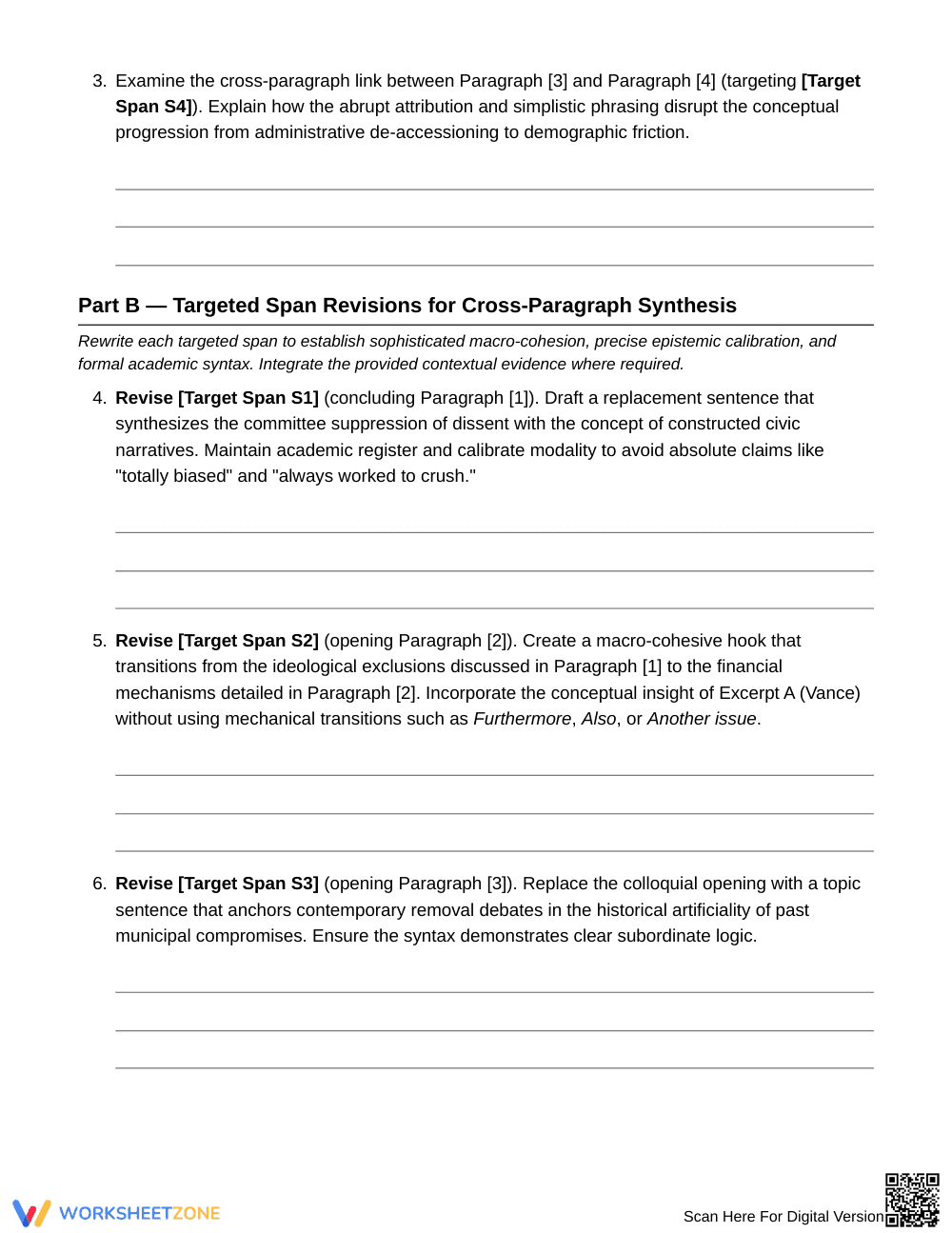
This 6-page printable resource centers on a scholarly passage detailing civic commemoration and municipal power, accompanied by three contextual evidence briefs. Students work through a 3-page student task sequence followed by a comprehensive 3-page explanatory answer key. The worksheet features an introductory concept summary on macro-cohesive linking and epistemic stance, targeted diagnostic questions, sentence-level revision frames, and analytical justification items.
Skill Progression
- Guided Practice (Part A, Items 1–3): Students analyze the model text to diagnose structural breakdowns, simplistic additive markers, and uncalibrated modal claims, explaining why these flaws compromise academic credibility.
- Supported Practice (Part B, Items 4–9): Learners rewrite six targeted spans, synthesizing research excerpts to construct retrospective-prospective topic sentences and nuanced conclusions using rigorous syntactic subordination.
- Independent Practice (Part C, Items 10–12): Students compose analytical justifications evaluating how lexical precision and qualified modality preserve rhetorical integrity across paragraph boundaries.
This gradual-release architecture moves students systematically from analytical error detection to autonomous, research-supported rhetorical revision.
Standards Alignment
This worksheet directly addresses W.11-12.5: Develop and strengthen writing as needed by planning, revising, editing, rewriting, or trying a new approach, focusing on addressing what is most significant for a specific purpose and audience. It also reinforces language precision under L.11-12.3 by requiring students to adapt syntax and lexical choices for academic register. Both standard codes can be copied directly into lesson plans, IEP goals, or district curriculum mapping tools.
How to Use It
Deploy this activity during an essay revision unit after students have drafted initial research arguments. Have students complete Part A in collaborative pairs to identify rhetorical disconnects, then transition to independent completion for Parts B and C. As a formative assessment check, review student revisions of Item 5 to ensure they replace basic additive connectors with conceptual noun phrases. The full exercise takes between 45 and 60 minutes.
Who It's For
This resource is tailored for Grade 12 English IV, AP Language and Composition, and dual-enrollment writing courses. It provides targeted rigor for college-bound writers while supporting developing editors through structured contextual evidence briefs. Pair this worksheet with an anchor chart on academic signal phrases or a direct instruction lesson on epistemic hedging.
According to research in Fisher & Frey (2014), explicit instructional routines that combine targeted diagnostic modeling with purposeful revision justifications yield significant gains in adolescent syntactic complexity and writing quality. Addressing standard W.11-12.5, this Grade 12 resource operationalizes that evidence base by guiding students through the structural mechanics of macro-cohesion and epistemic calibration. Rather than treating revision as superficial proofreading, the 12 structured tasks require learners to evaluate authorial stance, eliminate colloquial absolutes, and craft sophisticated conceptual transitions across paragraph boundaries. By grounding revision in realistic civic policy texts, the resource builds the rigorous discourse competence demanded in postsecondary academic environments.


