


























Views
Downloads


Proven Ohm's Law Circuits Worksheet | Grades 8-12 Science
Paste this activity's link or code into your existing LMS (Google Classroom, Canvas, Teams, Schoology, Moodle, etc.).
Students can open and work on the activity right away, with no student login required.
You'll still be able to track student progress and results from your teacher account.
This physical science worksheet equips secondary students to apply Ohm's law, electric power calculations, and circuit relationships to authentic engineering scenarios. Learners examine component behaviors, interpret electrical data graphs, and calculate household current loads rather than relying on formula memorization.
At a Glance
- Grade: Grades 8–12 · Subject: Science / Physics
- Standard: Qualitative and quantitative analysis of electric circuit relationships
- Skill Focus: Applying voltage, current, and resistance to authentic contexts
- Format: 4 pages · 22 problems · Answer key included · PDF
- Best For: Guided physical science circuit practice
- Time: 45–60 minutes
What's Inside
This 4-page print-and-go activity features 22 targeted items organized across three distinct investigative sections. Students interpret circuit schematics with meters, complete data tables using experimental V-I values, evaluate graph slopes, calculate electric power, and evaluate multi-appliance household branch circuits. A complete 4-page teacher answer key provides full computational steps and conceptual explanations.
Skill Progression
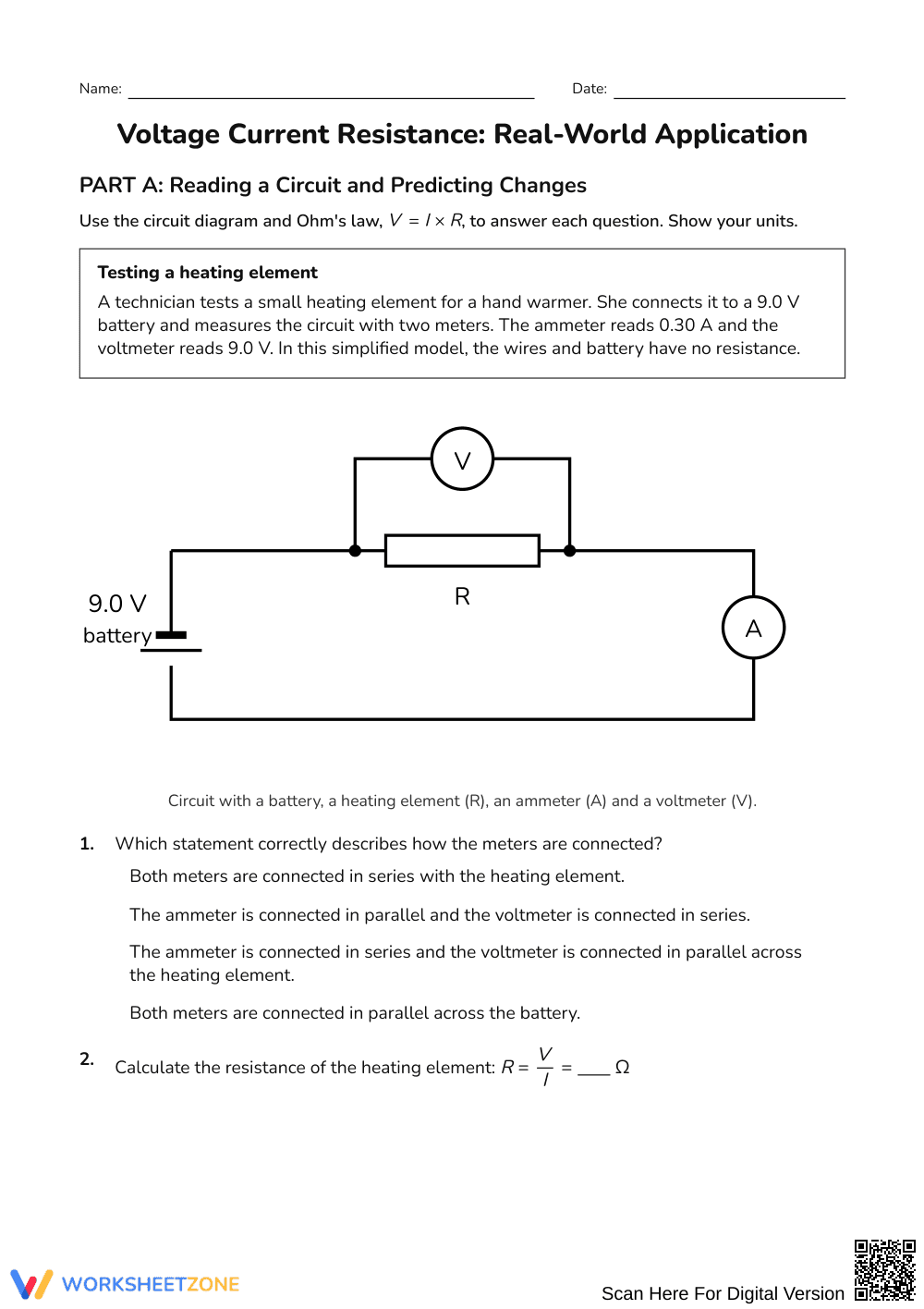
- Guided Practice (Part A, 4 tasks): Scaffolds meter identification and component calculations using a heating element schematic, guiding students to predict current changes when components are added in series.
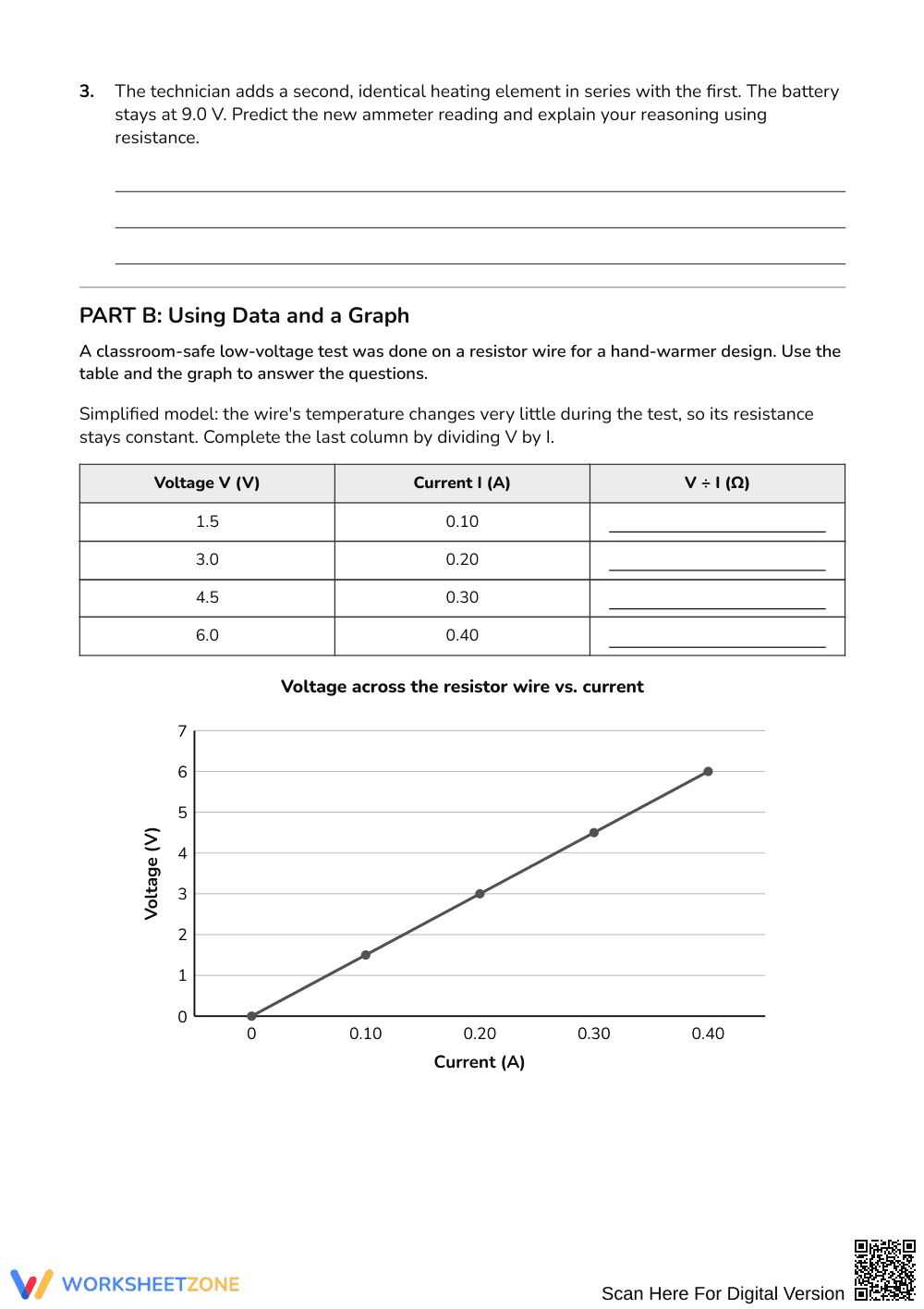
- Supported Practice (Part B, 6 tasks): Directs learners through authentic resistor-wire data, requiring table completion, proportional reasoning from a linear graph, slope analysis, and power calculations.
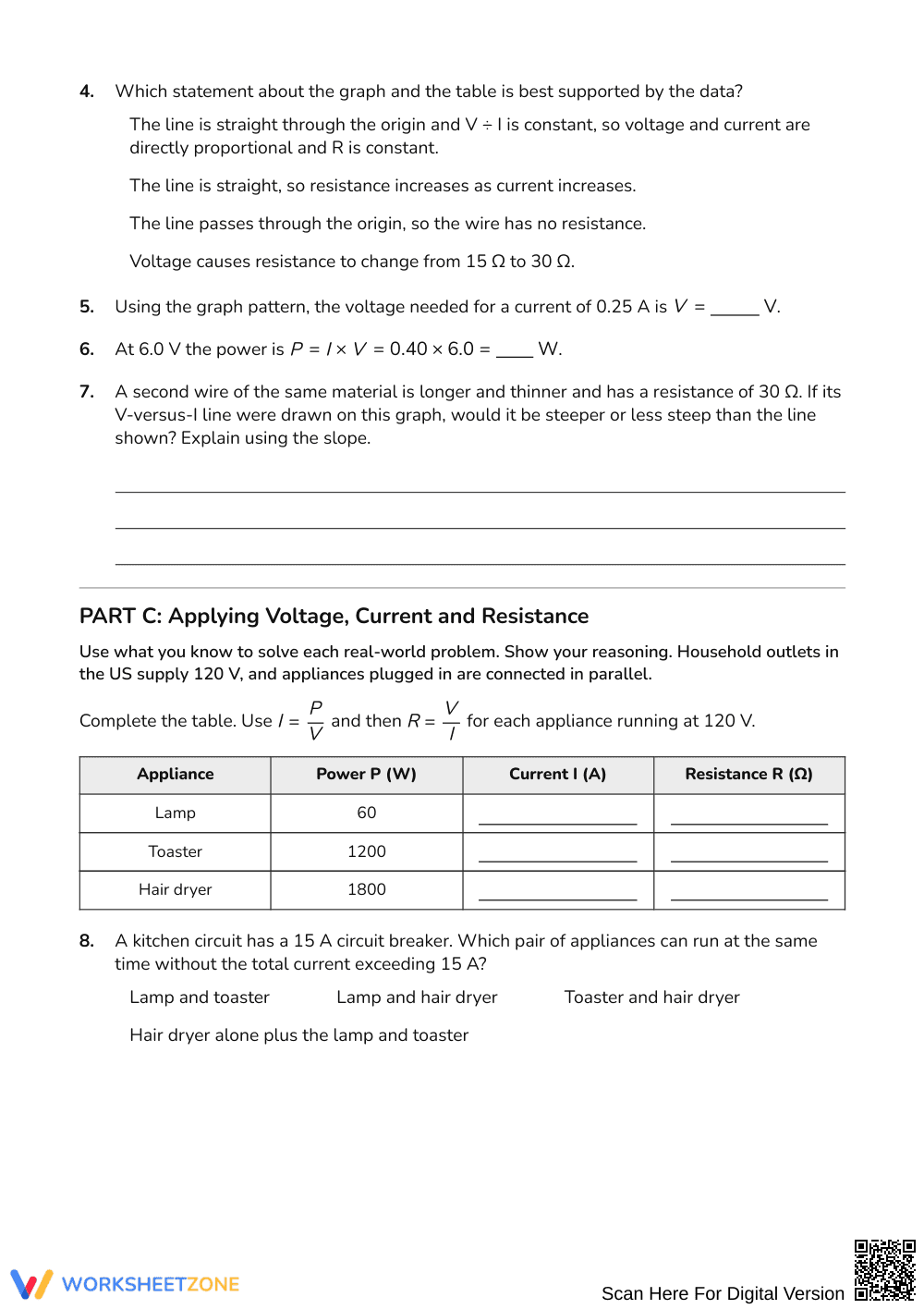
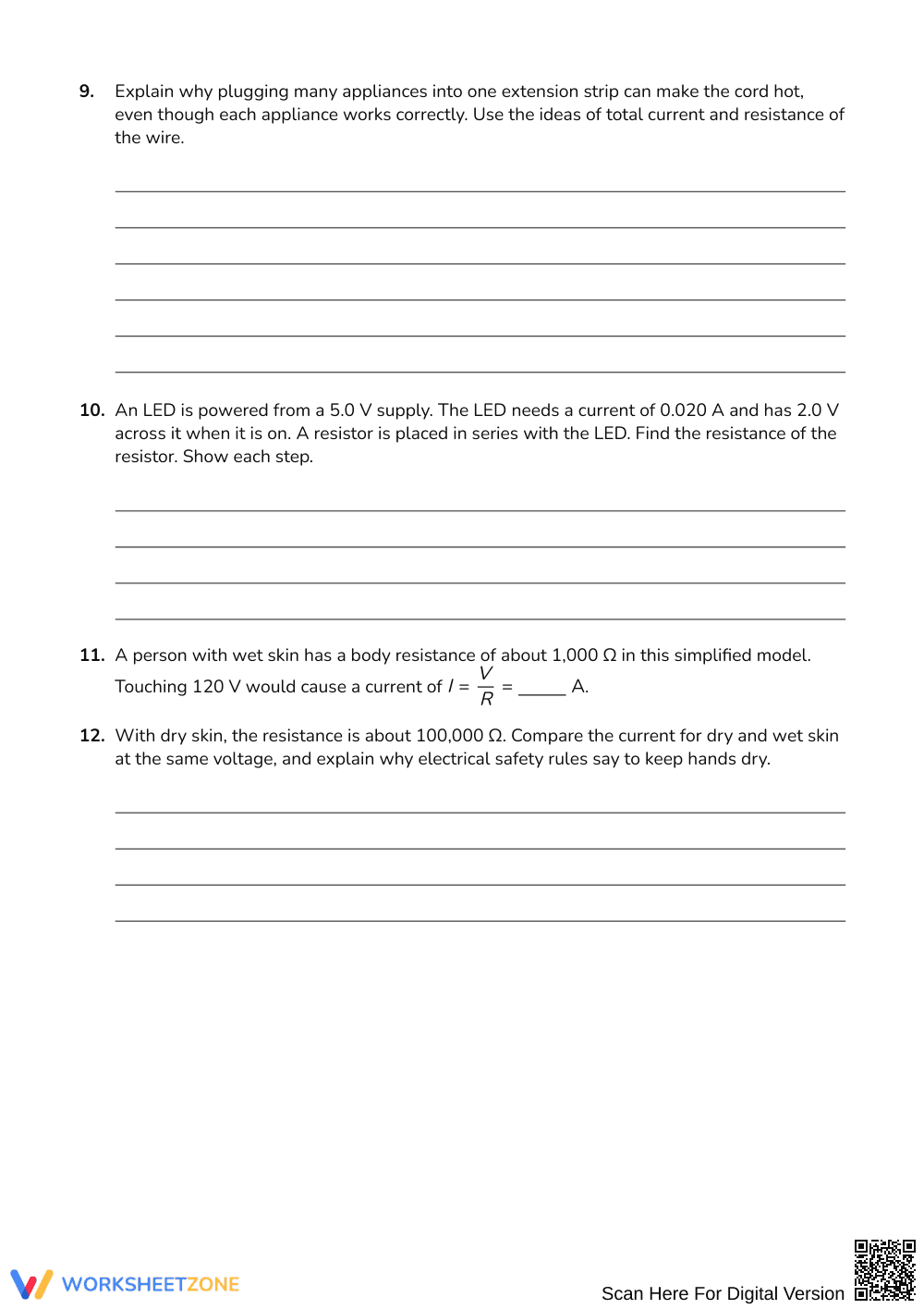
- Independent Practice (Part C, 12 tasks): Challenges students to transfer electrical formulas to parallel home appliances, extension cord heating risks, series LED circuits, and human skin resistance safety parameters.
This deliberate sequence follows the gradual release of responsibility model, ensuring students master basic schematic interpretation before tackling compound parallel loads and thermal hazard transfers.
Standards Alignment
This resource aligns with secondary physical science expectations for analyzing how electric fields, potential difference, and material resistance govern current in closed circuits. Students mathematically represent relationships between current, voltage, resistance, and electrical power while constructing evidence-based explanations for circuit safety phenomena. Both standard codes can be copied directly into lesson plans, IEP goals, or district curriculum mapping tools.
How to Use It
Deploy this worksheet after direct instruction on Ohm's law and basic circuit topology. For an effective mid-unit formative check, assign Parts A and B during class to observe whether students recognize that the slope of a V-I graph represents resistance. Part C serves effectively as a post-lesson assessment or collaborative group challenge. Expected completion time is 45 to 60 minutes.
Who It's For
This resource serves physical science, physics, and STEM engineering students in grades 8 through 12. Teachers can support developing learners by highlighting the provided circuit formula references or pair this activity directly with a hands-on breadboard lab or digital circuit simulation.
Based on the 2024 EdReports review of secondary science curricula, the worksheet meets the rigorous expectations for high‑school physical science by moving students beyond simple memorization toward authentic problem solving. The tasks require learners to translate Ohm’s law and power equations into real‑world scenarios such as multi‑appliance branch circuits, heating‑element resistance, and even human‑skin resistance limits. By confronting these contexts, students construct durable conceptual models that link voltage, current, resistance, and power in meaningful ways. The 22 carefully sequenced items give repeated practice with data interpretation, graph analysis, and safety calculations, providing multiple checkpoints for both teachers and students. This evidence‑based design supports deeper understanding, prepares learners for laboratory investigations, and aligns with best‑practice recommendations for science instruction without referencing any specific state or district standards. Educators can integrate the worksheet into unit plans to reinforce conceptual depth while offering clear scoring rubrics for formative assessment.


