




























Views
Downloads



Proven Multiplicative Change Worksheet | Grade 11 Algebra II

Paste this activity's link or code into your existing LMS (Google Classroom, Canvas, Teams, Schoology, Moodle, etc.).
Students can open and work on the activity right away, with no student login required.
You'll still be able to track student progress and results from your teacher account.
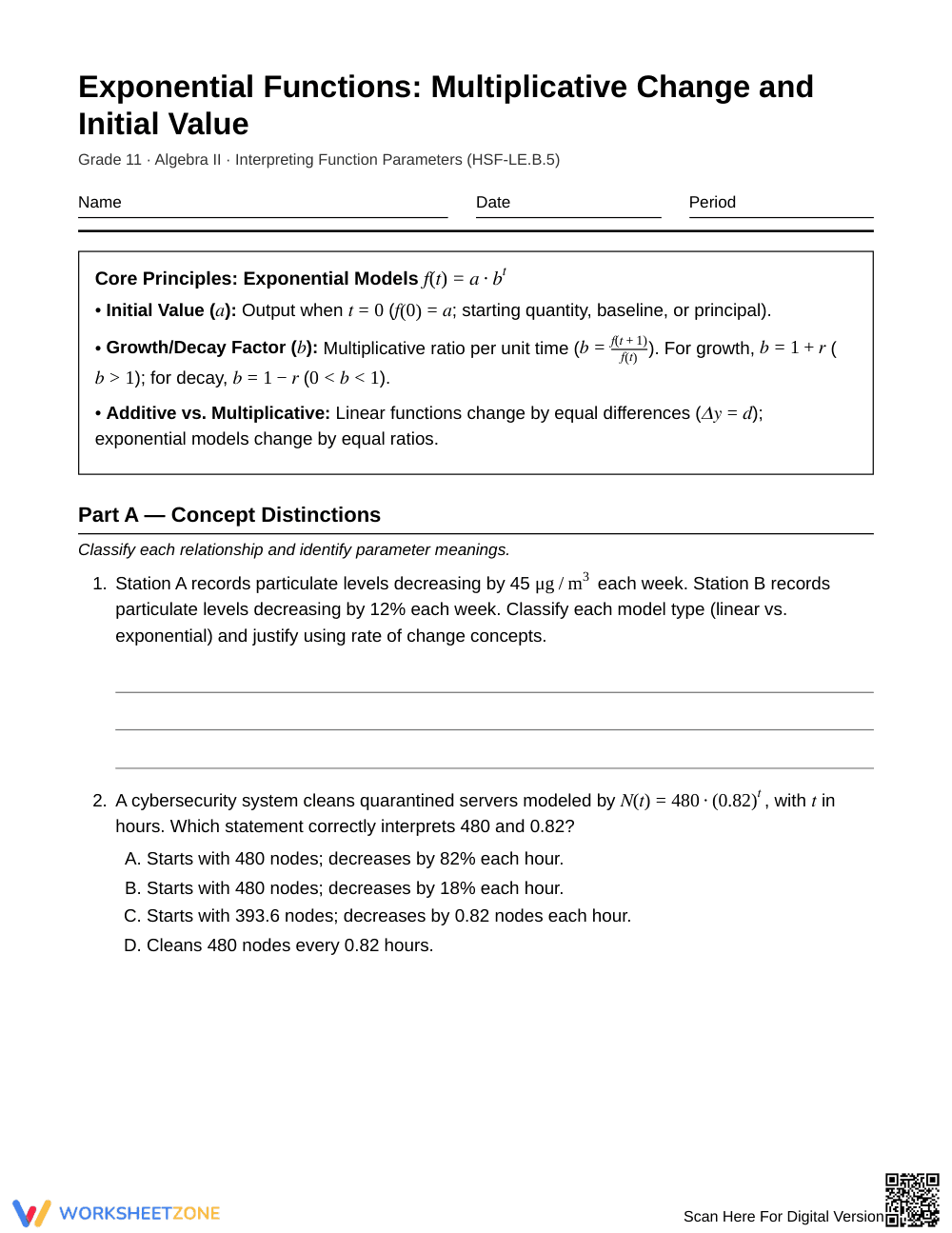
This Grade 11 Algebra II worksheet develops student mastery in analyzing multiplicative change and initial values within exponential functions. High schoolers learn to distinguish linear additive patterns from exponential multiplicative growth, construct mathematical models from real-world contexts, and interpret initial quantities and base factors with precision.
At a Glance
- Grade: 11 · Subject: Algebra II
- Standard:
HSF-LE.B.5— Interpret parameters in exponential functions representing real-world contexts- Skill Focus: Multiplicative Change and Initial Value
- Format: 5 pages · 16 problems · Answer key included · PDF
- Best For: High school exponential modeling practice
- Time: 45–60 minutes
What's Inside
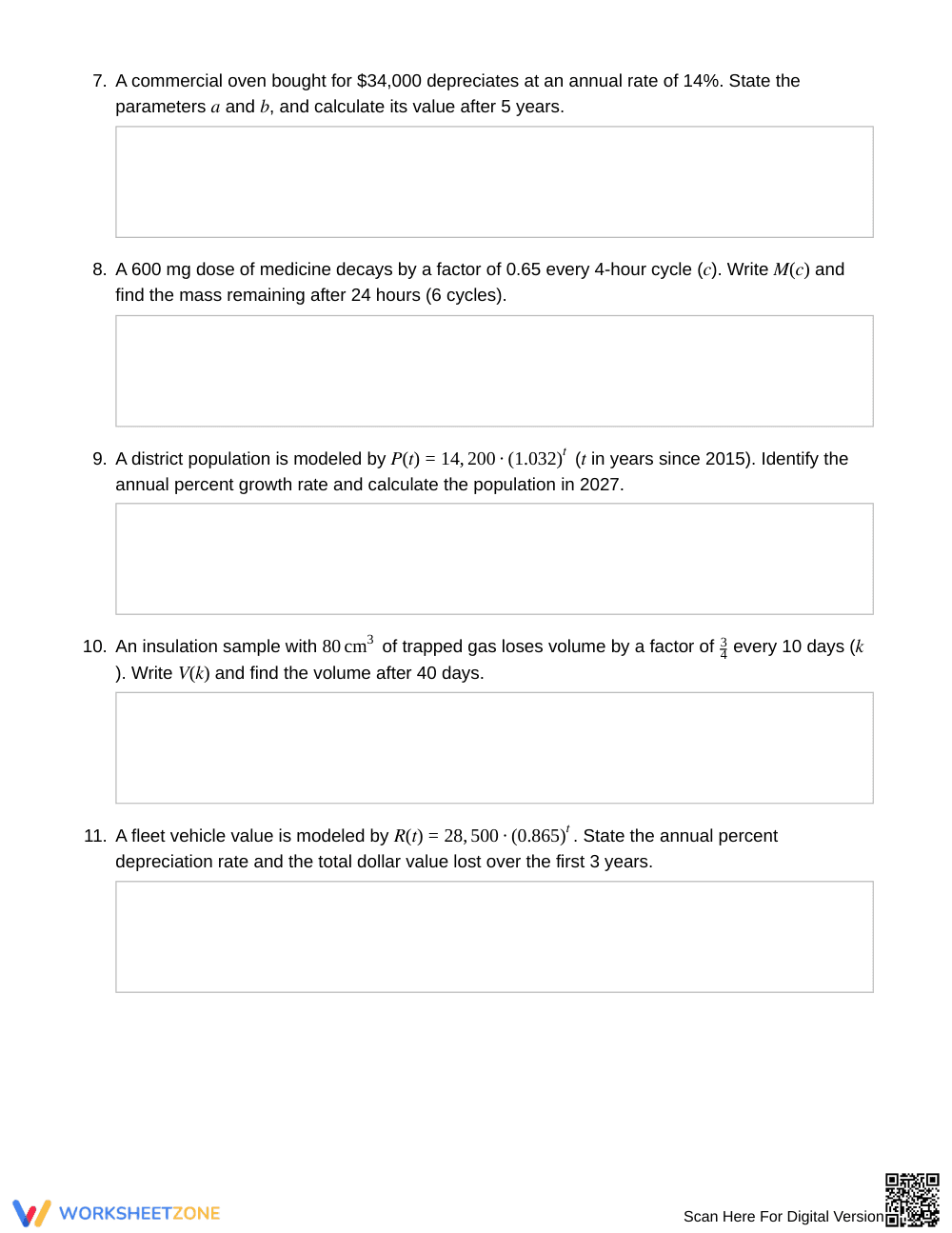
The 5-page printable resource delivers 16 carefully engineered problems supported by a core principles reference box defining initial value a and growth factor b. Students evaluate tabular sequences, solve authentic contextual word problems spanning biology and finance, and resolve conceptual non-examples. A comprehensive 2-page answer key provides step-by-step solutions and model formulations.
Skill Progression
- Guided Practice (Part A, Problems 1–4): Conceptual analysis tasks prompt students to contrast additive versus multiplicative change across data tables, interpret parameters in cybersecurity scenarios, and correct common misconceptions regarding negative bases.
- Supported Practice (Part B, Problems 5–12): Scaffolded application items require constructing models f(t) = a · bt across depreciation, population growth, and half-life cycles.
- Independent Practice (Part C, Problems 13–16): Advanced transfer tasks demand multi-step algebraic derivation of base values, comparative growth rate justifications, and compound interval conversions.
This structured sequence operationalizes the gradual release of responsibility model, guiding learners from conceptual identification to independent analytical derivation.
Standards Alignment
This resource aligns directly to HSF-LE.B.5: "Interpret the parameters in a linear or exponential function in terms of a context." Students examine how base factors represent percentage changes and evaluate initial values as vertical intercepts. Both standard codes can be copied directly into lesson plans, IEP goals, or district curriculum mapping tools.
How to Use It
Deploy this worksheet after direct instruction on exponential definitions or as a targeted mid-unit review. During independent seatwork, conduct formative spot-checks on Part A Problem 4 to ensure students understand why decay factors remain strictly between 0 and 1 rather than negative. The complete activity takes approximately 45 to 60 minutes and functions effectively for partnered investigation or individual assessment.
Who It's For
Designed for Grade 11 Algebra II and Integrated Math III students, this problem set accommodates varied ability levels through embedded formula references and progressive problem complexity. Pair this document with an introductory lesson on geometric sequences or a graphing calculator lab examining long-term exponential growth trajectories.
According to research from Fisher & Frey (2014) on structured instructional frameworks, learners achieve significantly deeper conceptual retention when guided practice systematically precedes independent transfer tasks. This 16-problem Algebra II worksheet implements that evidence-based architecture to master standard HSF-LE.B.5. By progressing from conceptual distinctions between additive differences and multiplicative ratios to multi-step contextual modeling, students build enduring fluency with function parameters. They analyze authentic scenarios involving radioactive decay, compound depreciation, and population dynamics, calculating initial values and common ratios across diverse measurement intervals. The embedded reference anchors and comprehensive two-page answer key enable educators to target algebraic misconceptions immediately during formative checkpoints. As demonstrated by pedagogical research, establishing clear structural relationships between mathematical parameters and their contextual meanings equips secondary mathematics students for higher-level calculus readiness and real-world analytical modeling.


