
































Proven Logic vs Emotional Force Worksheet | Grade 8 ELA

Paste this activity's link or code into your existing LMS (Google Classroom, Canvas, Teams, Schoology, Moodle, etc.).
Students can open and work on the activity right away, with no student login required.
You'll still be able to track student progress and results from your teacher account.
This Grade 8 informational text worksheet equips middle school readers to untangle manipulative rhetoric from sound factual reasoning. Students analyze competing policy texts regarding school equipment sharing, using structured analytical questions to isolate loaded emotional language, verify empirical claims, and determine overall argumentative validity without being swayed by rhetorical bias.
At a Glance
- Grade: 8 · Subject: ELA
- Standard:
RI.8.8— Evaluate argument soundness, evidence relevance, and rhetorical appeals in paired texts- Skill Focus: Separate Emotional Force from Logical Support
- Format: 5 pages · 12 problems · Answer key included · PDF
- Best For: Close reading and argument analysis units
- Time: 40–50 minutes
What's Inside
The 5-page student packet features an Argument Evaluation Checklist defining criteria for relevance, sufficiency, soundness, and neutrality, followed by a paired-text debate over school district equipment sharing. Students complete 12 rigorous analytical tasks comprising targeted multiple-choice identification, text-dependent short answers, and synthesis evaluations. A thorough 3-page answer key provides complete model responses and textual rationales.
Skill Progression
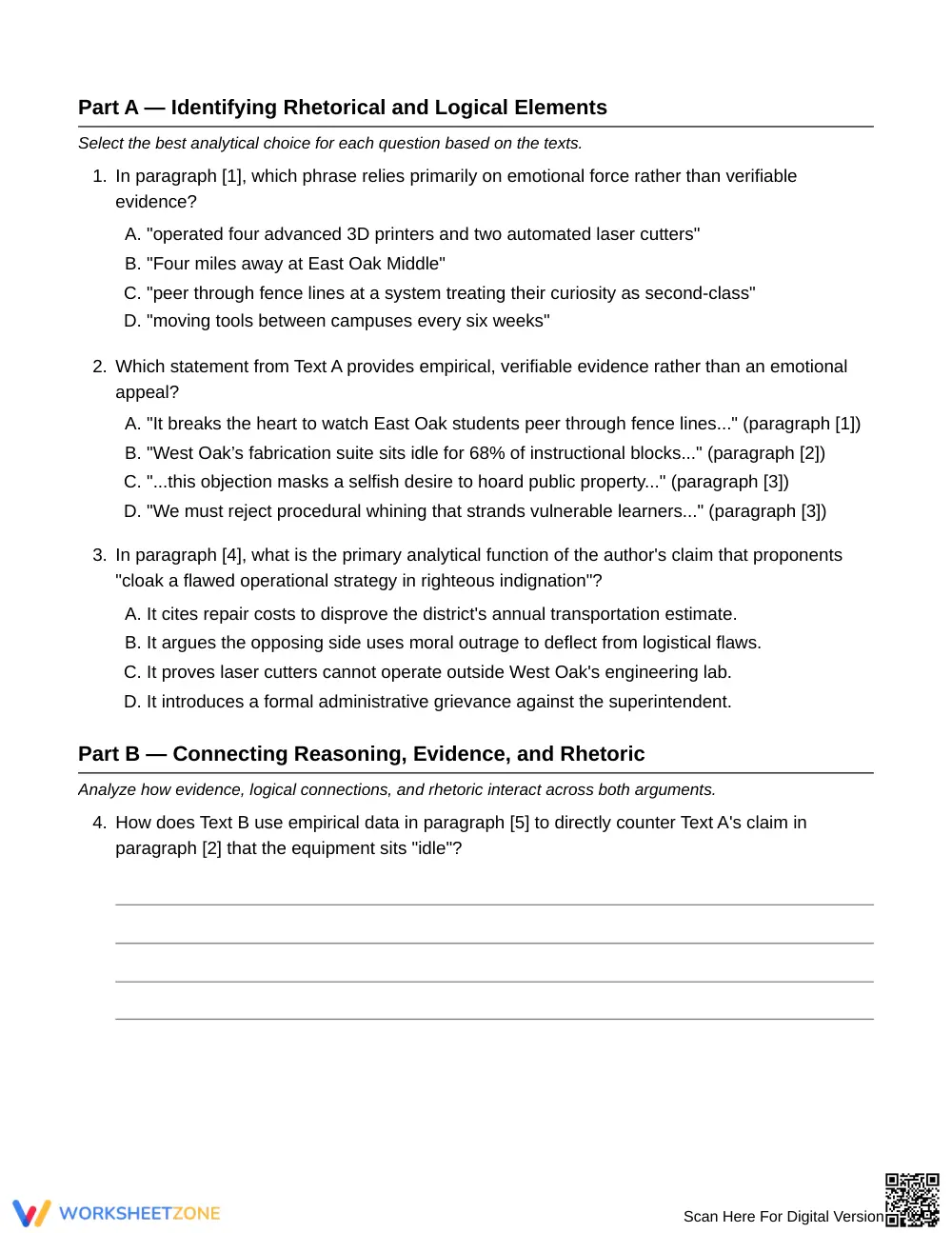
- Guided practice (Tasks 1–3): Multiple-choice items prompt students to identify loaded emotional phrases, distinguish empirical statements, and recognize how rhetorical outrage obscures operational flaws with reference to specific paragraphs.
- Supported practice (Tasks 4–9): Short-response prompts ask learners to cross-examine claims, use the checklist criteria to critique personal attacks, and evaluate the sufficiency of transit cost estimates against pilot data.
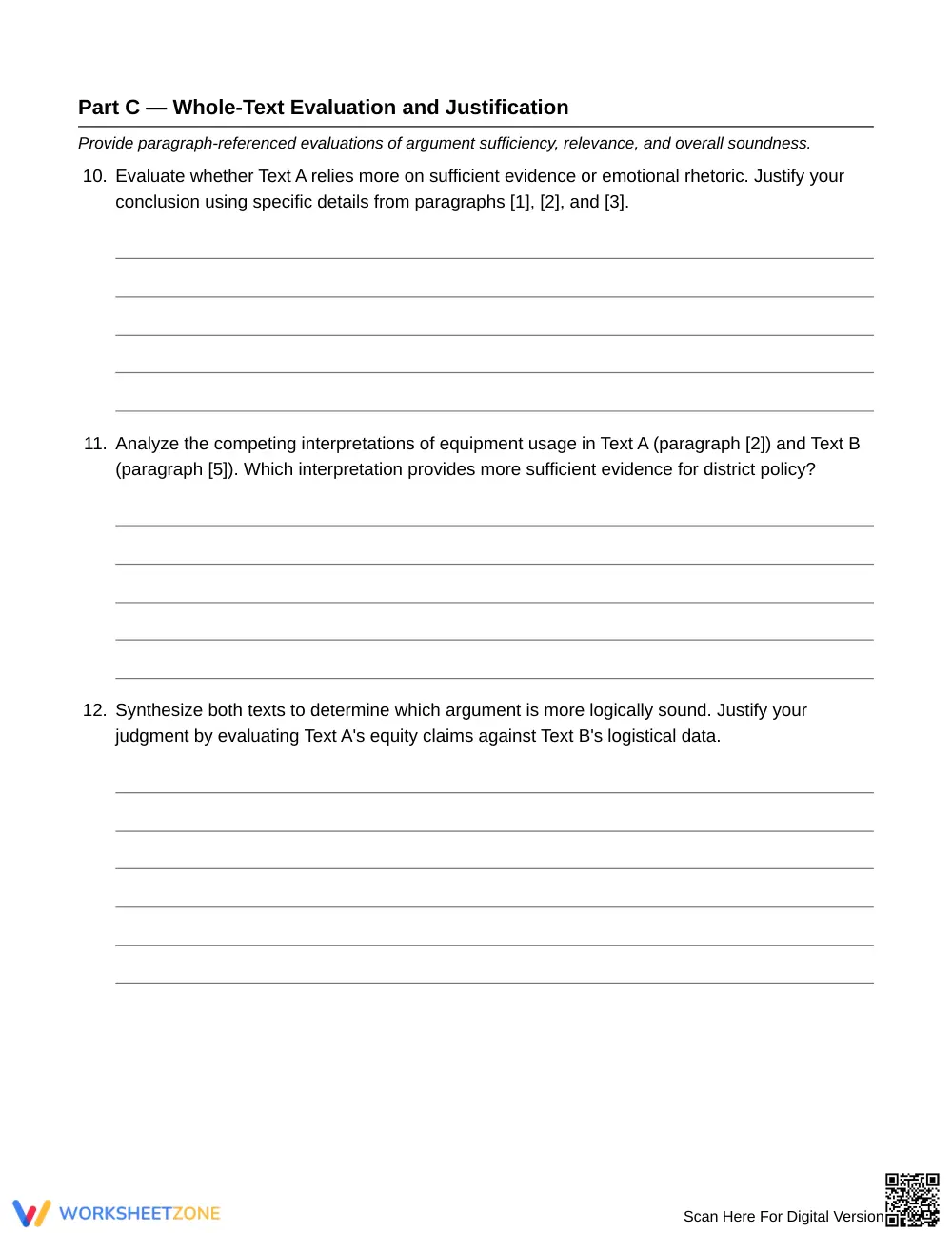
- Independent practice (Tasks 10–12): Extended synthesis questions require students to write paragraph-referenced evaluations judging which opposing text supplies more sound, sufficient evidence.
This structured sequence reflects the gradual release of responsibility model, guiding eighth graders from element recognition to independent evaluation of complex informational texts.
Standards Alignment
Primary Standard: `RI.8.8` — Delineate and evaluate the argument and specific claims in a text, assessing whether the reasoning is sound and the evidence is relevant and sufficient; recognize when irrelevant evidence is introduced. Supporting Standard: `RI.8.1` — Cite the textual evidence that most strongly supports an analysis of what the text says explicitly as well as inferences drawn from the text. Both standard codes can be copied directly into lesson plans, IEP goals, or district curriculum mapping tools.
How to Use It
Assign this resource after direct instruction on rhetorical appeals and fallacies. During guided reading, direct students to highlight emotional appeals in yellow and empirical data in green before answering Part B. For formative assessment, examine student responses to Task 5 to check whether learners can spot ad hominem attacks rather than accepting subjective rhetoric. Expected completion time is 40 to 50 minutes.
Who It's For
Designed for Grade 8 general education classrooms, honors language arts, and intervention groups focusing on informational argument analysis. Pair this practice packet with a direct instruction lesson on rhetorical devices or an anchor chart tracking faulty reasoning.
Educational research confirms that middle school students frequently mistake affective persuasion for substantive factual proof when evaluating non-fiction text. According to Fisher & Frey (2014), explicit instruction in text-dependent close reading routines combined with structured analytical criteria enables adolescent learners to unpack complex informational texts and delineate argumentative claims. This worksheet directly supports standard RI.8.8 by targeting the critical plain-English skill of separating emotional force from logical support. Across 12 rigorous items spanning 5 pages, students learn to test claims for factual sufficiency, identify loaded rhetoric, and evaluate underlying logical soundness. Grounded in systematic cognitive scaffolds, this resource builds the analytical discipline eighth-grade students need for secondary-level source verification and evidence-based textual synthesis.


