




























Views
Downloads



Proven Intermolecular Forces Worksheet | Grade 9-12 Science

Paste this activity's link or code into your existing LMS (Google Classroom, Canvas, Teams, Schoology, Moodle, etc.).
Students can open and work on the activity right away, with no student login required.
You'll still be able to track student progress and results from your teacher account.
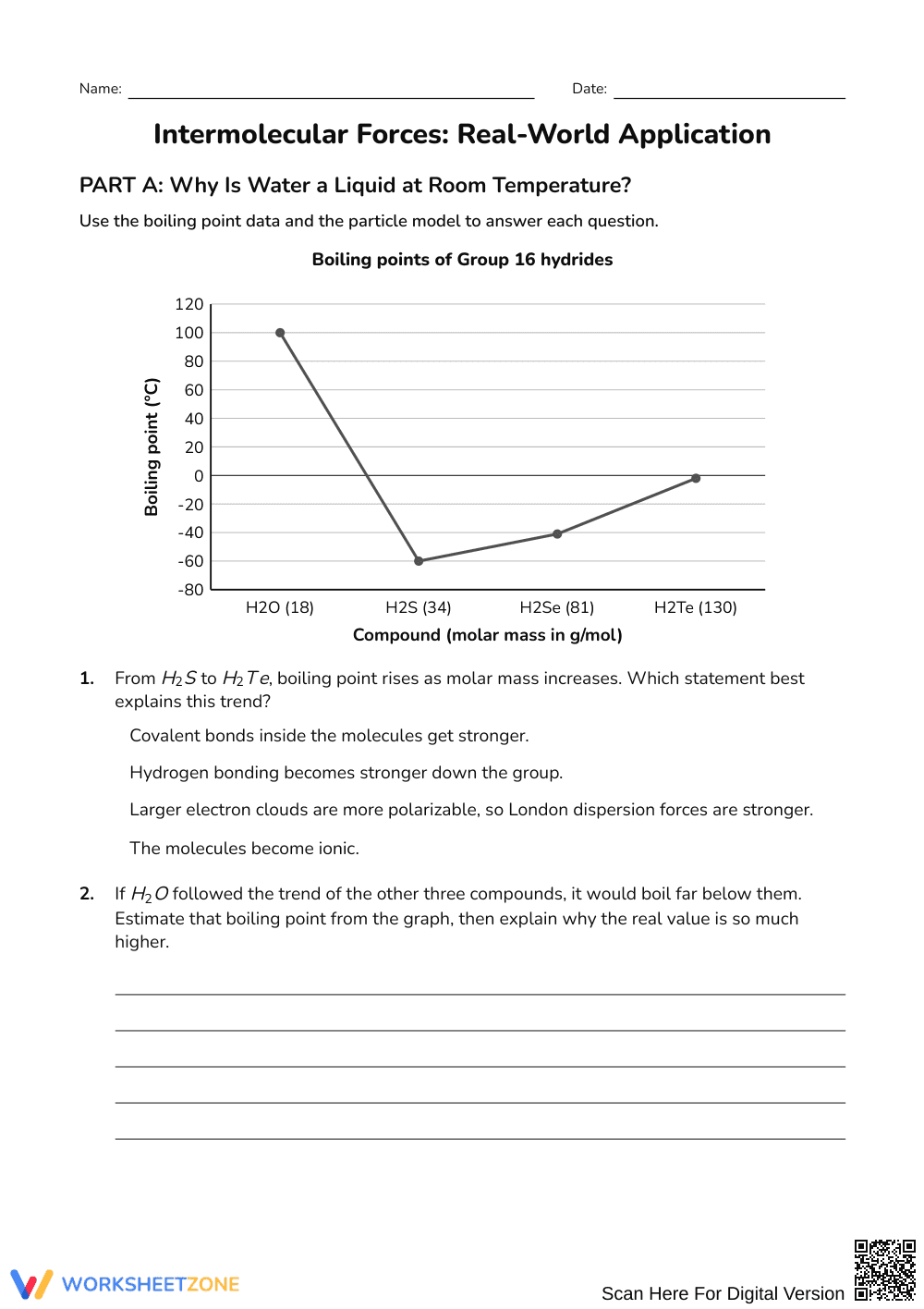
This high school science worksheet trains students to analyze intermolecular forces across authentic physical phenomena. Students evaluate hydride boiling points, classify polarity, calculate evaporative cooling, and explain surfactant behavior. Through structured data analysis, learners connect submicroscopic attractions directly to macroscopic bulk properties like boiling points and solubility.
At a Glance
- Grade: Grades 9–12 · Subject: Science
- Standard: Relate molecular structure and intermolecular attractions to observed macroscopic properties
- Skill Focus: Intermolecular Forces: Real-World Application
- Format: 4 pages · 24 problems · Answer key included · PDF
- Best For: Chemistry practice and concept application
- Time: 45–60 minutes
What's Inside
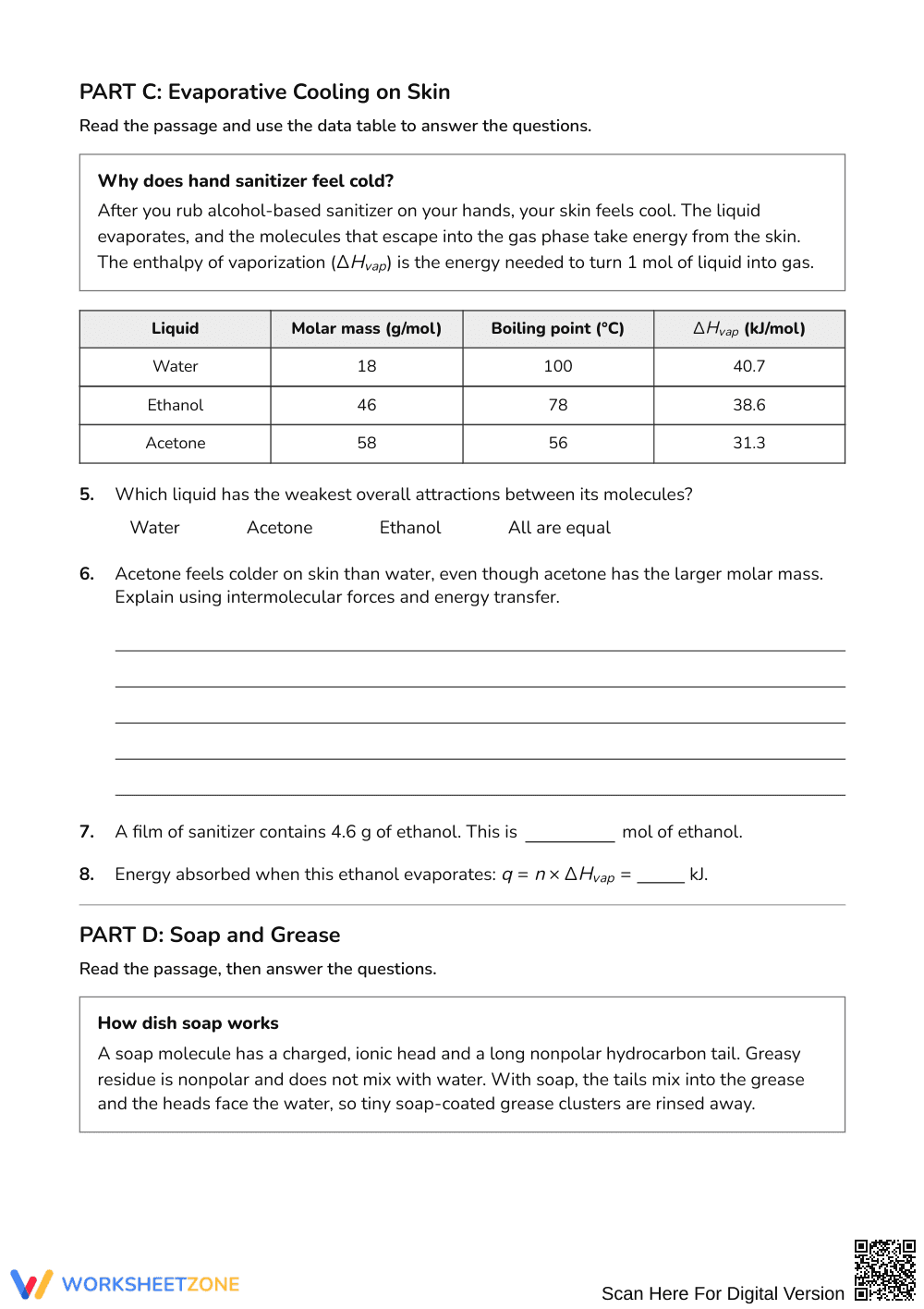
This four-page worksheet contains 24 structured tasks distributed across five real-world contexts. Students examine hydride boiling point anomalies, complete molecular polarity tables, analyze evaporative cooling rates using enthalpy data, evaluate soap mechanics, and select subzero camping fuels. A complete four-page answer key provides full qualitative explanations and sample calculations.
Skill Progression
- Guided practice (Parts A–B): Students examine hydride boiling points and classify molecular polarity, using particle models to identify London dispersion, dipole-dipole, and hydrogen bonds across 10 items.
- Supported practice (Parts C–D): Learners analyze enthalpy tables for skin cooling and evaluate dish soap interactions across 8 contextual data-response questions.
- Independent practice (Part E): Students evaluate hydrocarbon fuel data to justify stove fuel selection for subzero camping across 6 prompts.
This sequence follows a gradual-release model, moving from guided diagram analysis to independent scientific reasoning.
Standards Alignment
This worksheet addresses high school physical science standards requiring students to communicate why intermolecular forces determine bulk properties. Learners demonstrate how hydrogen bonding, dipole attractions, and London dispersion forces dictate boiling points and volatility. These curriculum expectations can be copied directly into lesson plans, IEP goals, or district curriculum mapping tools.
How to Use It
Deploy this worksheet following direct instruction on molecular polarity and intermolecular attractions. It functions effectively as a collaborative partner activity or independent summative practice. During the activity, check whether students correctly distinguish breaking intermolecular attractions from breaking covalent bonds in Part D. The complete four-page worksheet takes approximately 45 to 60 minutes to finish.
Who It's For
This resource targets high school chemistry and physical science students seeking applied practice with intermolecular interactions. Organized data tables support emerging science readers, while quantitative enthalpy questions challenge advanced learners. Pair this worksheet with an interactive molecular simulation or a laboratory measuring liquid evaporation rates.
Explicit instruction linking submicroscopic molecular interactions to observable macroscopic phenomena forms the foundation of chemistry proficiency. According to findings from Fisher & Frey (2014) on productive group work and gradual release, guiding students through scaffolded data interpretation before requiring independent synthesis significantly increases mastery of complex science content. This Grade 9–12 resource operationalizes that evidence-based pedagogy across 24 focused tasks, requiring students to interpret boiling point graphs, tabulate polar attractions, and calculate molar heat exchange. Rather than relying on rote memorization of definitions, learners construct evidence-based scientific arguments explaining real-world events, including hand sanitizer evaporation and surfactant grease removal. Systematic progression from supported classification to independent justification ensures students grasp how intermolecular forces govern matter. The complete 4-page student packet and 4-page answer key provide secondary science educators with a rigorous tool for measurable conceptual growth.


