































Proven Integrand Parameters Worksheet | Grade 12 Calculus

Paste this activity's link or code into your existing LMS (Google Classroom, Canvas, Teams, Schoology, Moodle, etc.).
Students can open and work on the activity right away, with no student login required.
You'll still be able to track student progress and results from your teacher account.
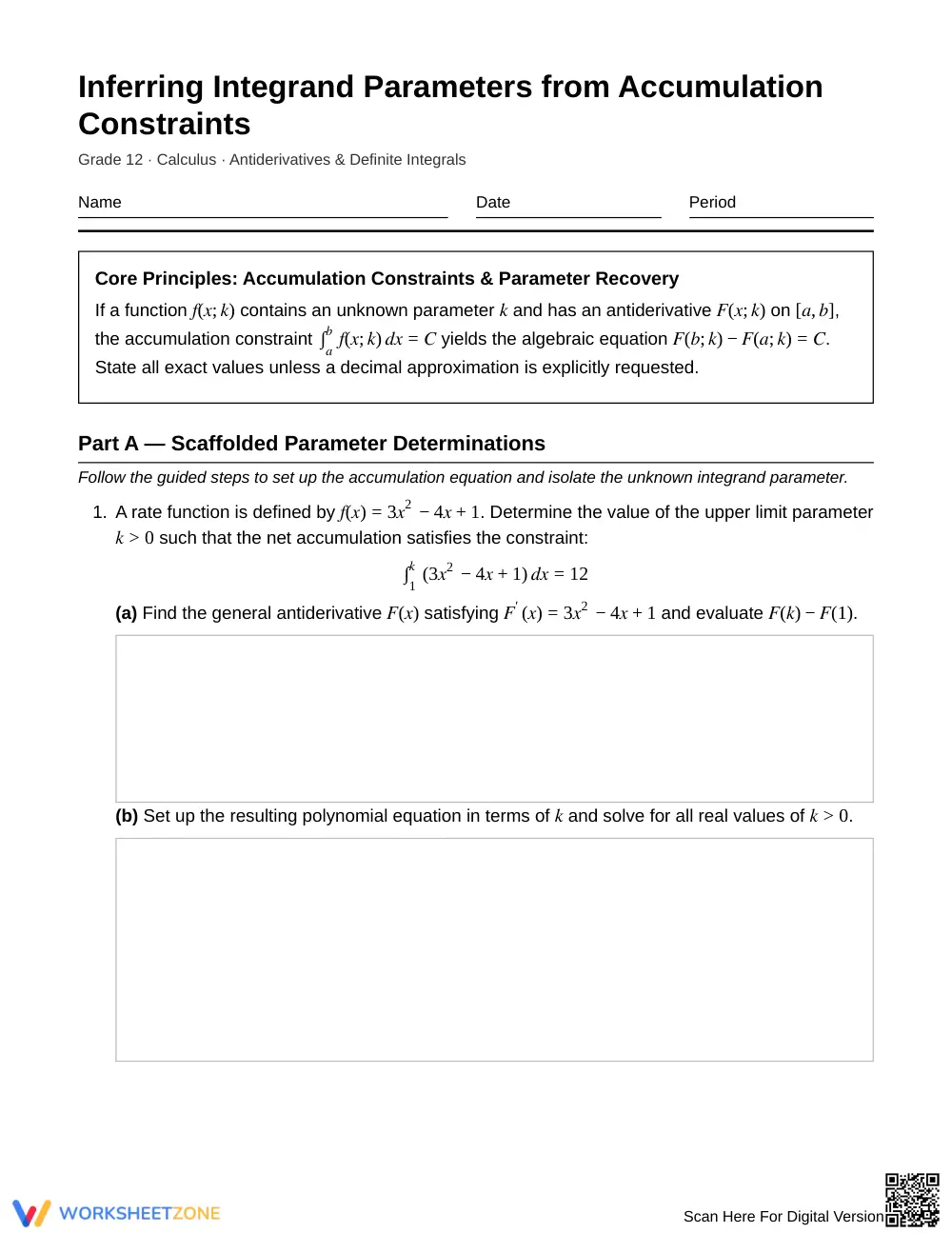
This advanced calculus worksheet develops student mastery in solving for unknown integrand constants and integration limits using definite accumulation constraints. Students apply the Fundamental Theorem of Calculus to convert integral equations into solvable algebraic and transcendental relations, calculating exact parameter values across polynomial, exponential, trigonometric, and piecewise models.
At a Glance
- Grade: 12 · Subject: Calculus
- Standard: Definite Integrals — Solve accumulation equations to isolate unknown integrand and boundary parameters
- Skill Focus: Inferring Integrand Parameters from Accumulation Constraints
- Format: 5 pages · 6 problems · Answer key included · PDF
- Best For: Advanced definite integral analytical practice
- Time: 45–60 minutes
What's Inside
This 5-page student resource features 6 multi-part analytical problems supported by an introductory Core Principles reference frame. The layout transitions students from structured two-part setups to complex piecewise models and contextual rate analysis. A complete 3-page answer key provides step-by-step antiderivative evaluations, exact algebraic derivations, and full optimization justifications.
Skill Progression
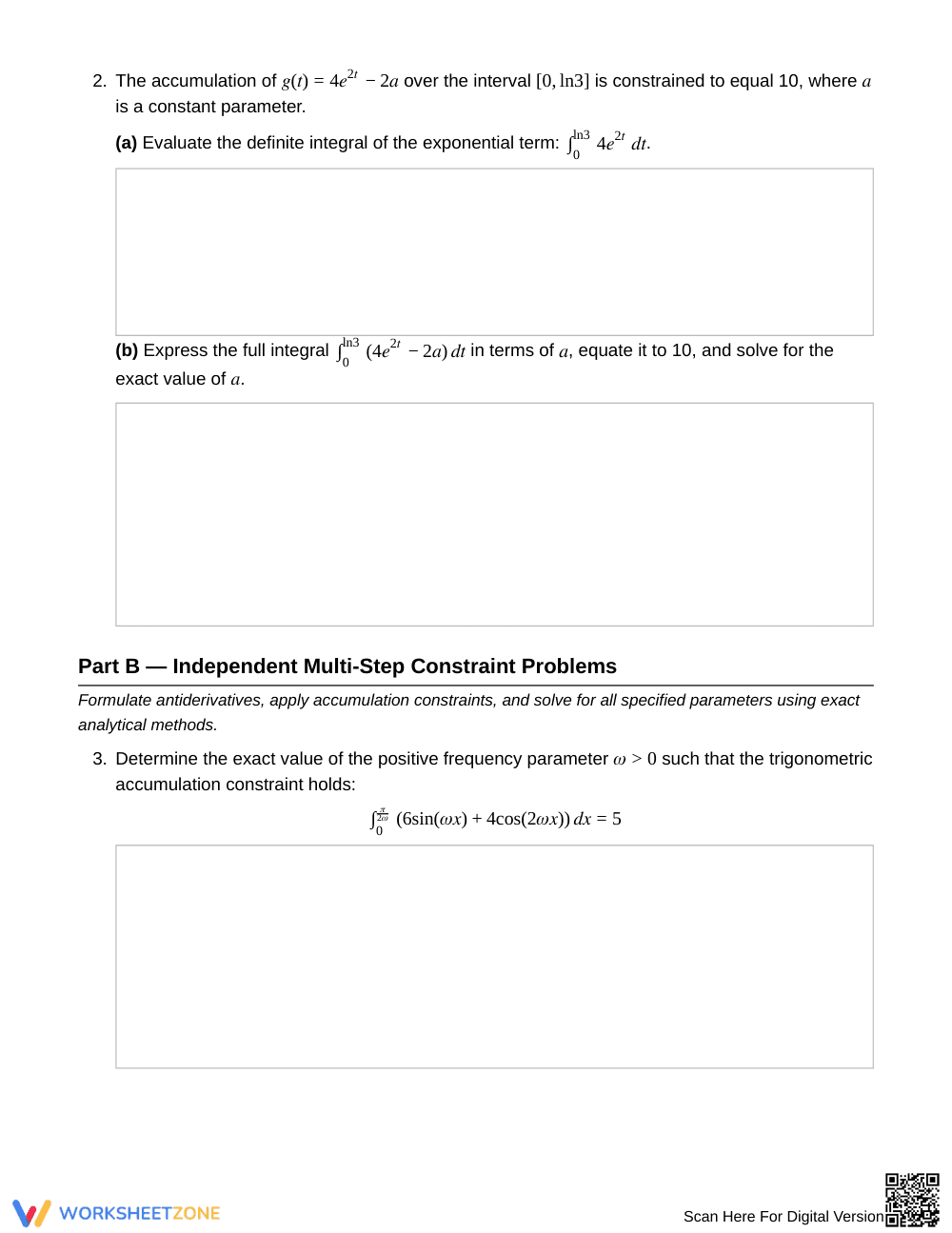
- Guided Practice (Part A, Problems 1–2): Structured prompts scaffold antiderivative formulation and equation isolation for polynomial boundary limits and exponential coefficient parameters.
- Supported Practice (Part B, Problems 3–5): Multi-step independent tasks require students to integrate trigonometric rates, apply the Mean Value Theorem for Integrals to rational functions, and evaluate piecewise continuity systems.
- Independent Practice (Part C, Problem 6): Students construct an accumulation model from an applied quadratic runoff rate, determine admissible parameter domains from inequality constraints, and perform derivative analysis to prove an absolute minimum.
This sequence reinforces the gradual release model, establishing algebraic confidence before demanding contextual modeling and analytical justification.
Standards Alignment
This resource targets integral calculus standards governing definite integrals, accumulation functions, and the Fundamental Theorem of Calculus. Students demonstrate fluency with average value theorems and piecewise continuity criteria under fixed accumulation boundaries. Both curricular standards can be copied directly into lesson plans, IEP goals, or district curriculum mapping tools.
How to Use It
Assign this worksheet after direct instruction on definite integration techniques and accumulation applications. Use Part A during paired guided practice to check whether students correctly evaluate antiderivatives before setting up algebraic equalities. Expect completion within 45 to 60 minutes. As a formative assessment checkpoint, examine Part B Problem 5 to verify that students enforce continuity at boundary boundaries before computing piecewise integrals.
Who It's For
This worksheet is tailored for Grade 12 AP Calculus AB, BC, or dual-enrollment college calculus students preparing for analytical free-response tasks. For differentiated support, pair this activity with an antiderivative reference sheet or a graphing calculator to visualize parameter transformations.
According to research by Fisher & Frey (2014), structuring advanced mathematical tasks through guided release significantly improves conceptual transfer and procedural execution during complex multi-step problem solving. This worksheet applies those principles to parameter inference under definite integral constraints, requiring students to translate integral accumulation into exact algebraic expressions across six rigorous exercises. By moving systematically from isolated polynomial evaluations to applied piecewise functions and environmental optimization models, the resource ensures high school seniors synthesize antidifferentiation with algebraic modeling. The full 3-page worked solution key enables immediate feedback and systematic error analysis.


