































Proven Hunting the Elements Worksheet | Grades 9-12 Science

Paste this activity's link or code into your existing LMS (Google Classroom, Canvas, Teams, Schoology, Moodle, etc.).
Students can open and work on the activity right away, with no student login required.
You'll still be able to track student progress and results from your teacher account.
This comprehensive physical science worksheet provides secondary students with rigorous practice connecting macroscopic chemical observations to subatomic structure. Across four analytical sections, high school learners interpret ionization data, calculate reaction stoichiometry, analyze calorimetry data using specific heat equations, and explain periodic trends using nuclear charge and electron shielding.
At a Glance
- Grade: Grades 9–12 · Subject: High School Physical Science & Chemistry
- Standard: Relate atomic structure, valence electron configuration, and periodic trends to chemical reactivity and energy changes
- Skill Focus: Periodic trends, stoichiometry, and thermochemistry
- Format: 4 pages · 20 problems · Answer key included · PDF
- Best For: Unit review and cumulative assessment
- Time: 45–60 minutes
What's Inside
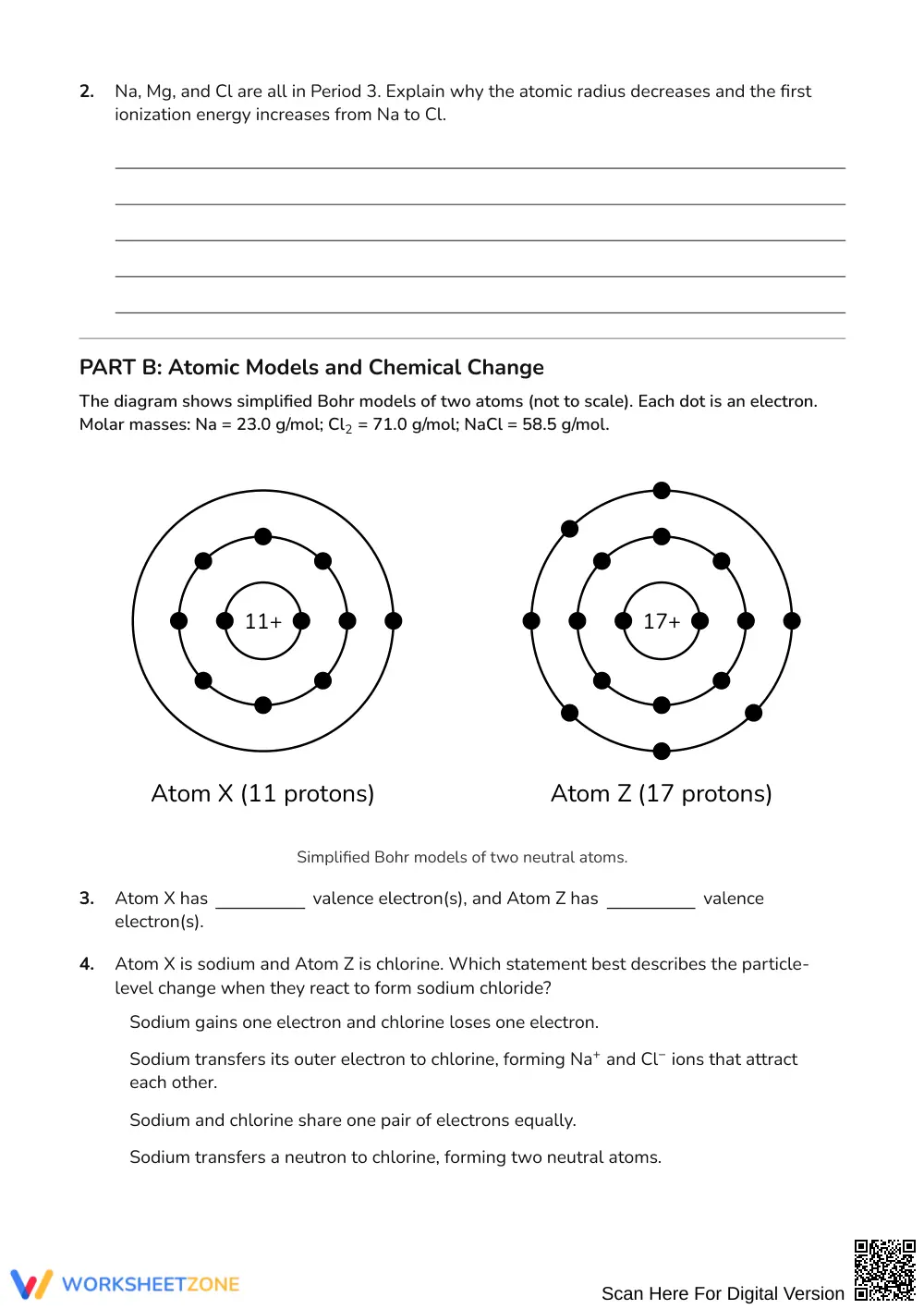
This four-page assessment integrates authentic laboratory data, Bohr atomic models, and mathematical problem sets. Students complete structured data tables, analyze multi-step molar calculations with sodium chloride synthesis, and determine thermal energy changes using the calorimetry formula q = mcΔT. A detailed 4-page answer key provides step-by-step mathematical solutions and particle-level explanations.
Skill Progression
- Guided practice (Tasks 1–6): Students reference provided periodic excerpts and data tables to identify trends in atomic radii and first ionization energies across periods and down chemical groups.
- Supported practice (Tasks 7–14): Learners inspect particle diagrams, balance chemical equations, and apply stoichiometric mole ratios to predict product mass and calculate molar relationships.
- Independent practice (Tasks 15–20): Students independently compute enthalpy changes from calorimeter trial data and deduce unknown elements using successive ionization energy evidence.
This structured progression reflects the gradual release of responsibility model, guiding students systematically from guided visual analysis to independent quantitative reasoning.
Standards Alignment
This resource aligns directly with high school physical science standards addressing the structure and properties of matter, chemical reactions, and conservation of energy. Students demonstrate how the periodic table predicts relative properties of elements based on valence electron patterns and calculate energy flow during dissolution. Both standard codes can be copied directly into lesson plans, IEP goals, or district curriculum mapping tools.
How to Use It
Deploy this worksheet after direct instruction on atomic theory and thermochemistry, or as a capstone review following video viewings of element documentaries. For formative assessment, examine student responses on Part C to verify whether learners correctly classify positive and negative temperature shifts as endothermic or exothermic processes. Expected completion time is 45 to 60 minutes.
Who It's For
This resource is tailored for on-grade chemistry and physical science students in grades 9 through 12. Support developing learners with a reference sheet of chemical formulas and molar masses, while challenging advanced students to graph successive ionization energies. Pair this packet directly with hands-on dissolution calorimetry lab activities.
According to Fisher & Frey (2014), structured scaffolds that transition from representational data interpretation to independent problem-solving significantly deepen student mastery of abstract scientific models. High school chemistry curricula demand that students continuously bridge observable phenomena with particulate interactions. This 20-task worksheet reinforces that cognitive connection by requiring students to justify empirical periodic trends and calorimetric data through Coulombic attraction, nuclear charge, and energy conservation principles. Rather than relying on rote memorization of chemical definitions, learners engage in quantitative analysis and evidence-based scientific argumentation across 4 complete pages of targeted practice. By evaluating successive ionization energies to deduce valence configurations, students establish durable mental models of electron shell organization that support success in advanced secondary science coursework.


