































Proven Hunting the Elements Worksheet | Grade 9-12 Science

Paste this activity's link or code into your existing LMS (Google Classroom, Canvas, Teams, Schoology, Moodle, etc.).
Students can open and work on the activity right away, with no student login required.
You'll still be able to track student progress and results from your teacher account.
This high school science worksheet connects foundational chemistry concepts to realistic technological systems across 21 rigorous problems. Students evaluate periodic trends, model lithium battery bonding, calculate calorimetry values for first-aid packs, and balance spacecraft air scrubber reactions, driving measurable conceptual mastery.
At a Glance
- Grade: Grades 9–12 · Subject: Science
- Standard: Physical Science — Apply chemistry principles and periodic properties to solve technological and environmental problems
- Skill Focus: Real-world chemistry and chemical reactions
- Format: 4 pages · 21 problems · Answer key included · PDF
- Best For: Post-video review or unit synthesis
- Time: 45–60 minutes
What's Inside
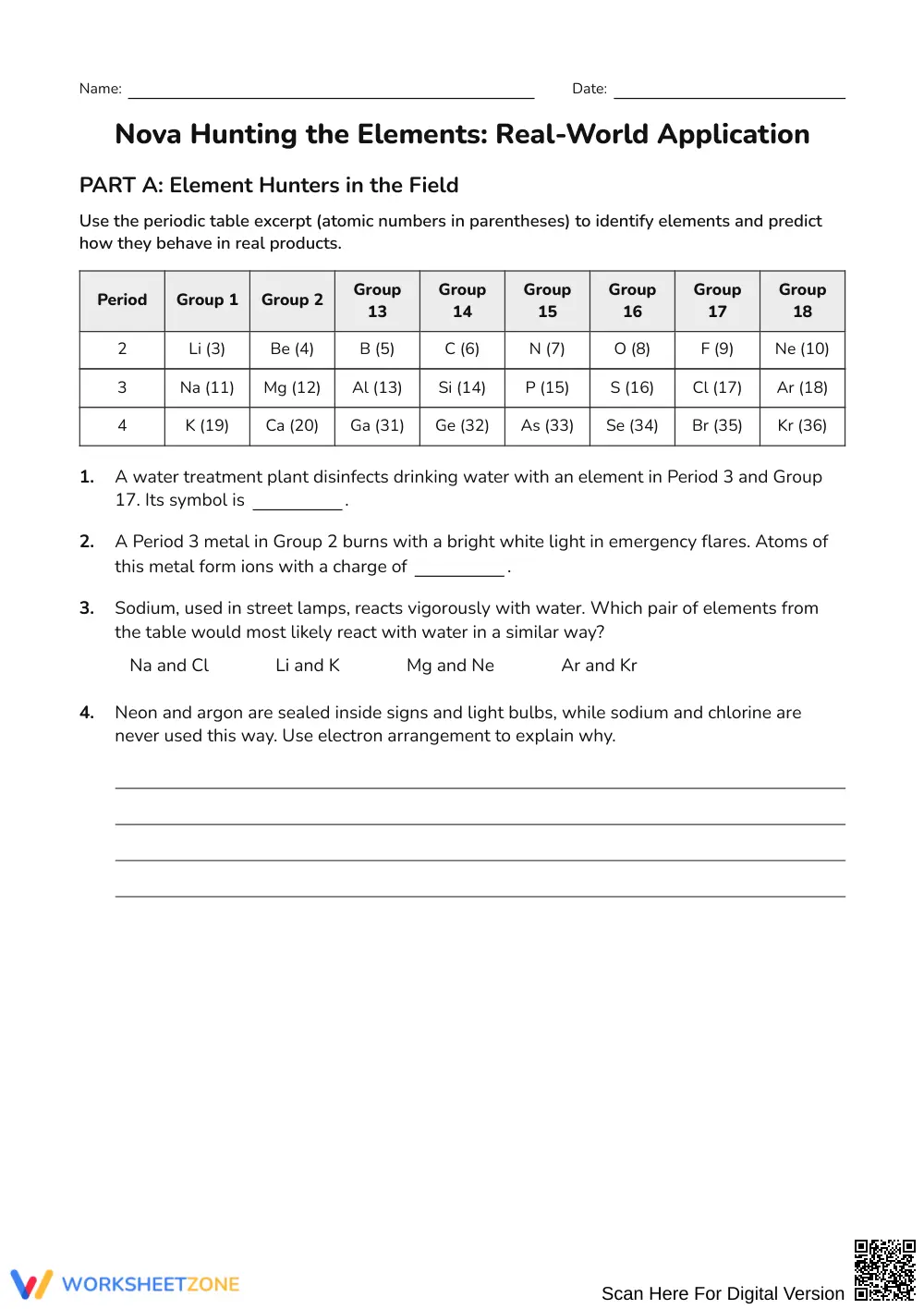
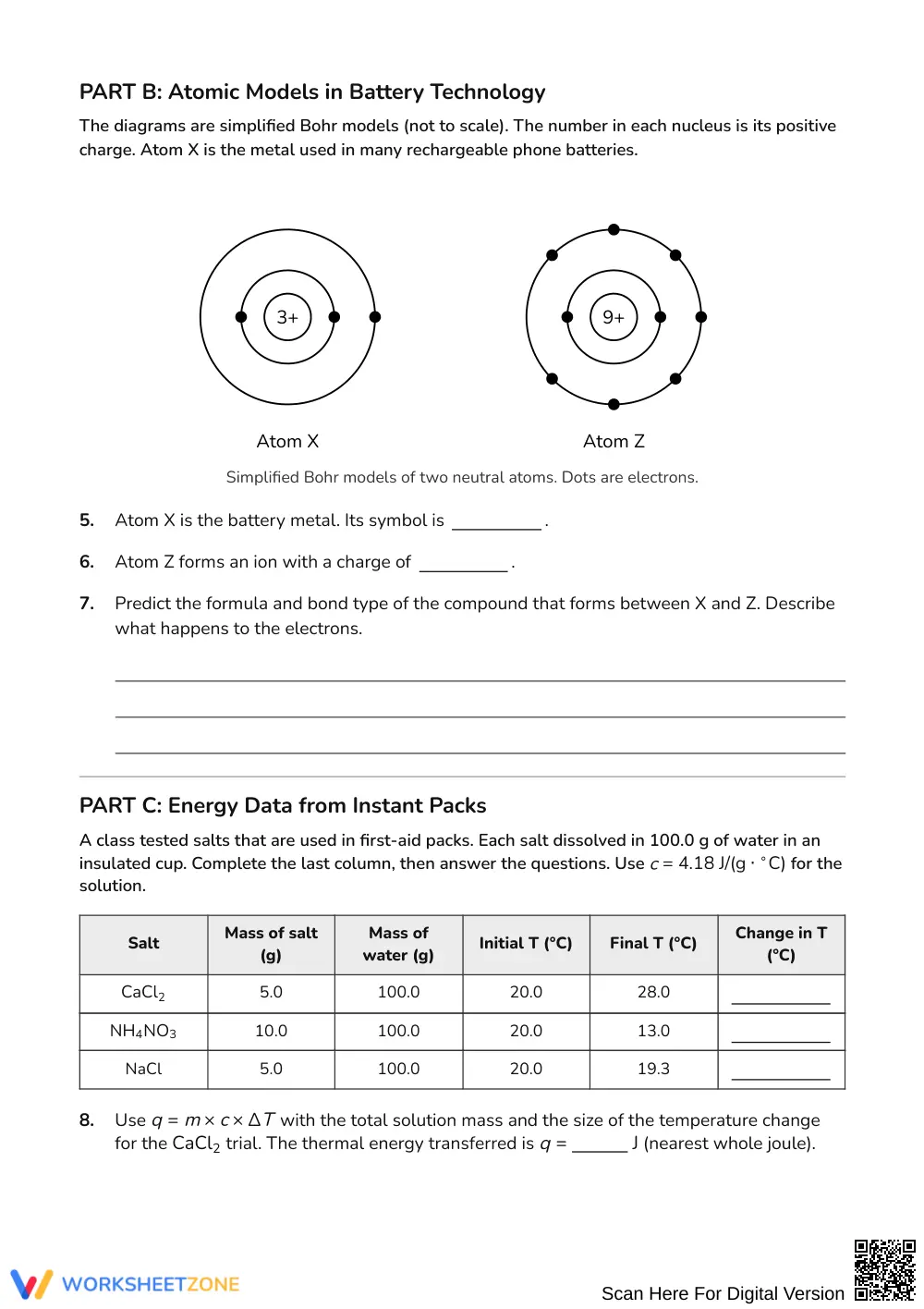
This 4-page student activity features 21 structured questions across five focused sections. Learners interpret an excerpted periodic table, analyze simplified Bohr models, and evaluate experimental calorimetry tables using standard thermal formulas. The resource includes stoichiometry calculations, short-answer items, and a structured Claim-Evidence-Reasoning task, alongside an explicit 4-page answer key.
Skill Progression
- Guided practice: Parts A and B provide an embedded periodic table and Bohr models to guide element identification and ionic compound prediction.
- Supported practice: Parts C and D guide quantitative analysis, prompting students to calculate calorimetry values and balance spacecraft air-scrubber equations.
- Independent practice: Part E requires students to evaluate de-icing salts autonomously, writing a complete Claim, Evidence, and Reasoning argument without prompts.
This sequence implements the gradual-release model, moving students from guided visual analysis to independent quantitative scientific argumentation.
Standards Alignment
This resource aligns with high school physical science standards requiring students to construct models, analyze periodic trends, and calculate conservation of matter. It focuses on how valence electron structures determine chemical reactivity and using calorimetry data to demonstrate energy conservation. Both standard codes can be copied directly into lesson plans, IEP goals, or district curriculum mapping tools.
How to Use It
Use this activity immediately following the NOVA documentary or after direct instruction on chemical bonding. It serves well for collaborative partner work before students complete Part E individually. During class, monitor student work on Part C to verify they correctly identify exothermic and endothermic processes. Expected completion time is 45 to 60 minutes.
Who It's For
This worksheet is designed for high school chemistry and physical science students studying atomic theory and chemical reactions. Embedded data tables and Bohr diagrams scaffold instruction for emerging learners, while open-ended engineering trade-offs challenge advanced students. Pair this lesson directly with the NOVA: Hunting the Elements program or an anchor chart on periodic trends.
High school physical science curricula require structured opportunities for learners to apply periodic trends, chemical bonding principles, and thermochemical conservation to authentic technological and environmental scenarios. According to Fisher & Frey (2014), intentional scaffolding that transitions students through guided visual modeling, quantitative data analysis, and independent scientific argumentation produces significantly higher transfer of complex STEM competencies than isolated skill drills. This comprehensive 21-task curriculum resource supports rigorous science classroom instruction by grounding abstract chemical properties—such as valence electron configurations, calorimetry calculations, and conservation of mass—in tangible engineering contexts like rechargeable lithium batteries, instant first-aid packs, and spacecraft air revitalization systems. By guiding students step by step through explicit Claim, Evidence, and Reasoning structures, this learning tool reinforces evidence-based scientific discourse, strengthens stoichiometric problem-solving accuracy, and ensures secondary students achieve durable conceptual mastery across essential physical science domains.


