




























Views
Downloads


Proven Food Chain & Web Models Worksheet | Grade 6 Science

Paste this activity's link or code into your existing LMS (Google Classroom, Canvas, Teams, Schoology, Moodle, etc.).
Students can open and work on the activity right away, with no student login required.
You'll still be able to track student progress and results from your teacher account.
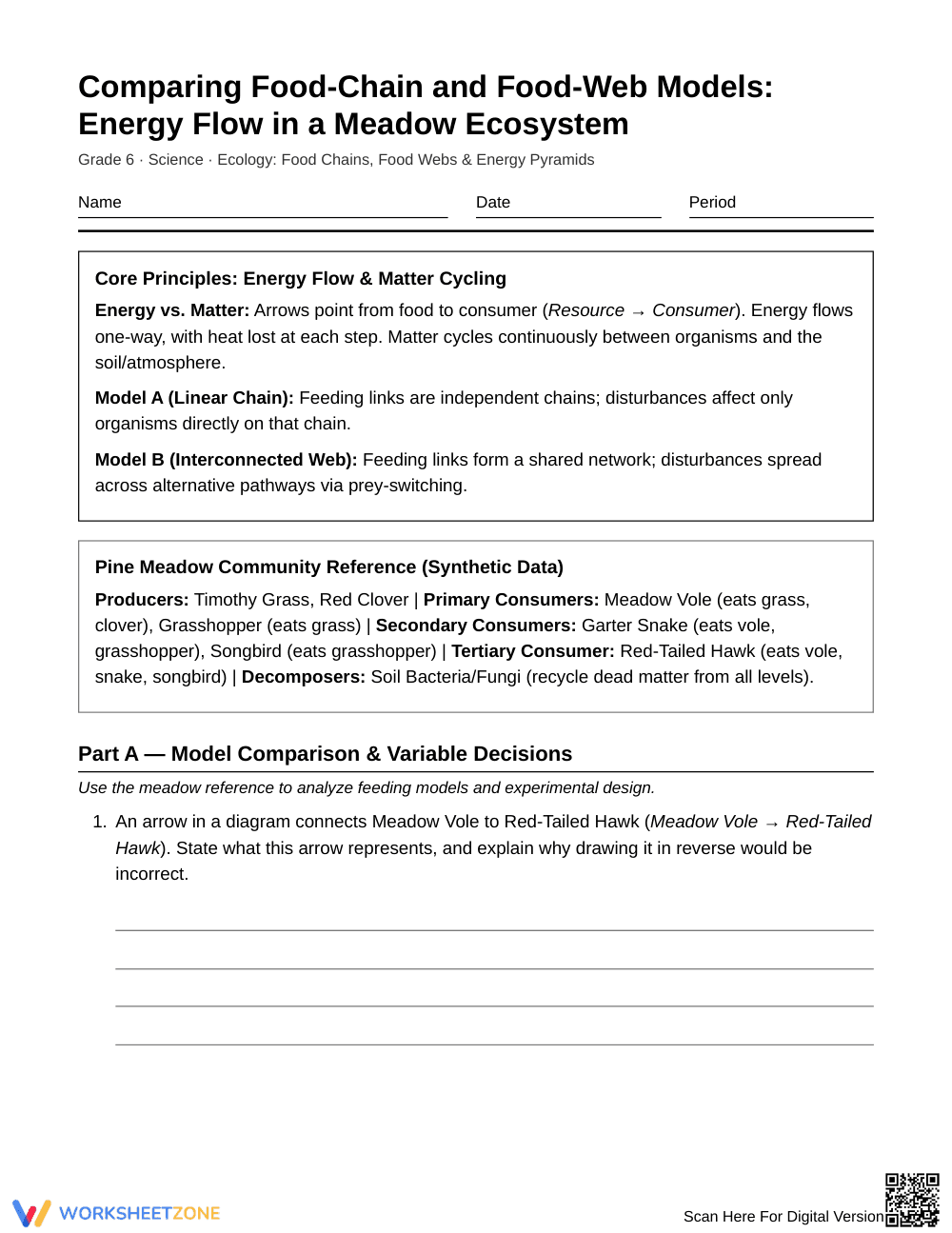
This Grade 6 science worksheet guides students through comparing linear food chains with interconnected food webs in a meadow community. Students evaluate how disturbance events cascade through trophic levels, analyze synthetic population data, and explain the distinct physical mechanisms governing one-way energy flow versus closed matter cycling.
At a Glance
- Grade: 6 · Subject: Science
- Standard: Ecosystem Dynamics — Develop a model to describe matter cycling and energy flow
- Skill Focus: Compare Food-Chain and Food-Web Models
- Format: 4 pages · 10 problems · Answer key included · PDF
- Best For: Ecosystem unit modeling and data analysis
- Time: 40–50 minutes
What's Inside
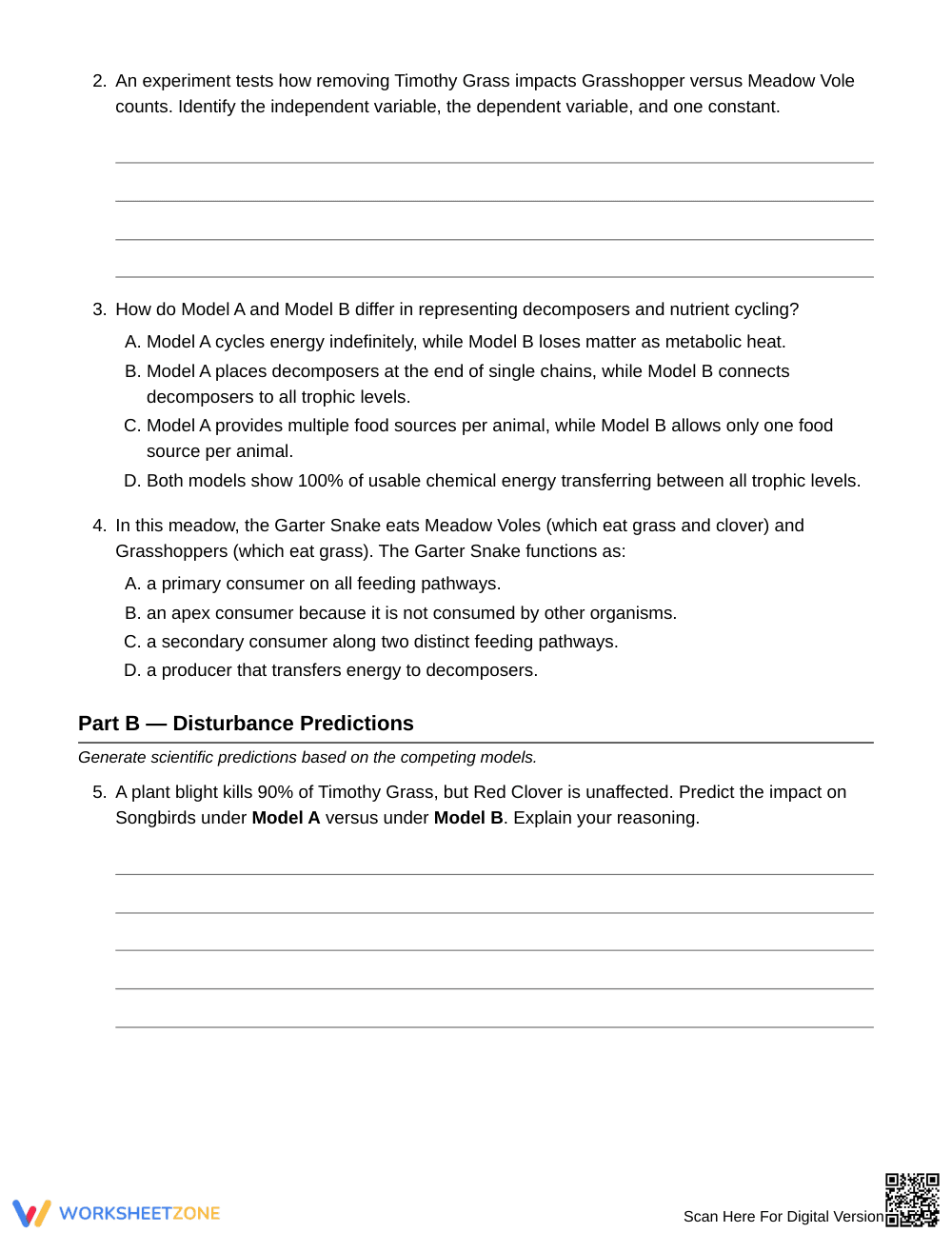
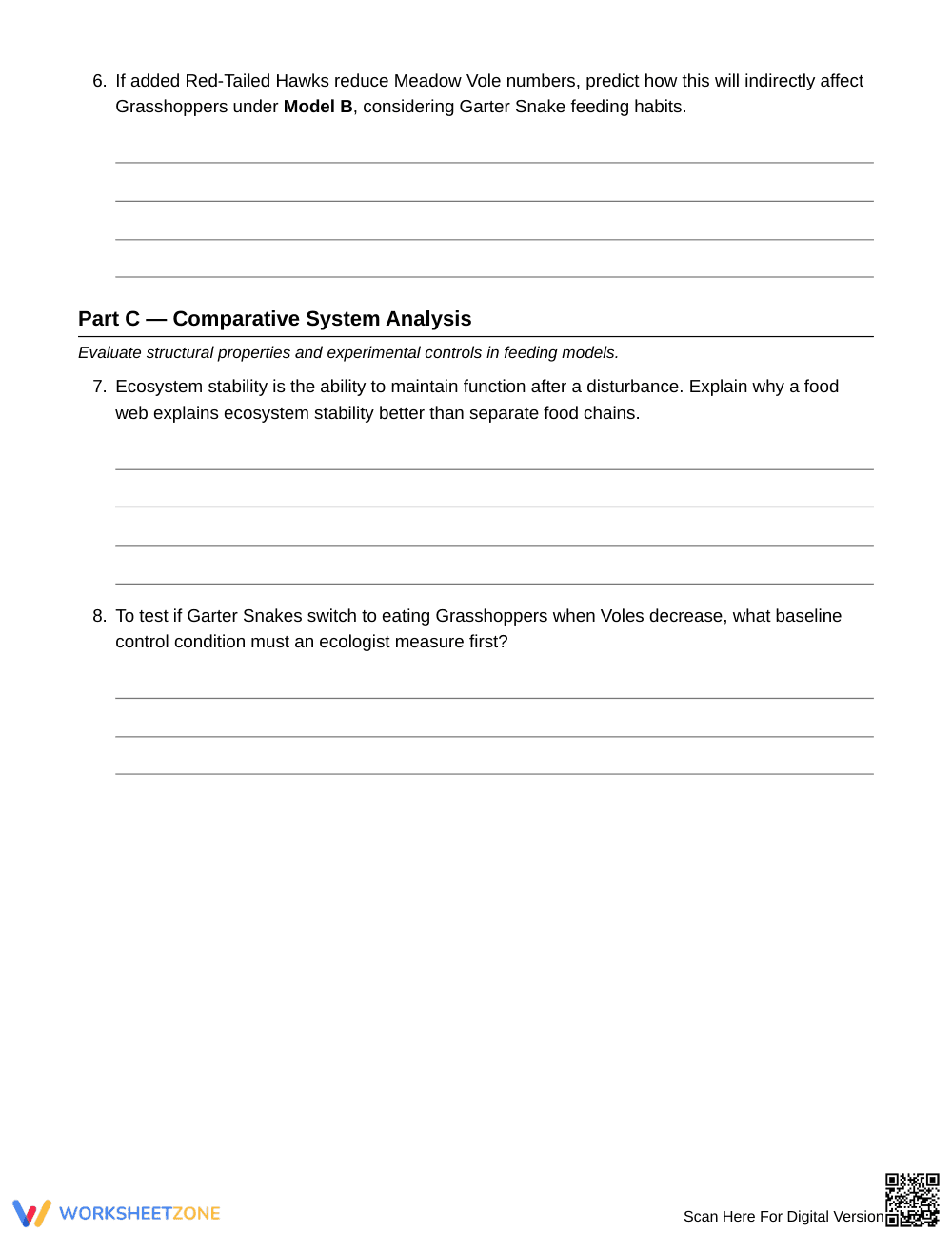
This 4-page worksheet features 10 rigorous ecological tasks organized around an authentic Pine Meadow reference community. It includes a core principle summary defining trophic transfer rules, multiple-choice items targeting experimental variables, short-response prompts modeling blight disturbances, and a 3-year population data table. A complete 2-page answer key provides expected scientific reasoning and numerical justifications.
Skill Progression
- Guided Practice (Part A, 4 problems): Students analyze foundational arrow conventions, identify experimental variables, and contrast decomposer roles using explicit reference definitions.
- Supported Practice (Parts B & C, 4 problems): Students apply competing models to predict population shifts following plant blight and evaluate how dietary flexibility confers system stability.
- Independent Practice (Part D, 2 problems): Students independently analyze a 3-year quantitative diet and density table to defend model validity using numerical evidence.
This structured progression follows an intentional gradual-release framework, moving students from scaffolded conceptual comparisons to unassisted empirical data interpretation.
Standards Alignment
This resource aligns with middle school life science standards requiring students to develop models describing the cycling of matter and the flow of energy among living and nonliving components of an ecosystem. Both standard codes can be copied directly into lesson plans, IEP goals, or district curriculum mapping tools.
How to Use It
Deploy this activity after direct instruction on trophic levels and trophic cascades. In a mid-unit modeling lab, pairs work through Parts A through C to predict how population shifts propagate across food webs. Formatively assess student explanations in Part A to verify that arrows indicate energy transfer rather than predator targeting. The 10 problems require approximately 40 to 50 minutes of instructional time.
Who It's For
This resource serves general education Grade 6 life science students, advanced Grade 5 learners, and middle school intervention groups needing concrete modeling practice. Built-in reference definitions support English learners and developing readers. Pair this activity with an interactive owl pellet dissection or a local biome food-web construction lesson.
According to research on scaffolded science instruction documented by Fisher & Frey (2014), student conceptual mastery of complex ecological systems increases significantly when graphic models are paired with guided cognitive transitions. Middle school students frequently conflate the unidirectional flow of metabolic energy with the continuous biogeochemical cycling of physical matter. This 10-problem worksheet explicitly resolves that misconception by requiring learners to contrast linear food chains against interconnected web models using concrete empirical evidence. By transitioning from foundational diagram interpretation to quantitative multi-year field data evaluation, students construct durable mental models of ecosystem resilience, trophic redundancy, and biomass interactions. Grounding model analysis in synthetic ecological data ensures that students substantiate theoretical predictions with verified numerical shifts in population density and predator diet composition. Consequently, learners build essential analytical rigor required for evaluating competing scientific arguments in secondary life science classrooms.


