




























Views
Downloads



Proven Exponential Models Worksheet | Grade 11 Algebra II

Paste this activity's link or code into your existing LMS (Google Classroom, Canvas, Teams, Schoology, Moodle, etc.).
Students can open and work on the activity right away, with no student login required.
You'll still be able to track student progress and results from your teacher account.
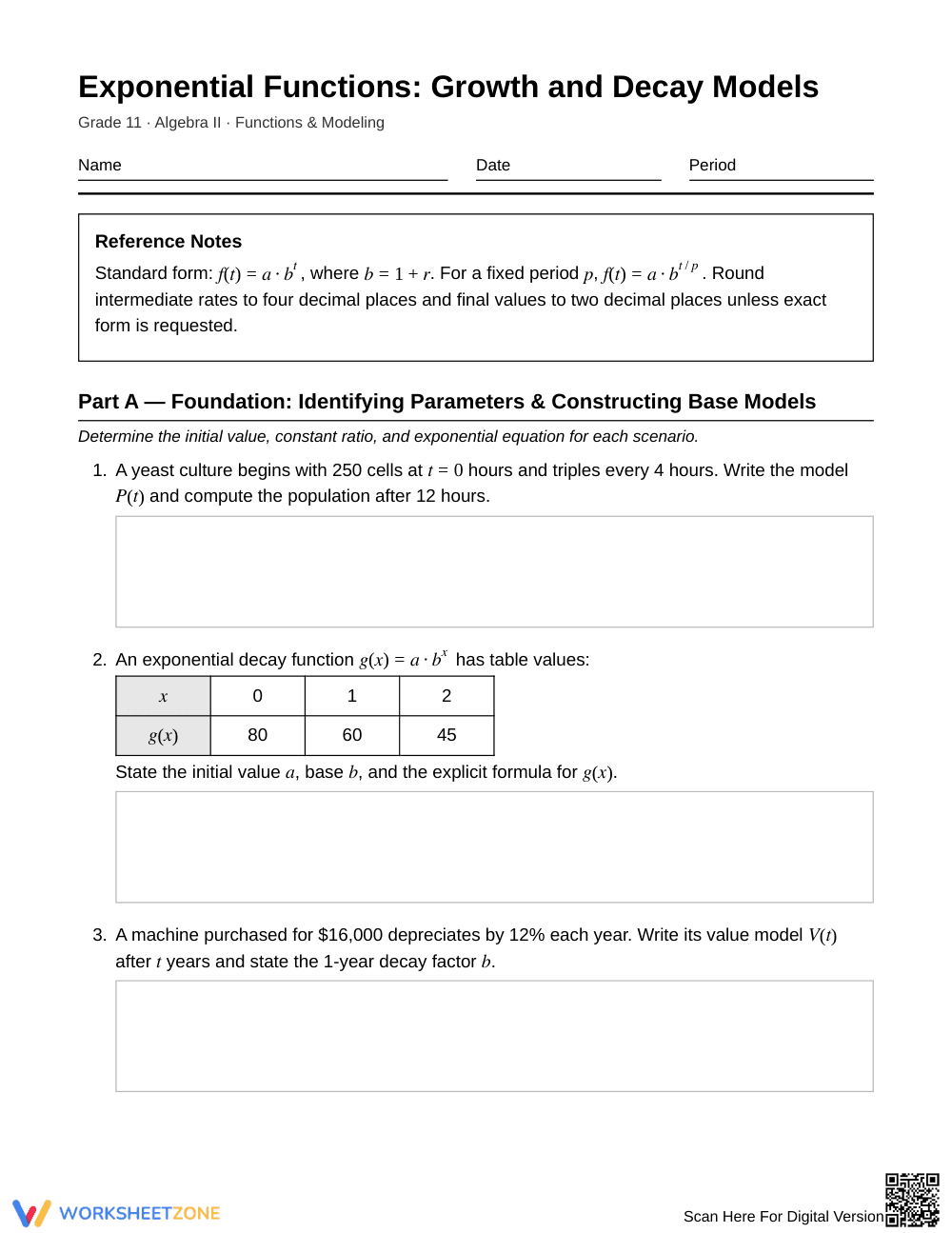
This Grade 11 Algebra II worksheet guides students through constructing and analyzing exponential growth and decay models. Learners transition from identifying base rates and initial values to formulating periodic functions from tables, verbal scenarios, and data points. The 16 problems build computational precision and modeling confidence across diverse contexts.
At a Glance
- Grade: Grade 11 · Subject: Algebra II
- Standard:
HSF-LE.A.2— Construct linear and exponential functions given a graph, a description, or two points- Skill Focus: Exponential-Function Check
- Format: 5 pages · 16 problems · Full answer key included · Printable PDF
- Best For: High school classroom mastery and review
- Time: 45–60 minutes
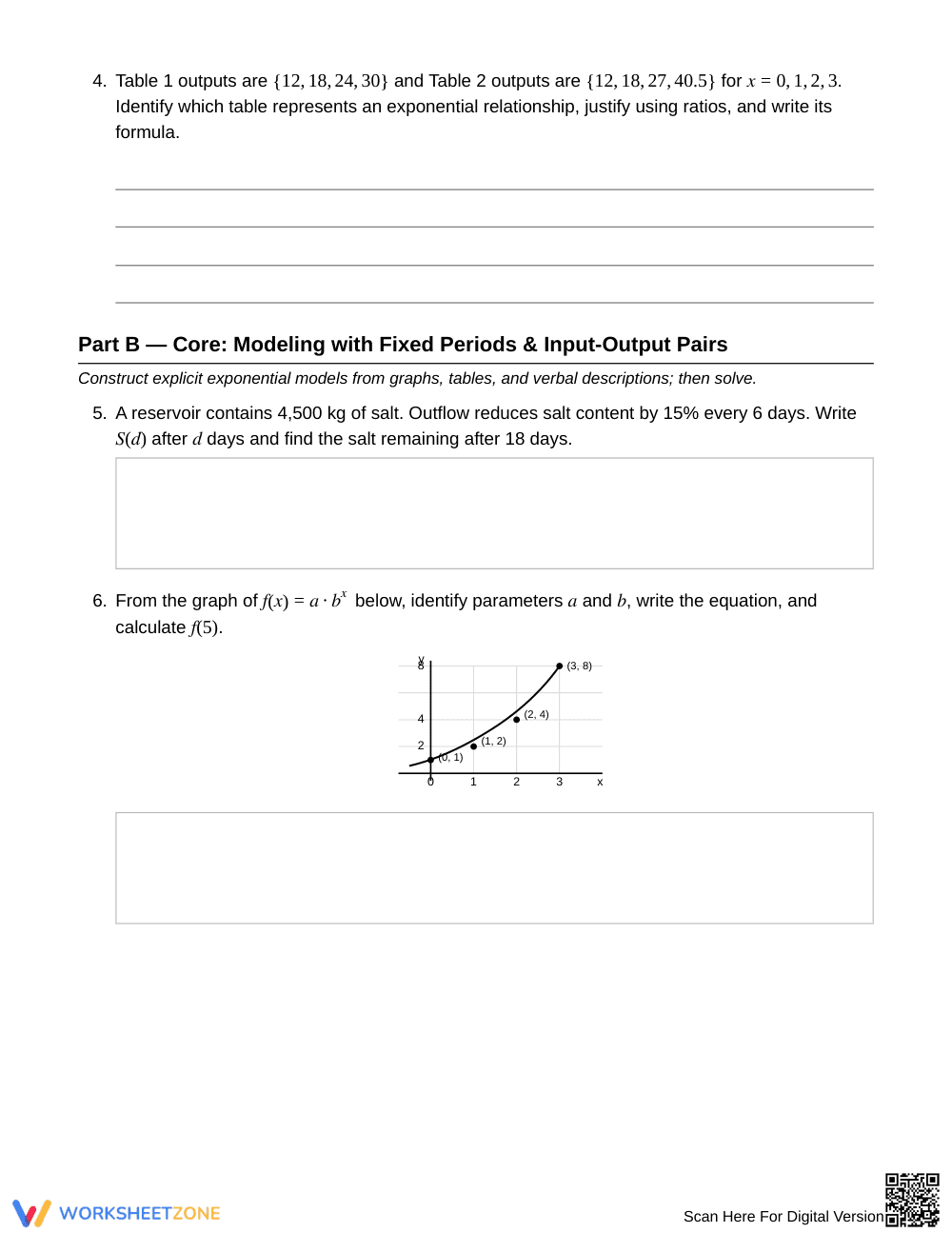
The 5-page PDF features 16 multi-step problems organized across three progressive parts, complete with reference notes and a 3-page answer key. Students examine real-world scenarios including biological growth, isotope decay, and depreciation. The worksheet integrates data tables, coordinate pairs, and graphical figures to anchor algebraic derivations.
Skill Progression
- Guided practice (Part A, Problems 1–4): Foundational tasks require finding initial values, common ratios, and formulas from tables and scenarios.
- Supported practice (Part B, Problems 5–12): Core tasks prompt students to build periodic models, interpret graphs, and derive equations from two points.
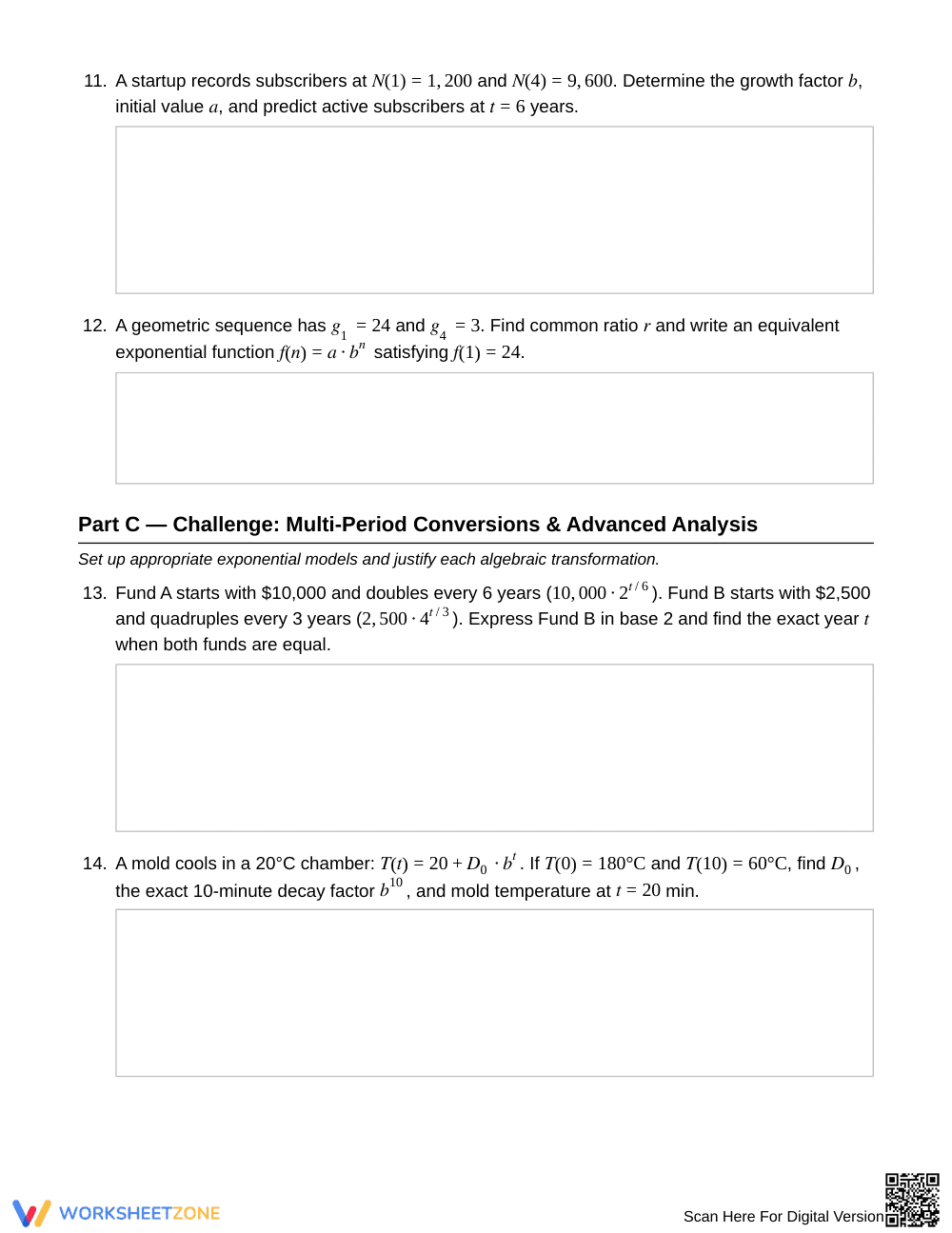
- Independent practice (Part C, Problems 13–16): Challenge problems demand equating different exponential bases, modeling cooling curves, and converting periodic percentage rates.
This sequence follows a gradual-release framework, moving learners from basic parameter identification to independent algebraic modeling.
Standards Alignment
This worksheet aligns directly with HSF-LE.A.2 by having students construct exponential functions from verbal descriptions, tables, graphs, and two points. It also supports HSF-BF.A.1 through contextual mathematical modeling. Both standard codes can be copied directly into lesson plans, IEP goals, or district curriculum mapping tools.
How to Use It
Use this resource after introducing exponential formulas and periodic rate adjustments. It serves well as a collaborative practice set during mid-unit instruction or as an individual check before summative testing. Observe how students write fractional exponents in Part B to catch period confusion early. Expected completion time is 45 to 60 minutes.
Who It's For
This worksheet is designed for Grade 11 Algebra II and Integrated Math III students mastering functional relationships. Part A offers entry points for developing learners, while Part C extends high-achieving students. Pair this practice set with an anchor chart comparing linear and exponential patterns.
According to instructional frameworks established by Fisher & Frey (2014), structured practice that systematically shifts cognitive responsibility accelerates student mastery in complex secondary mathematics. This Grade 11 Algebra II worksheet operationalizes that framework by addressing standard HSF-LE.A.2, guiding high school students to construct exponential functions from verbal descriptions, tables, graphs, and paired coordinates. By structuring 16 problems across foundational identification, intermediate periodic modeling, and advanced multi-period base conversions, the resource reinforces the critical mathematical distinction between additive change and multiplicative growth factors. Students develop fluency in manipulating fractional exponents and evaluating rate constants in real-world scenarios such as half-life decay and financial growth. Supported by a complete 3-page answer key, this resource provides measurable evidence of student progress, ensuring high school learners acquire the algebraic modeling competencies required for advanced precalculus and collegiate STEM coursework.


