





























Proven Confounder Control Worksheet | Grade 12 Science
Paste this activity's link or code into your existing LMS (Google Classroom, Canvas, Teams, Schoology, Moodle, etc.).
Students can open and work on the activity right away, with no student login required.
You'll still be able to track student progress and results from your teacher account.
This advanced science worksheet trains students to isolate causal mechanisms in complex ecological systems by controlling for abiotic confounders. Working through empirical disturbance scenarios, high school learners construct controlled comparisons, evaluate competing theoretical hypotheses, and analyze quantitative post-fire recovery data across forest quadrats.
At a Glance
- Grade: 12 · Subject: Environmental Science
- Standard: Scientific Inquiry — Design controlled observational comparisons and evaluate competing ecological models
- Skill Focus: Controlling Confounding Variables in Ecological Comparisons
- Format: 6 pages · 10 problems · Answer key included · PDF
- Best For: AP or advanced ecology experimental design
- Time: 45–60 minutes
What's Inside
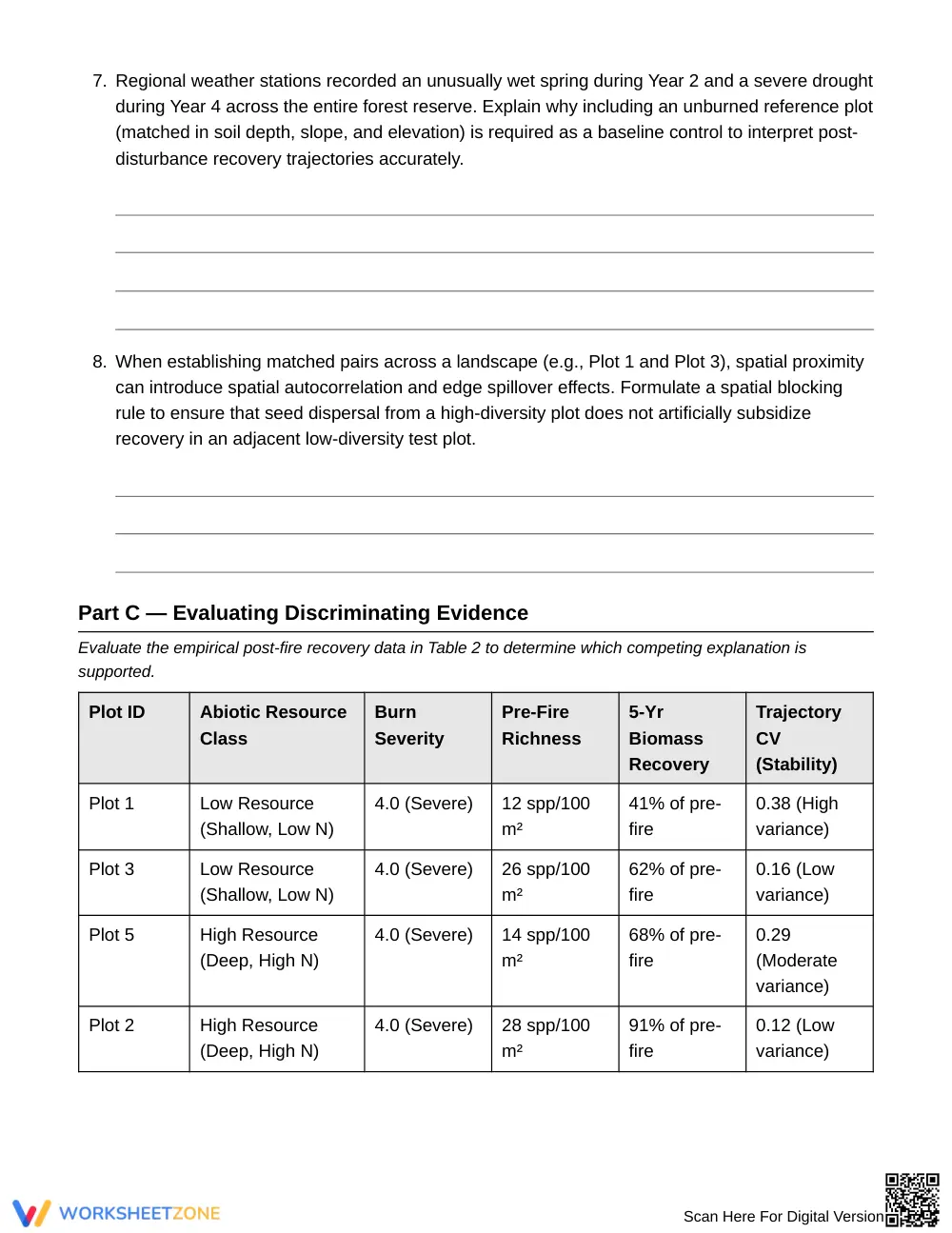
This 6-page investigative worksheet provides a complete scientific analysis scenario featuring background theoretical models, baseline environmental quadrat data, and post-fire recovery metrics. Across 10 in-depth analytical tasks, students formulate model predictions, identify confounding variables, establish matched-pair quadrat controls, and interpret multi-year recovery trajectories using structured data tables and a thorough 4-page answer key.
Skill Progression
- Guided practice (Tasks 1–2): Operationalizing distinct theoretical predictions for the Diversity-Insurance Hypothesis versus the Abiotic Resource Filtering Model using matched and unstratified landscape baselines.
- Supported practice (Tasks 3–8): Analyzing multivariate environmental data tables to identify biophysical confounders, construct valid pairwise matched comparisons, resolve spatial autocorrelation, and select robust ecological stability metrics.
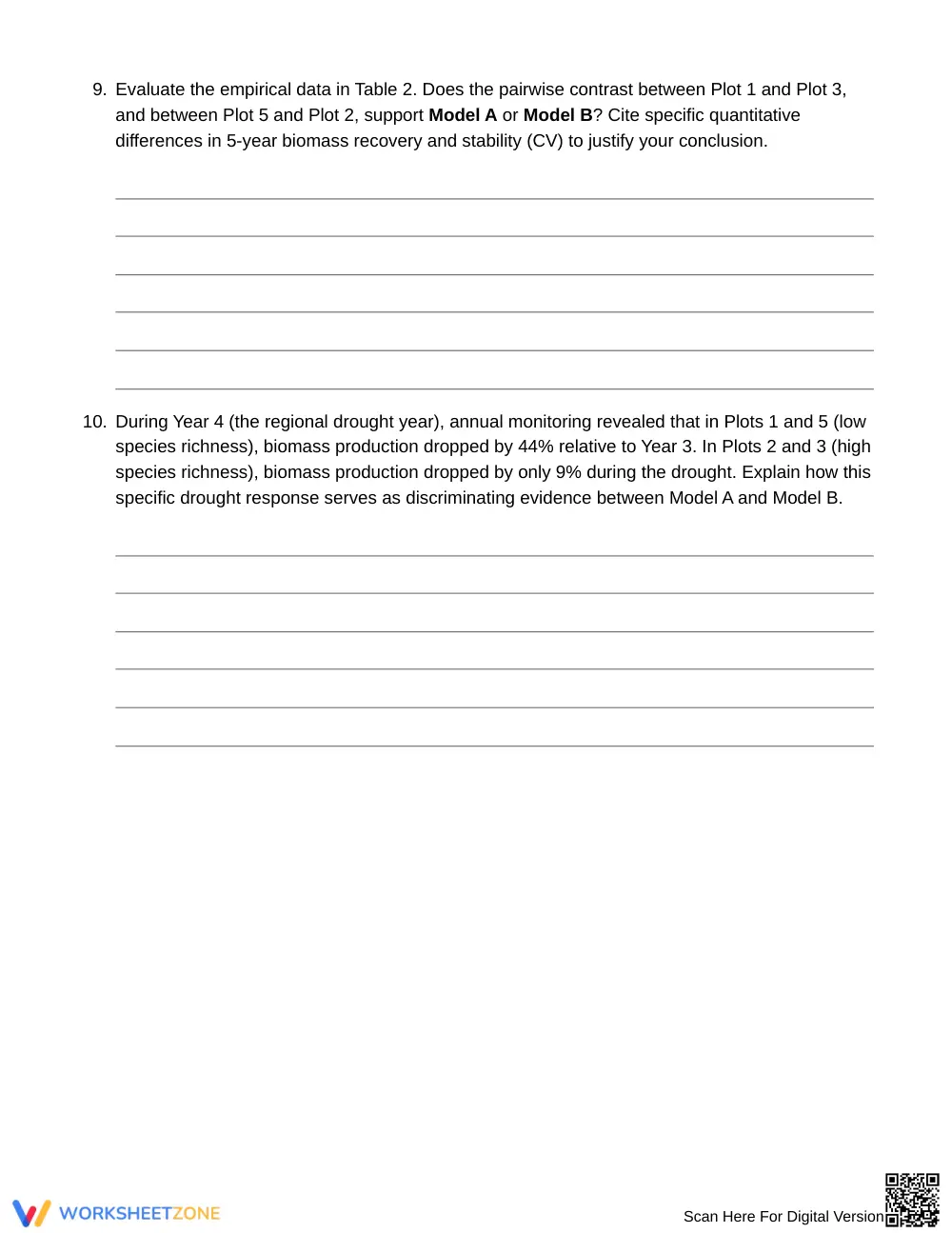
- Independent practice (Tasks 9–10): Synthesizing quantitative post-fire recovery data and drought-response metrics to evaluate which competing ecological model is empirically supported.
The sequence follows a gradual-release framework that shifts students from theoretical model interpretation to rigorous independent experimental critique.
Standards Alignment
This resource directly supports advanced high school science inquiry standards requiring students to evaluate experimental designs, control variables, and interpret complex data to distinguish correlation from causation. Standard identifiers and learning goals can be copied directly into lesson plans, IEP goals, or district curriculum mapping tools.
How to Use It
Implement this worksheet after direct instruction on community stability, biodiversity metrics, and experimental design principles. For formative assessment, examine student responses to Task 4 during class to check whether learners can correctly isolate confounding abiotic gradients from species richness before they proceed to data evaluation. The full 10-task activity takes approximately 45 to 60 minutes of focused analytical work.
Who It's For
This resource is designed for Grade 12 Environmental Science, AP Environmental Science, and advanced biology students tackling complex scientific reasoning. Pair this activity with an interactive lecture on ecosystem resilience or an authentic field survey data-collection lab.
According to research synthesized by Fisher & Frey (2014), engaging secondary students in structured scientific argumentation and systematic variable control builds durable analytical competence in disciplinary literacy. This 6-page instructional module operationalizes advanced experimental design by guiding Grade 12 learners through the evaluation of competing ecological explanations using synthetic field data. By requiring students to identify environmental confounders, design pairwise matched comparisons, and evaluate multi-year disturbance metrics across 10 structured prompts, the activity reinforces critical scientific reasoning practices that prepare students for college-level research analysis.


