




























Views
Downloads




Proven Comparing Compounds Worksheet | Grade 11 Chemistry

Paste this activity's link or code into your existing LMS (Google Classroom, Canvas, Teams, Schoology, Moodle, etc.).
Students can open and work on the activity right away, with no student login required.
You'll still be able to track student progress and results from your teacher account.
This high school chemistry worksheet develops rigorous analytical skills by guiding students to contrast ionic lattices and molecular compounds. Learners evaluate macroscopic properties—such as melting points, electrical conductivity, and lattice cleavage—by connecting them directly to submicroscopic electrostatic attractions and intermolecular forces across 10 multi-part analytical questions.
At a Glance
- Grade: 11 · Subject: Chemistry
- Standard: Relate macroscopic chemical properties to submicroscopic bonding models and intermolecular forces
- Skill Focus: Compare Compounds with Different Structures
- Format: 5 pages · 10 problems · Answer key included · PDF
- Best For: Post-instruction practice and formative bonding assessment
- Time: 45–55 minutes
What's Inside
The 5-page printable resource includes a foundational reference summary defining crystal lattices, covalent bonds, and intermolecular forces. Students complete 10 in-depth problems distributed across three targeted sections, incorporating chemical formulas, comparative data tables, and qualitative evaluation tasks. A comprehensive 3-page teacher answer key provides complete model rationales, particle-level diagrams, and common student misconceptions for efficient grading.
Skill Progression
- Guided Practice (Part A, Problems 1–2): Students apply core structural principles to predict macroscopic conductivity in aqueous solutions and physical states at designated temperatures using paired examples like potassium bromide and sucrose.
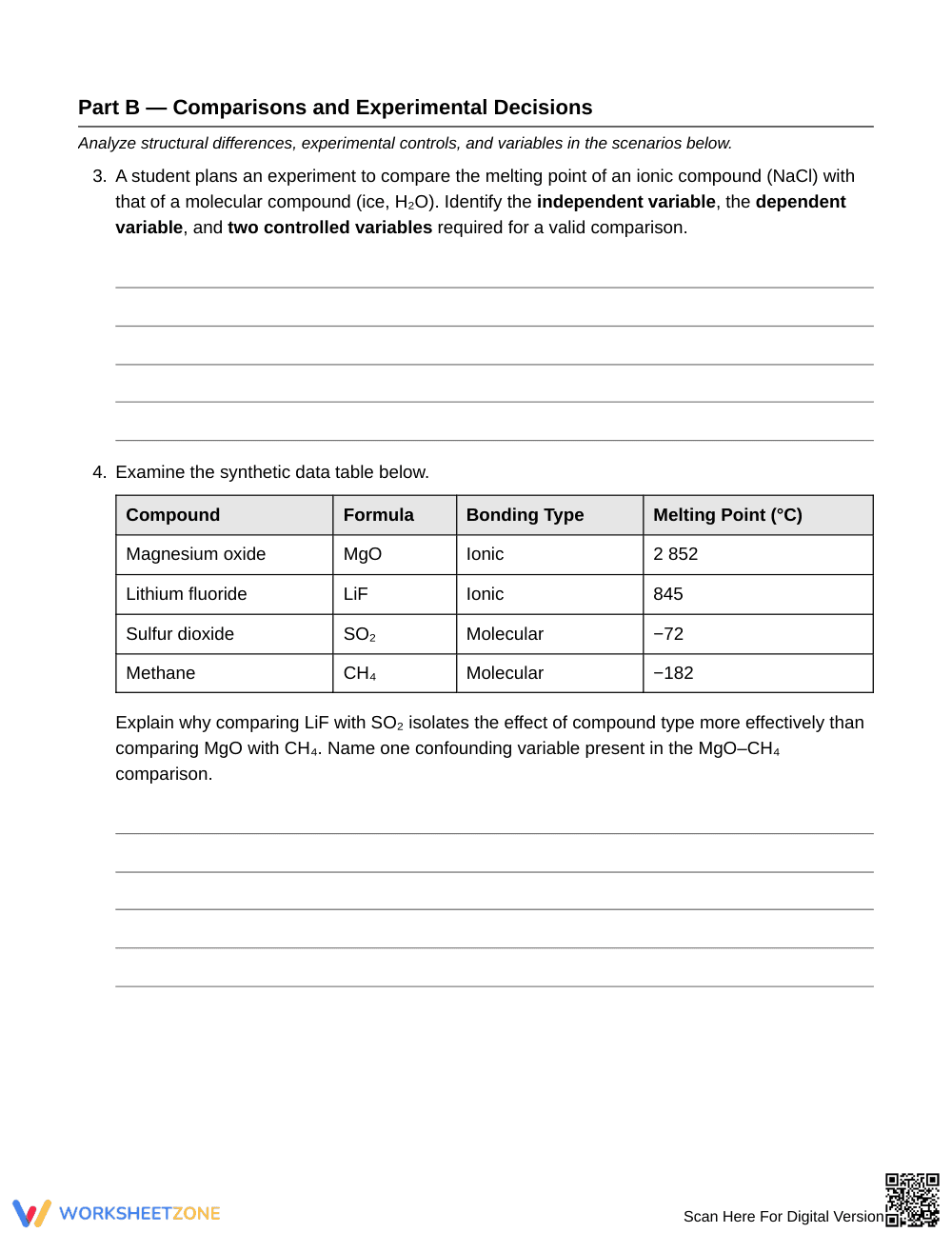
- Supported Practice (Part B, Problems 3–8): Learners analyze synthetic melting point tables, isolate experimental variables, evaluate lattice energy differences between salts, and contrast dipole attractions with hydrogen bonding.
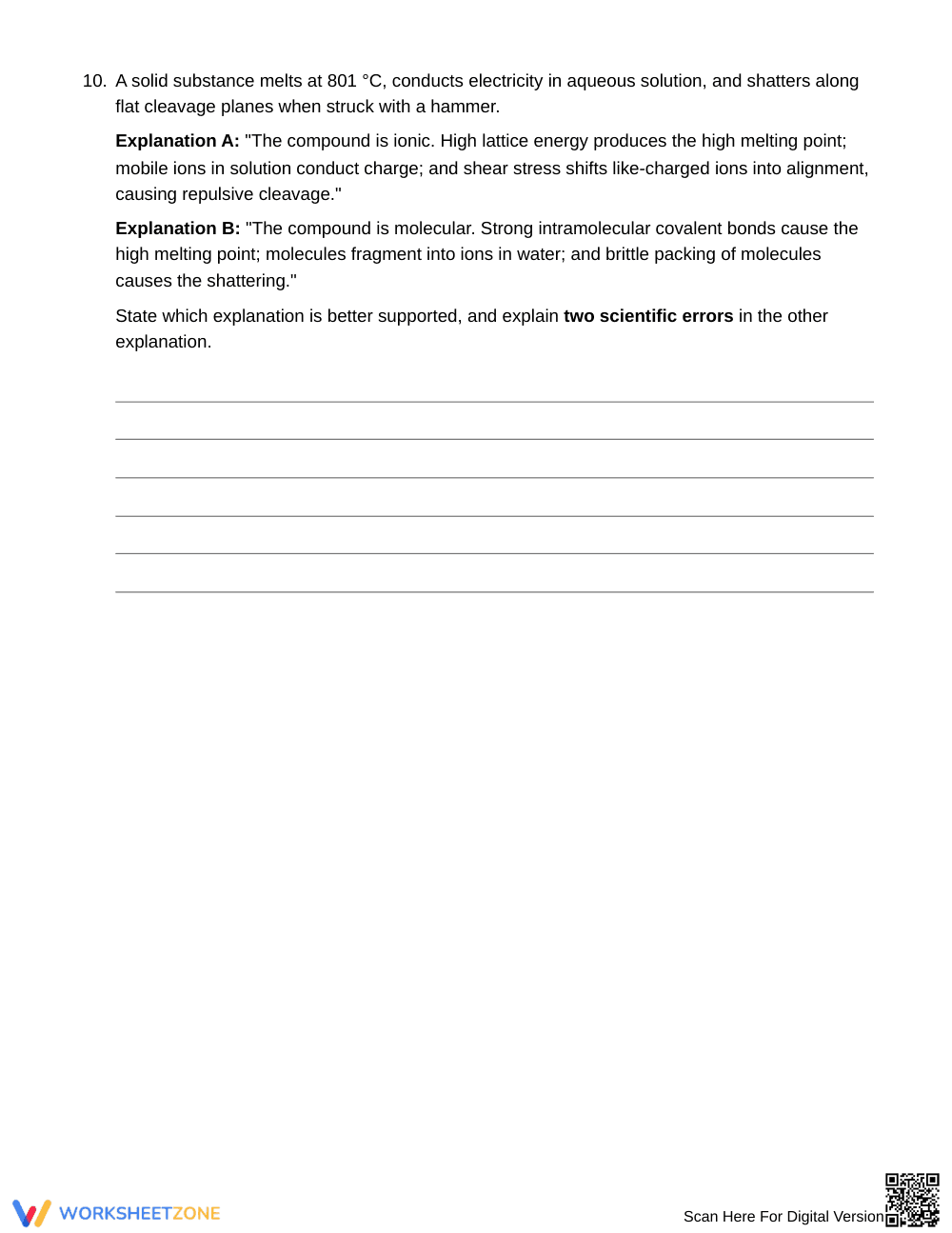
- Independent Practice (Part C, Problems 9–10): Students critically evaluate competing student explanations against laboratory data, identifying specific conceptual fallacies in multi-property scenarios.
This structured progression reflects the gradual release of responsibility model, shifting students systematically from guided qualitative prediction to independent scientific critique.
Standards Alignment
This resource aligns with high school physical science standards requiring learners to plan and conduct investigations or construct explanations regarding how submicroscopic structures determine the macroscopic properties of matter. Students demonstrate how differences in ionic lattice energy and molecular intermolecular attractions produce divergent thermal, mechanical, and electrical behaviors. Both standard concepts and performance expectations can be copied directly into lesson plans, IEP goals, or district curriculum mapping tools.
How to Use It
Deploy this worksheet immediately following direct instruction on ionic bonding and intermolecular attractions. It functions effectively during mid-unit collaborative problem-solving, where partner pairs debate experimental controls in Part B. Alternatively, assign Part C as an individual formative assessment check to evaluate whether students can spot flawed scientific reasoning. The estimated completion time is 45 to 55 minutes.
Who It's For
This problem set is engineered for Grade 11 Chemistry students, Honors Chemistry cohorts, and introductory AP Chemistry review units. Scaffolded prompts support struggling students through structured comparisons, while advanced analytical questions challenge high-performing learners. Pair this worksheet with a laboratory conductivity investigation or a molecular geometry molecular modeling kit lesson.
Mastering structural differentiation between ionic and covalent compounds requires students to construct accurate conceptual bridges between submicroscopic particle interactions and observable macroscopic phenomena. As highlighted by Fisher & Frey (2014) in their foundational research on purposeful classroom practice, deliberate sequencing through guided modeling, scaffolded analytical tasks, and independent critique ensures students internalize complex domain-specific schema. This 5-page instructional resource operationalizes those insights by organizing 10 rigorous problems into distinct cognitive tiers. Students not only identify chemical formulas and bonding categories but also dissect experimental design flaws, explain anomalous boiling points, and dismantle common misconceptions regarding charge mobility in solids versus aqueous solutions. By demanding clear mechanistic justifications rather than rote vocabulary recall, this worksheet provides educators with an actionable diagnostic tool to solidify essential physical chemistry competencies across diverse classroom settings.


