


























Views
Downloads

Protons Neutrons Electrons Worksheet | Grade 9 Essential
Paste this activity's link or code into your existing LMS (Google Classroom, Canvas, Teams, Schoology, Moodle, etc.).
Students can open and work on the activity right away, with no student login required.
You'll still be able to track student progress and results from your teacher account.
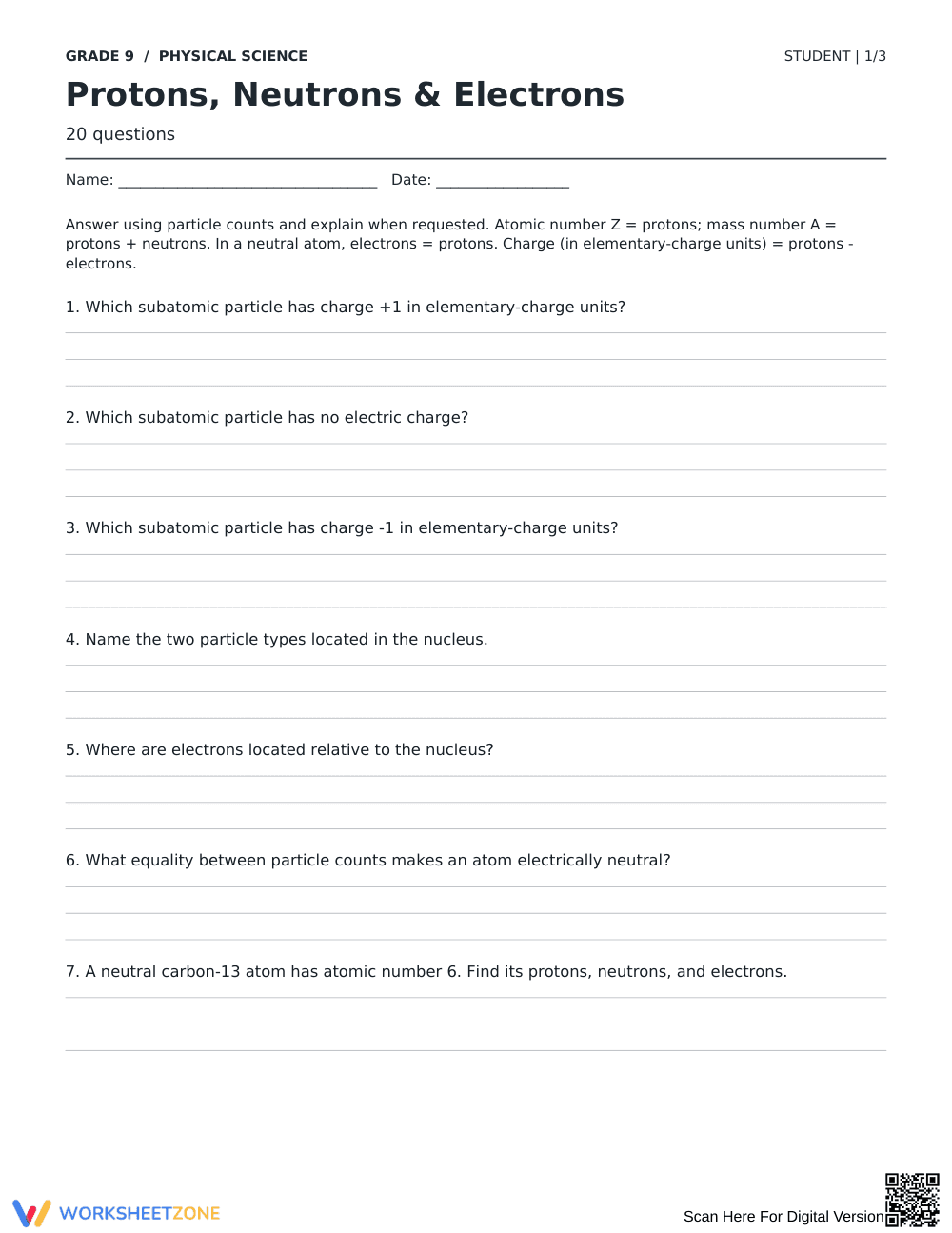
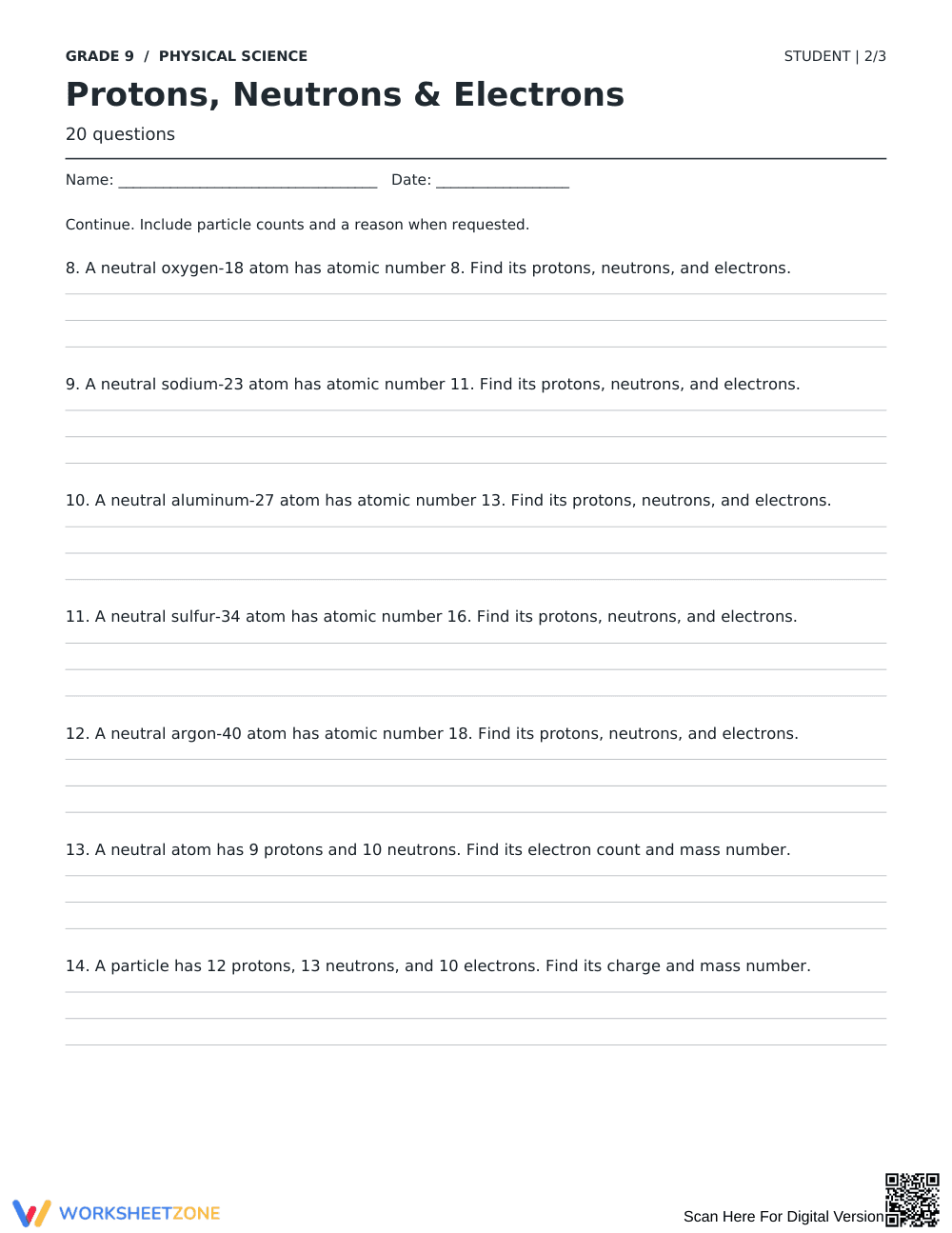
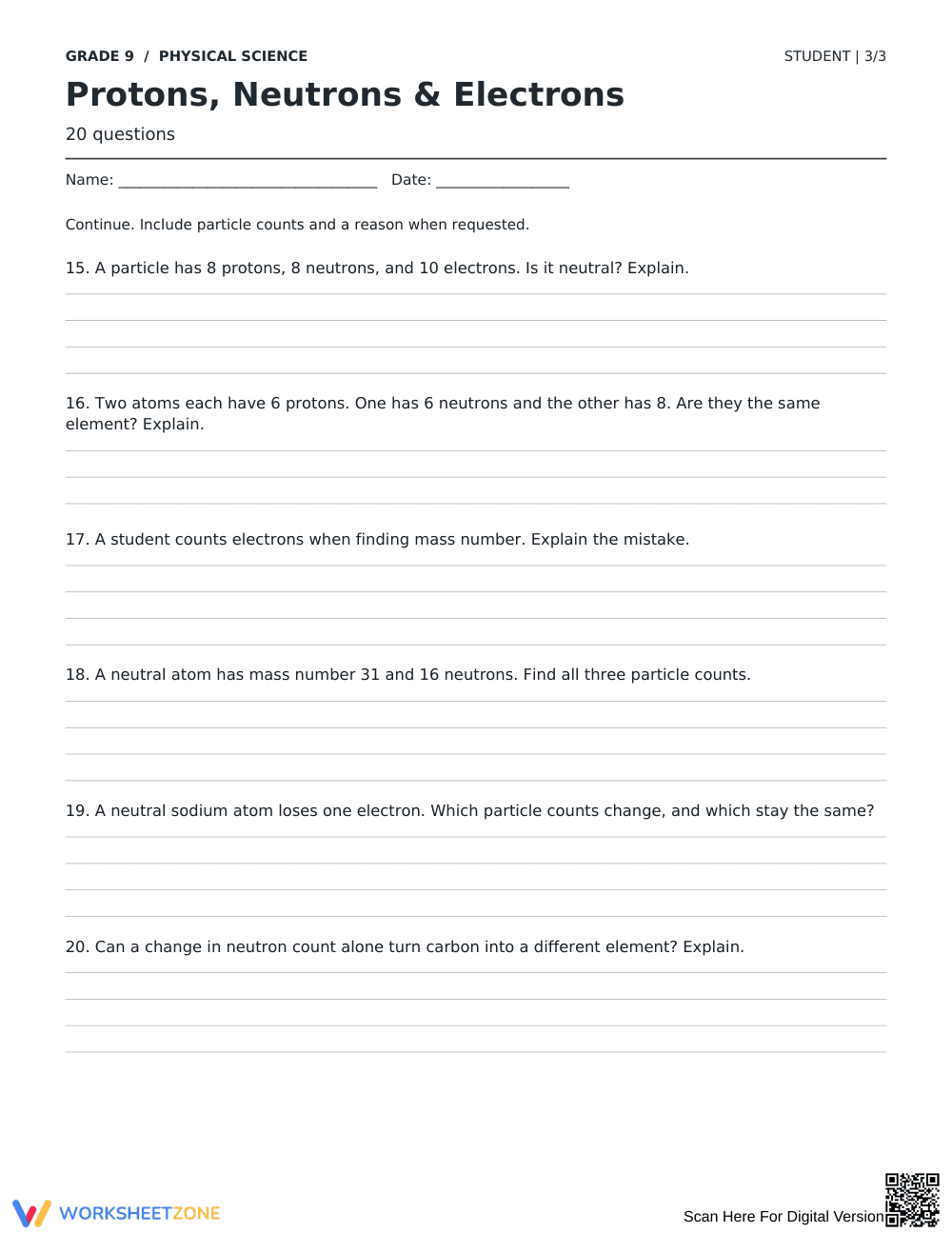
Master atomic structure with this comprehensive physical science worksheet designed for ninth-grade learners. Students calculate subatomic particles, determine isotopic mass numbers, and predict net electrical charges across 20 rigorous questions. This resource establishes foundational fluency with subatomic properties, preparing high school students to analyze chemical bonding and periodic trends with confidence.
At a Glance
- Grade: 9 · Subject: Science
- Standard:
HS-PS1-1— Use atomic structure and subatomic particle counts to explain periodic trends- Skill Focus: Protons, neutrons, electrons, and net charge calculations
- Format: 3 pages · 20 problems · Answer key included · PDF
- Best For: Independent practice, formative assessment, or homework
- Time: 25–40 minutes
This 3-page printable PDF features 20 structured problems accompanied by a complete 2-page answer key with step-by-step scoring guidance. Students encounter fundamental recall items, isotope arithmetic tables, and higher-order conceptual prompts. A reference formulas header provides instant support for calculating mass numbers, net elementary charge, and neutral particle relationships without external aids.
Skill Progression
- Guided practice (Questions 1–6): Six foundational recall items identify subatomic particle charges, nuclear locations, and electron cloud placement with minimal cognitive strain.
- Supported practice (Questions 7–14): Eight computational problems require students to apply mass number and atomic number equations to determine particle counts for neutral isotopes and charged ions.
- Independent practice (Questions 15–20): Six rigorous conceptual prompts challenge learners to evaluate student errors, justify isotopic identities, and explain ionization mechanics without scaffolding.
This structured progression reflects the gradual-release framework, moving learners purposefully from conceptual recall to complex atomic reasoning.
Standards Alignment
This activity aligns with NGSS `HS-PS1-1`: Use the periodic table as a model to predict the relative properties of elements based on the patterns of electrons in the outermost energy level of atoms. It also reinforces foundational middle school standard `MS-PS1-1` regarding atomic models. Both standard codes can be copied directly into lesson plans, IEP goals, or district curriculum mapping tools.
How to Use It
Administer this worksheet immediately after direct instruction on atomic structure as an in-class independent check. During completion, circulate to observe whether students mistakenly add electrons to calculate mass numbers in Questions 14 through 17. Alternatively, assign the 20 questions as a 25-to-40-minute homework assignment or sub plan to reinforce isotopic notation.
Who It's For
Designed for Grade 9 Physical Science and introductory Chemistry students, this resource includes explicit formula reminders to assist struggling learners while offering demanding analytical items for advanced students. Pair this activity directly with a periodic table reference chart or an introductory lecture on Bohr models for optimal results.
According to research synthesized by Fisher & Frey (2014) on the gradual release of responsibility, structured problem sequences that transition systematically from foundational recall to complex, open-ended problem solving significantly boost student conceptual retention and analytical independence. This 20-problem physical science resource embodies that instructional architecture by guiding high school science students through subatomic particle calculations, isotope mass determinations, and net ion charge evaluations aligned with NGSS standard HS-PS1-1. By establishing mastery over elementary charges, nuclear structures, and electron configurations in neutral and charged atoms, learners build the requisite cognitive schema necessary to predict periodic table trends and chemical reactivity. Teachers can reliably utilize this standards-aligned worksheet to diagnose persistent student misconceptions regarding atomic mass versus charge balance, ensuring ninth-grade learners achieve verifiable proficiency in atomic substructure prior to advanced periodic modeling.


