


























Views
Downloads


Printable Volume & Capacity Worksheet | Grade 5 Math
Paste this activity's link or code into your existing LMS (Google Classroom, Canvas, Teams, Schoology, Moodle, etc.).
Students can open and work on the activity right away, with no student login required.
You'll still be able to track student progress and results from your teacher account.
This math worksheet gives Grade 5 students focused practice on measuring volume and capacity. Through 32 structured problems, learners will convert between metric units like liters and milliliters and apply these skills to solve multi-step word problems, building a solid foundation in measurement.
At a Glance
- Grade: 5 · Subject: Math
- Standard:
CCSS.MATH.CONTENT.5.MD.A.1— Convert measurement units and use conversions to solve problems.- Skill Focus: Volume and Capacity (Metric Units)
- Format: 3 pages · 32 problems · Answer key included · PDF
- Best For: Unit review, independent practice, or formative assessment
- Time: 25–40 minutes
What's Inside
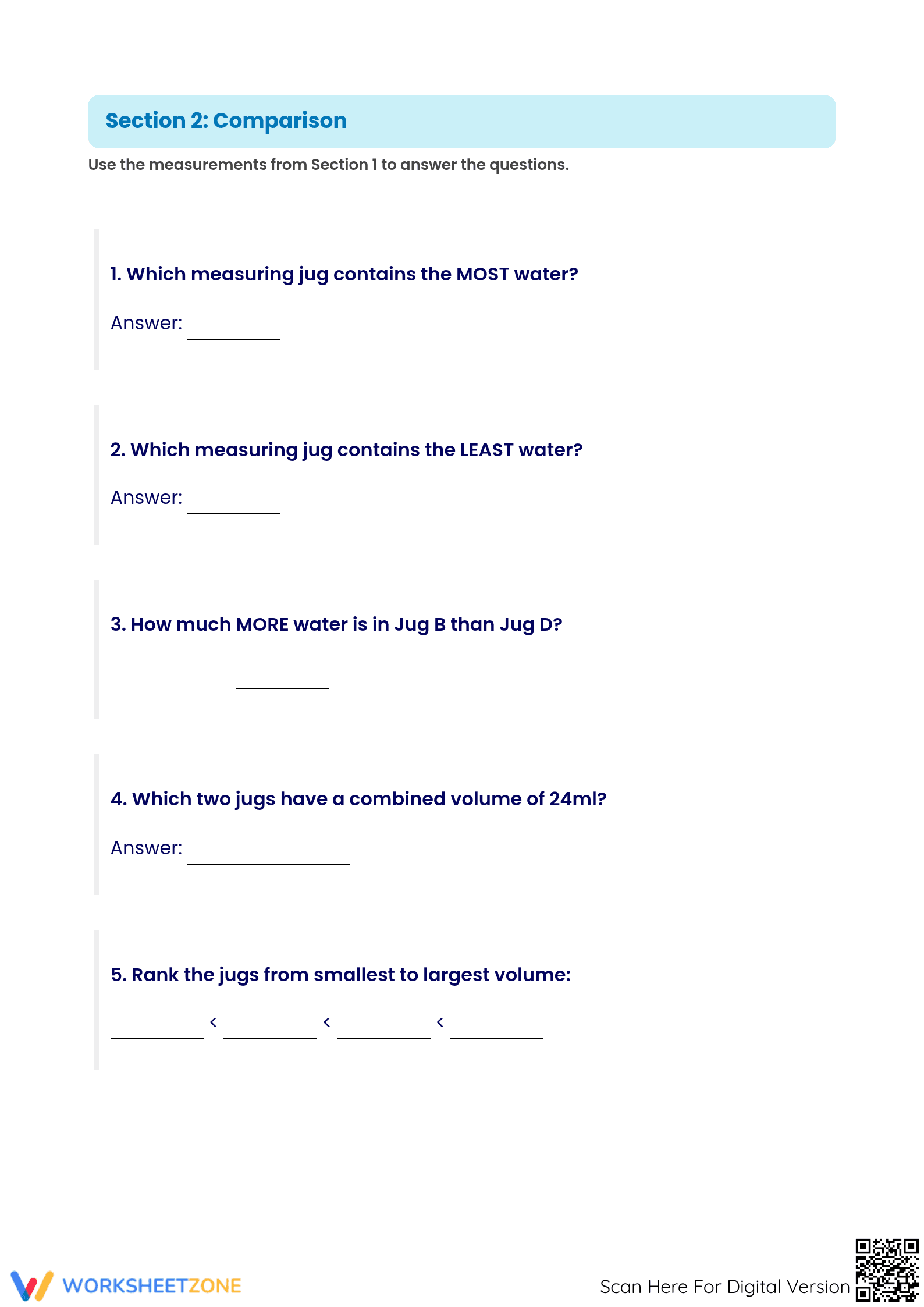
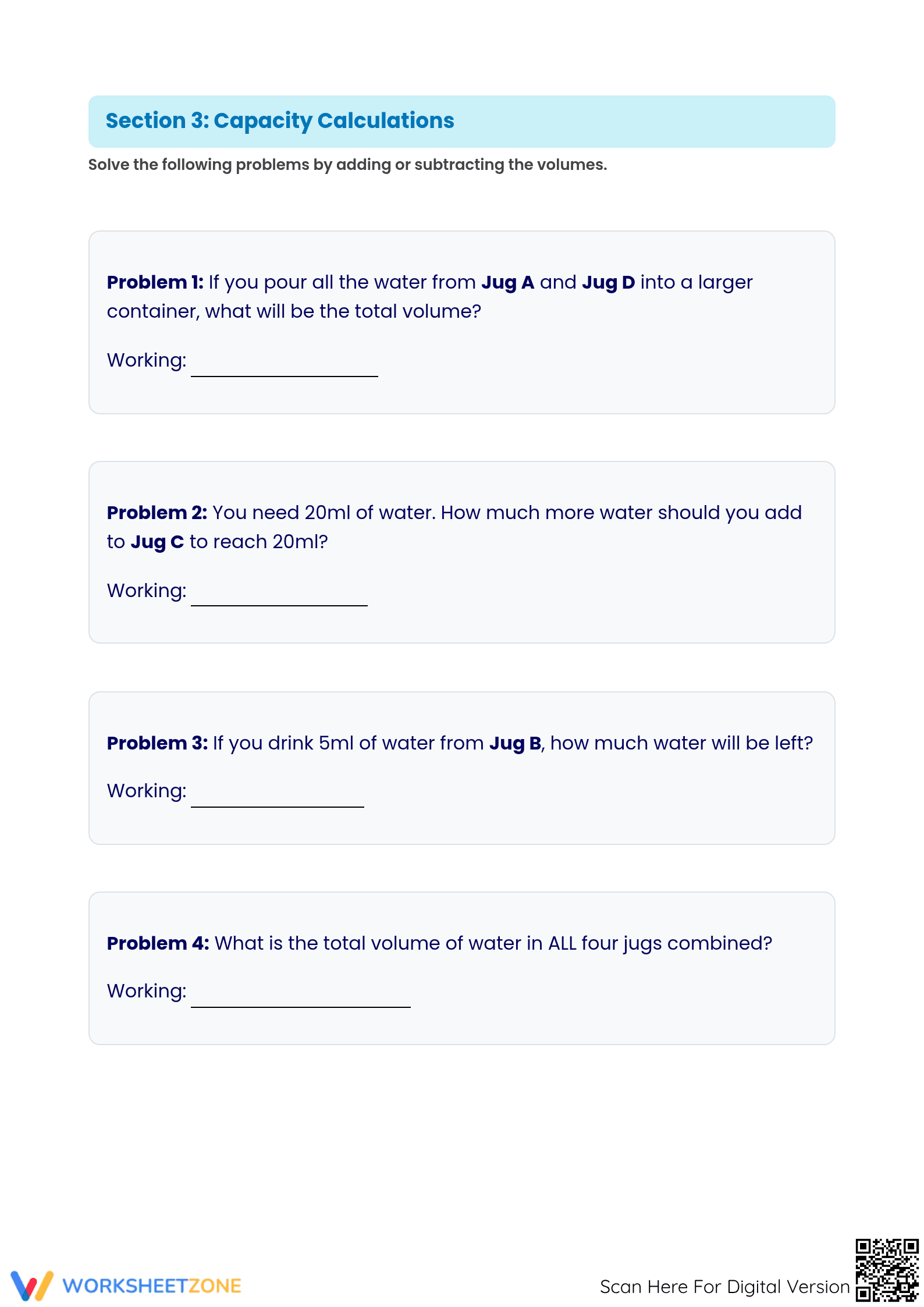
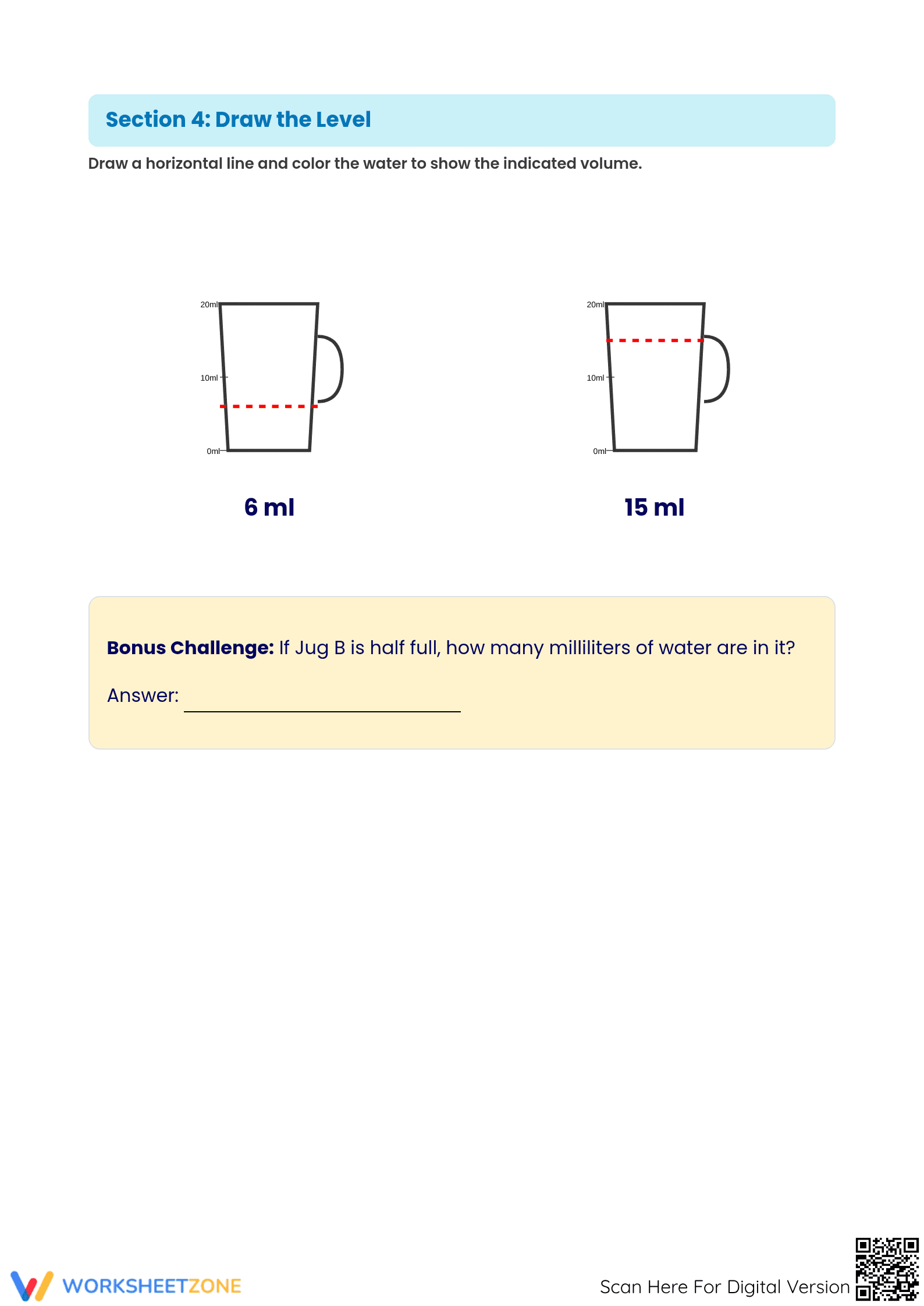
This four-page PDF contains a three-page worksheet and a full answer key. The student pages are organized into sections covering reading scales, unit conversions, comparisons, and word problems. The layout provides ample space for students to show their work.
Skill Progression
This worksheet follows a gradual-release model.
- Guided Practice: The first sections (8 problems) ask students to read scales and calculate new readings, grounding the concept of volume with visuals.
- Supported Practice: The middle sections (20 problems) provide drills on converting between liters/milliliters and comparing capacities, reinforcing core procedures.
- Independent Practice: The final section has four multi-step word problems, requiring students to synthesize skills to solve realistic scenarios independently.
This structure ensures all learners can access the material.
Standards Alignment
This resource aligns to CCSS.MATH.CONTENT.5.MD.A.1, which requires students to 'Convert among different-sized standard measurement units... and use these conversions in solving multi-step, real world problems.' The worksheet's progression from conversions to word problems targets this standard precisely. The standard code can be copied into lesson plans or curriculum maps.
How to Use It
Use this worksheet for independent practice after a lesson on converting metric units. It also works as a homework assignment. For formative assessment, observe how students tackle the word problems to identify any conceptual gaps before a test. Most students will complete it in 25-40 minutes.
Who It's For
Designed for fifth-grade students, this resource is great for whole-class instruction or small group remediation. For students needing support, complete the first few conversion problems together. This worksheet pairs well with hands-on activities using real measuring cups to connect the math to concrete experiences.
Providing structured practice is a cornerstone of effective mathematics instruction, directly supporting the development of procedural fluency from conceptual understanding. This Grade 5 worksheet on volume and capacity aligns with this principle, targeting standard CCSS.MATH.CONTENT.5.MD.A.1. It requires students to convert between different-sized measurement units within a system and apply this skill to solve problems. Research from Fisher & Frey (2014) emphasizes the importance of a gradual release of responsibility, moving from guided to independent practice, a structure embedded in this resource's design. By progressing from simple scale-reading to complex word problems, the worksheet provides the deliberate practice necessary for students to internalize measurement conversions and confidently apply them, a critical skill for future success in science and mathematics. This approach ensures that procedural fluency is built upon a solid conceptual foundation, rather than rote memorization.


