































Printable Winter Clothing Word Search | Grades 2–3 ELA

Paste this activity's link or code into your existing LMS (Google Classroom, Canvas, Teams, Schoology, Moodle, etc.).
Students can open and work on the activity right away, with no student login required.
You'll still be able to track student progress and results from your teacher account.
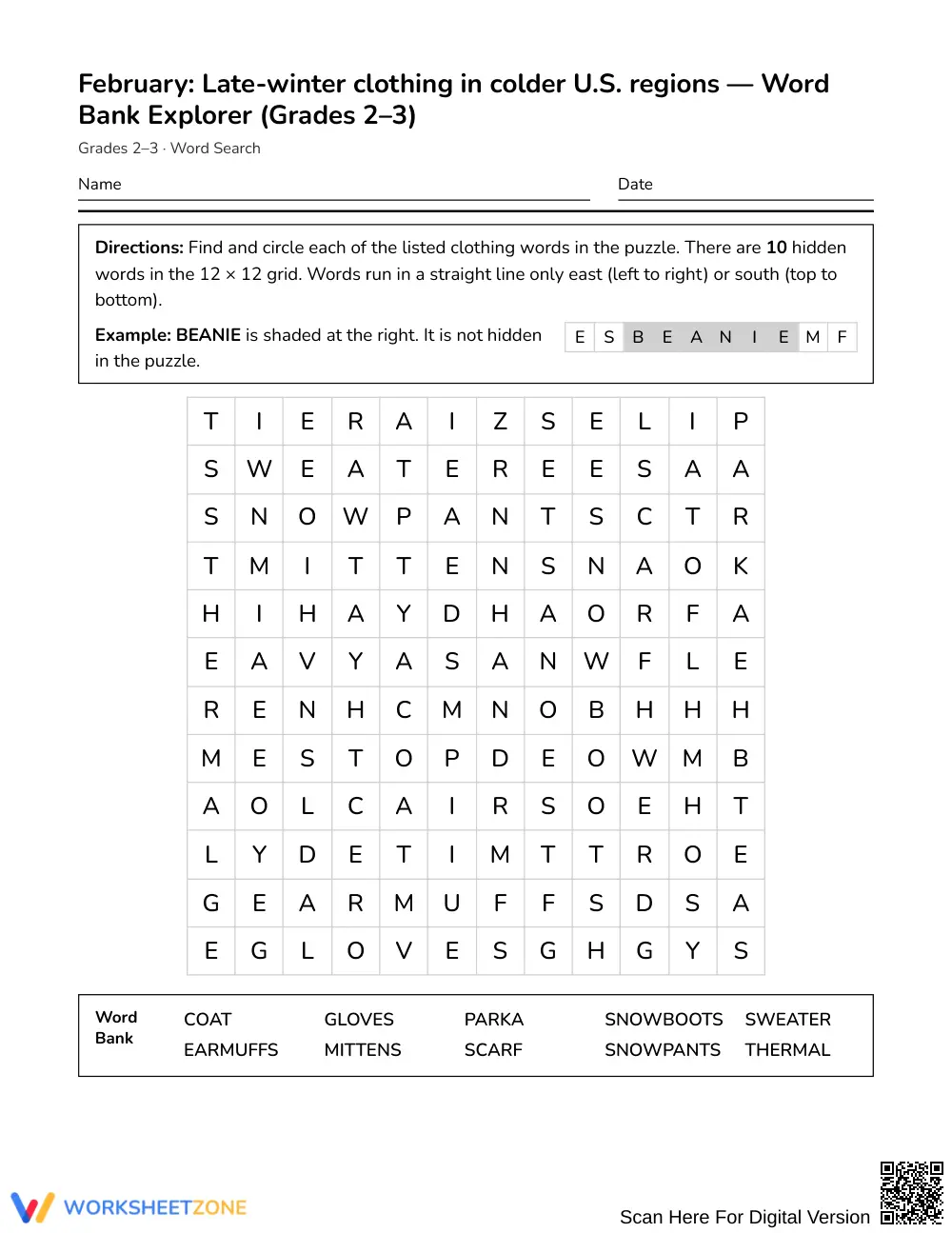
This Grades 2–3 vocabulary word search introduces learners to essential cold-weather apparel terms. Students identify 10 seasonal vocabulary words hidden across the letter grid while reviewing clear contextual definitions. The activity builds spelling pattern recognition, reinforces domain-specific seasonal vocabulary, and provides immediate, productive engagement during English Language Arts blocks.
At a Glance
- Grade: Grades 2–3 · Subject: English Language Arts
- Standard: Not standards-assessed — vocabulary enrichment
- Skill Focus: Late-winter clothing vocabulary
- Format: 1 pages · 10 words · Answer key included · PDF
- Best For: Independent morning work or sub plans
- Time: 15–20 minutes
What's Inside
This single-page vocabulary activity contains a clear letter grid accompanied by an alphabetical word bank and accessible student definitions. Students locate 10 winter-themed terms, including parka, thermal, snowpants, and earmuffs. The resource comes paired with a 2-page complete answer key showing exact letter coordinates for effortless grading and rapid student self-checking.
Puzzle Mechanics and Structure
The activity is built on an age-appropriate 12 × 12 letter grid tailored to early elementary visual scanning skills. Hidden words run strictly East (horizontal left-to-right) and South (vertical top-to-bottom), avoiding confusing diagonal or reverse backward placements. A clean alphabetical word bank supports systematic scanning, while corresponding definitions for each clothing item reinforce word meaning alongside spelling recognition.
Standards Alignment
This activity provides targeted vocabulary enrichment and is not aligned to a formal standard code. It supplements foundational literacy by reinforcing high-utility seasonal nouns, orthographic recognition, and decoding skills across elementary reading and writing contexts.
How to Use It
Deploy this printable puzzle as an independent warm-up during winter morning meetings or as a calm sponge activity after direct phonics instruction. During work time, circulate to observe how students track word boundaries and utilize the first-letter scanning strategy across rows and columns. Most students finish within 15 to 20 minutes.
Who It's For
This puzzle is designed for learners in Grades 2–3 building familiarity with regional seasonal vocabulary and practical outerwear concepts. It serves as an accessible resource for general education classes, English language learners, and intervention groups. Pair this printable with an informational read-aloud about winter weather patterns or a seasonal descriptive writing prompt.
Structured orthographic scanning activities reinforce foundational word recognition and domain-specific vocabulary acquisition in elementary classrooms. According to Fisher & Frey (2014), intentional exposure to domain-rich terminology across diverse, low-stakes formats deepens student lexical retention and strengthens overall text comprehension. While standard rote memorization exercises can create cognitive fatigue, structured letter-search tasks prompt young readers to inspect internal spelling patterns, initial phonemes, and consonant blends closely. The predictable 12 by 12 format allows developing readers in early elementary grades to build confidence with multisyllabic seasonal nouns without cognitive overload. Incorporating supportive word-level tasks into recurring literacy routines fosters sustained engagement and provides valuable print exposure during independent learning periods.


