




























Views
Downloads

Printable Veterans Day Word Search | Grades 3–4 ELA

Paste this activity's link or code into your existing LMS (Google Classroom, Canvas, Teams, Schoology, Moodle, etc.).
Students can open and work on the activity right away, with no student login required.
You'll still be able to track student progress and results from your teacher account.
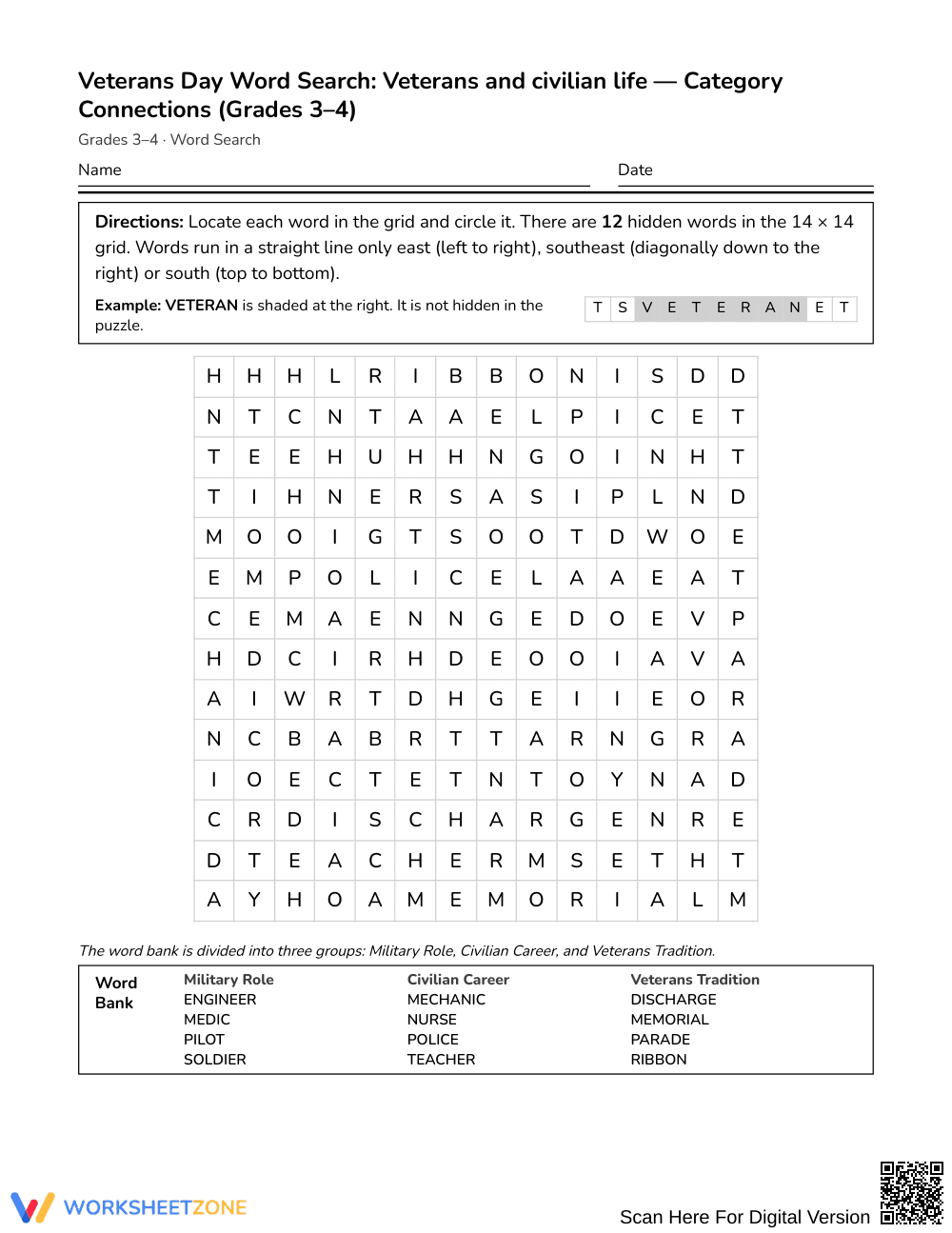
This Veterans Day word search helps elementary learners explore vocabulary connecting military service and community careers. Students search for 12 thematic terms while categorizing roles and civic traditions. Designed as an independent vocabulary booster, this printable puzzle reinforces social studies and literacy concepts without requiring prior teacher instruction or complicated setup.
At a Glance
- Grade: Grades 3–4 · Subject: English Language Arts (ELA)
- Standard: Not standards-assessed — vocabulary enrichment
- Skill Focus: Veterans and civilian life
- Format: 1 pages · 12 words · Answer key included · PDF
- Best For: Holiday stations, morning work, or sub plans
- Time: 15–20 minutes
What's Inside
The resource features a single-page puzzle containing 12 target vocabulary words organized into three conceptual groups: Military Role, Civilian Career, and Veterans Tradition. Each term includes a concise student-friendly definition clue to anchor comprehension. The package includes a multi-page solution key showing exact grid coordinates, making student self-checking or peer grading straightforward.
Zero-Prep Classroom Workflow
The activity follows an intuitive three-step implementation that requires under 2 minutes of teacher preparation:
- Print (1 minute): Send the single-page puzzle directly to the copier without adjusting borders or collating multiple sheets.
- Distribute (30 seconds): Hand the worksheet to students as an independent task during holiday observances, literacy blocks, or emergency substitute days.
- Review (30 seconds): Display the included answer key on a projector or station it at a correction table for instant verification.
The puzzle is built on a 14 x 14 grid where words run East, Southeast, and South. Learners use the categorized word bank to locate terms such as mechanic, soldier, and memorial systematically.
Standards Alignment
This activity is designed purely for vocabulary enrichment and cultural literacy around patriotic observances; it is not formally aligned to an evaluated grade-level standard.
How to Use It
Deploy this puzzle during a designated Veterans Day literacy block following a read-aloud or brief discussion about service members. It functions exceptionally well as a calm morning work task or an early finisher activity during social studies rotations. While students work, circulate to observe whether they recognize the semantic links between military occupations and parallel civilian jobs, such as medic and nurse. Most learners complete the full search in 15 to 20 minutes.
Who It's For
This word search is tailored for third- and fourth-grade students building civic awareness and domain-specific vocabulary. Emerging readers benefit from searching only in forward and diagonal directions (E, SE, S) without backwards letter arrangements. Pair this puzzle with an informational text about Veterans Day or a community helper anchor chart to deepen thematic connections.
Educational research confirms that structured vocabulary puzzles strengthen orthographic mapping and thematic word associations when implemented alongside explicit content discussions. According to Fisher & Frey (2014), intentional word exposure embedded within engaging, collaborative literacy routines supports language acquisition across diverse student populations. By organizing 12 high-utility words into clear categories, this puzzle encourages learners to notice semantic relationships between armed service positions and community professions. The uncluttered layout and directional constraints allow elementary students to experience high rates of success, reinforcing spelling memory while maintaining an accessible entry point for all literacy tiers.


