






























Paste this activity's link or code into your existing LMS (Google Classroom, Canvas, Teams, Schoology, Moodle, etc.).
Students can open and work on the activity right away, with no student login required.
You'll still be able to track student progress and results from your teacher account.


Printable Two-Step Equations Worksheet | Grade 3 Math

Paste this activity's link or code into your existing LMS (Google Classroom, Canvas, Teams, Schoology, Moodle, etc.).
Students can open and work on the activity right away, with no student login required.
You'll still be able to track student progress and results from your teacher account.
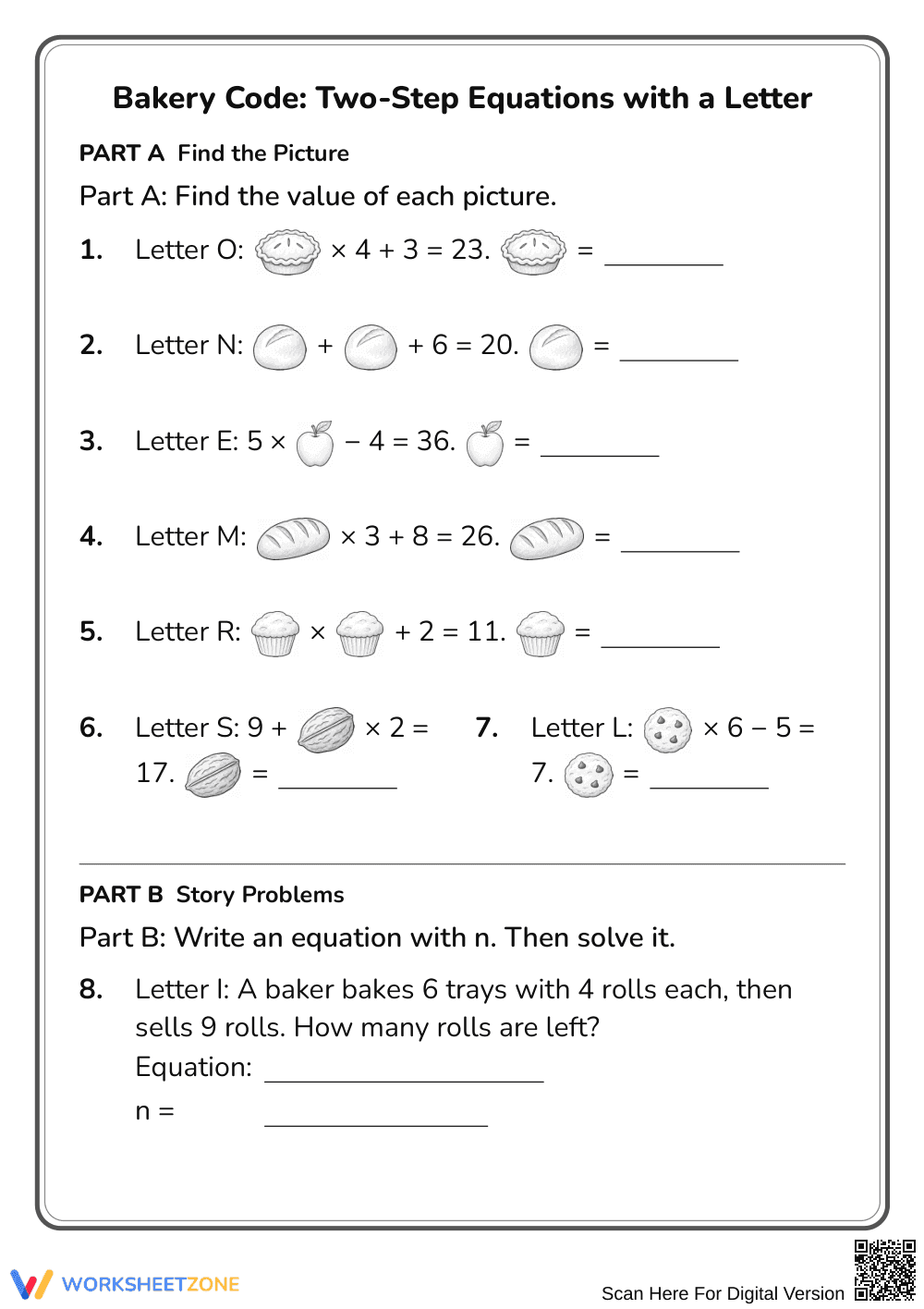
Students practice writing and solving two-step equations using unknown picture values and the letter n to crack a bakery-themed riddle. Across 33 structured tasks on 2 printable pages, Grade 3 learners connect visual reasoning to algebraic equations, build fluency with all four operations, and verify their own accuracy as the secret message emerges.
At a Glance
- Grade: 3 · Subject: Math
- Standard:
3.OA.D.8— Solve two-step word problems using equations with a letter for the unknown- Skill Focus: Two-step equations with unknown picture values and variables
- Format: 2 pages · 33 tasks · Answer key included · PDF
- Best For: Guided or independent Grade 3 math practice
- Time: 20–30 minutes
What's Inside
This 2-page PDF worksheet organizes 33 tasks into three connected parts plus a 2-page answer key. Part A presents 7 bakery picture equations where students find the value of items like pies and cookies. Part B features 4 two-step story problems requiring equations with the letter n. Part C provides a 22-letter riddle grid where solved values reveal the punchline.
Skill Progression
- Guided practice (Part A, 7 tasks): Students find unknown picture values in two-step equations using bakery icons as visual scaffolds.
- Supported practice (Part B, 4 tasks): Learners translate bakery word problems into formal two-step equations using the letter n for the unknown.
- Independent practice (Part C, 22 tasks): Students match solved code values across a 22-space riddle grid to decode the message independently.
This sequence follows an I Do, We Do, You Do gradual-release model from visual models to symbolic algebra.
Standards Alignment
This worksheet aligns to 3.OA.D.8, requiring Grade 3 students to solve two-step word problems using the four operations and equations with a letter for the unknown. It also reinforces 3.OA.C.7 as students multiply and divide fluently within 100. Both standard codes can be copied directly into lesson plans, IEP goals, or district curriculum mapping tools.
How to Use It
Assign this sheet after direct instruction on representing unknowns, either as a 20-to-30-minute independent activity or a math center. During circulation, watch for students who compute the two steps in Part B correctly but omit the letter n, signaling a need to model equation structure.
Who It's For
Designed for Grade 3 students building fluency with two-step equations, this resource supports learners who benefit from self-checking riddles. Provide multiplication charts for extra support, and pair the sheet with a two-step word problem anchor chart.
Aligned to Common Core standard 3.OA.D.8, this Grade 3 math worksheet builds student proficiency in solving two-step word problems and representing unknown quantities with a letter in an equation. Across 33 structured tasks on 2 printable pages, students move from concrete picture-based equations to symbolic word problems and a self-checking riddle decode. Research on instructional scaffolding by Fisher & Frey (2014) emphasizes that gradually shifting cognitive responsibility from visual models to independent application strengthens conceptual retention and procedural accuracy. By pairing familiar bakery contexts with explicit equation-writing prompts and a complete 2-page answer key, this resource gives teachers immediate visibility into student reasoning while helping third graders connect arithmetic operations to early algebraic thinking. Teachers can use the built-in riddle key to spot calculation errors early, while students gain confidence verifying each value before moving on to multi-step problem solving in upper elementary grades.


