





























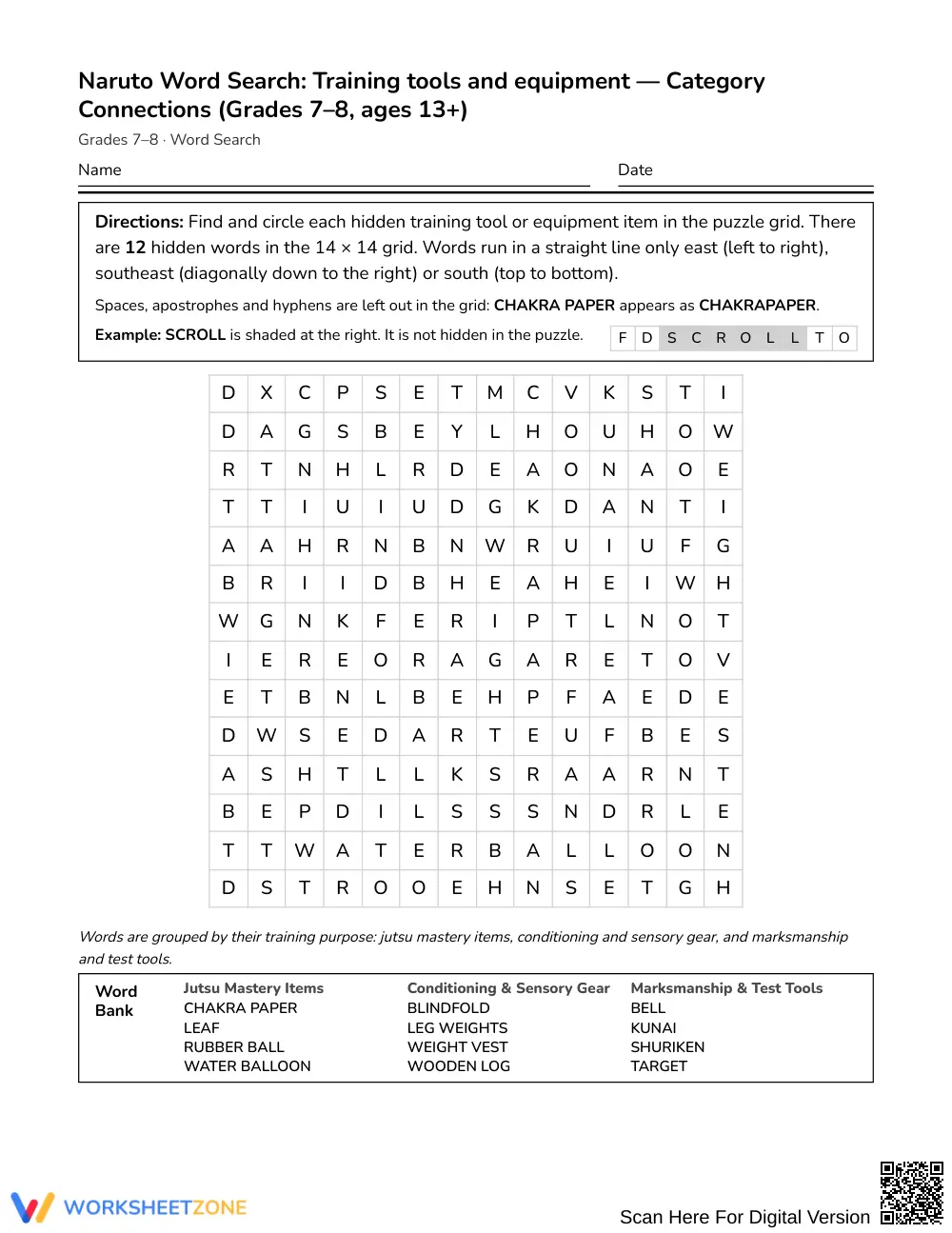


Printable Training Equipment Word Search | Grades 7–8 ELA

Paste this activity's link or code into your existing LMS (Google Classroom, Canvas, Teams, Schoology, Moodle, etc.).
Students can open and work on the activity right away, with no student login required.
You'll still be able to track student progress and results from your teacher account.
This Grades 7–8 English Language Arts word search builds vocabulary retention through category-based word recognition focused on training tools and equipment. Students identify 12 themed vocabulary terms organized by practical function, reinforcing contextual word meanings while strengthening visual scanning and orthographic mapping skills during independent classroom practice or literacy warm-ups.
At a Glance
- Grade: Grades 7–8 · Subject: Middle School English Language Arts (ELA)
- Standard: Not standards-assessed — vocabulary enrichment
- Skill Focus: Training tools and equipment terminology
- Format: 1 printable page · 12 hidden words · 3-page answer key included · PDF
- Best For: Independent vocabulary practice, early finishers, and emergency sub plans
- Time: 15–25 minutes total
What's Inside
The single-page puzzle presents a clean 14-by-14 grid containing 12 vocabulary terms organized into three thematic categories: jutsu mastery items, conditioning and sensory gear, and marksmanship and test tools. Each entry includes detailed descriptive clues explaining the item's function and physical purpose. A comprehensive 3-page answer key provides clear solution pathways for fast grading and self-monitoring.
How the Puzzle Works
Students navigate a 14-by-14 letter grid where terms are placed strictly in East (left to right), South (top to bottom), and Southeast (diagonal downward) orientations, avoiding backward placement for accessible middle school engagement. Instead of an unorganized list, terms appear categorized by operational focus—jutsu mastery, sensory conditioning, and marksmanship testing—paired with contextual clues that reinforce functional definitions as students locate each hidden word.
Standards Alignment
This resource serves as targeted vocabulary enrichment and is not aligned to a formal academic standard. It supports domain-specific terminology acquisition, visual scanning efficiency, and thematic categorization for secondary learners without requiring standard-based performance scoring.
How to Use It
Deploy this word search as an engaging bell ringer before direct instruction to activate analytical focus, or assign it as an independent extension task for early finishers following reading comprehension lessons. During seatwork, observe whether students identify terms using clue definitions or scan solely for letter strings, providing quick insight into reading automaticity. Most learners complete the activity in 15 to 25 minutes.
Who It's For
Designed for middle school learners in Grades 7–8 and young teens seeking high-interest literacy practice. The structured directional layout supports English language learners and developing readers by eliminating backward orientations. Pair this activity with an expository text on martial arts conditioning or an equipment-based creative writing prompt to deepen thematic connections.
Designed as a specialized vocabulary enrichment resource rather than a standards-aligned measure, this Grades 7–8 word search targets thematic domain-specific vocabulary through active orthographic scanning and contextual clues. According to Fisher & Frey (2014), intentional exposure to categorized terminology strengthens semantic networks and accelerates word consciousness, enabling secondary students to internalize disciplinary language more efficiently than through isolated rote memorization. By arranging 12 training equipment terms into functional groupings across a 14-by-14 grid restricted to forward and diagonal orientations, the puzzle reinforces orthographic awareness while reducing cognitive friction for developing readers. Educators can implement this print-and-ready literacy task during transition periods, homeroom blocks, or reading workshops to sustain high academic engagement while promoting independent word recognition. The included three-page answer key supports rapid verification, making it a reliable supplemental tool for middle school vocabulary acquisition.


