































Paste this activity's link or code into your existing LMS (Google Classroom, Canvas, Teams, Schoology, Moodle, etc.).
Students can open and work on the activity right away, with no student login required.
You'll still be able to track student progress and results from your teacher account.


Printable Three Sisters Garden: Corn, Beans and Squash

Paste this activity's link or code into your existing LMS (Google Classroom, Canvas, Teams, Schoology, Moodle, etc.).
Students can open and work on the activity right away, with no student login required.
You'll still be able to track student progress and results from your teacher account.
This Grade 3 science worksheet guides students to explain how three companion plants grown together help each other thrive. Through a passage on the Haudenosaunee Three Sisters garden, learners discover how corn, beans, and squash share light, nutrients, and physical support. Students complete visual labeling, structured comparison tables, and comprehension checks.
At a Glance
- Grade: 3 · Subject: Science
- Standard: Plant Ecosystems — Explain how plants grown together support one another
- Skill Focus: Explain how three plants grown together help each other
- Format: 3 pages · 16 problems · Answer key included · PDF
- Best For: Plant interdependence units and science centers
- Time: 30–45 minutes
What's Inside
The 3-page printable worksheet includes an introductory reading passage paired with an anatomical garden diagram, followed by structured data tables, a plant interaction cycle, four multiple-choice questions, and an analytical written response. A complete 3-page answer key provides clear model answers for efficient evaluation.
Skill Progression
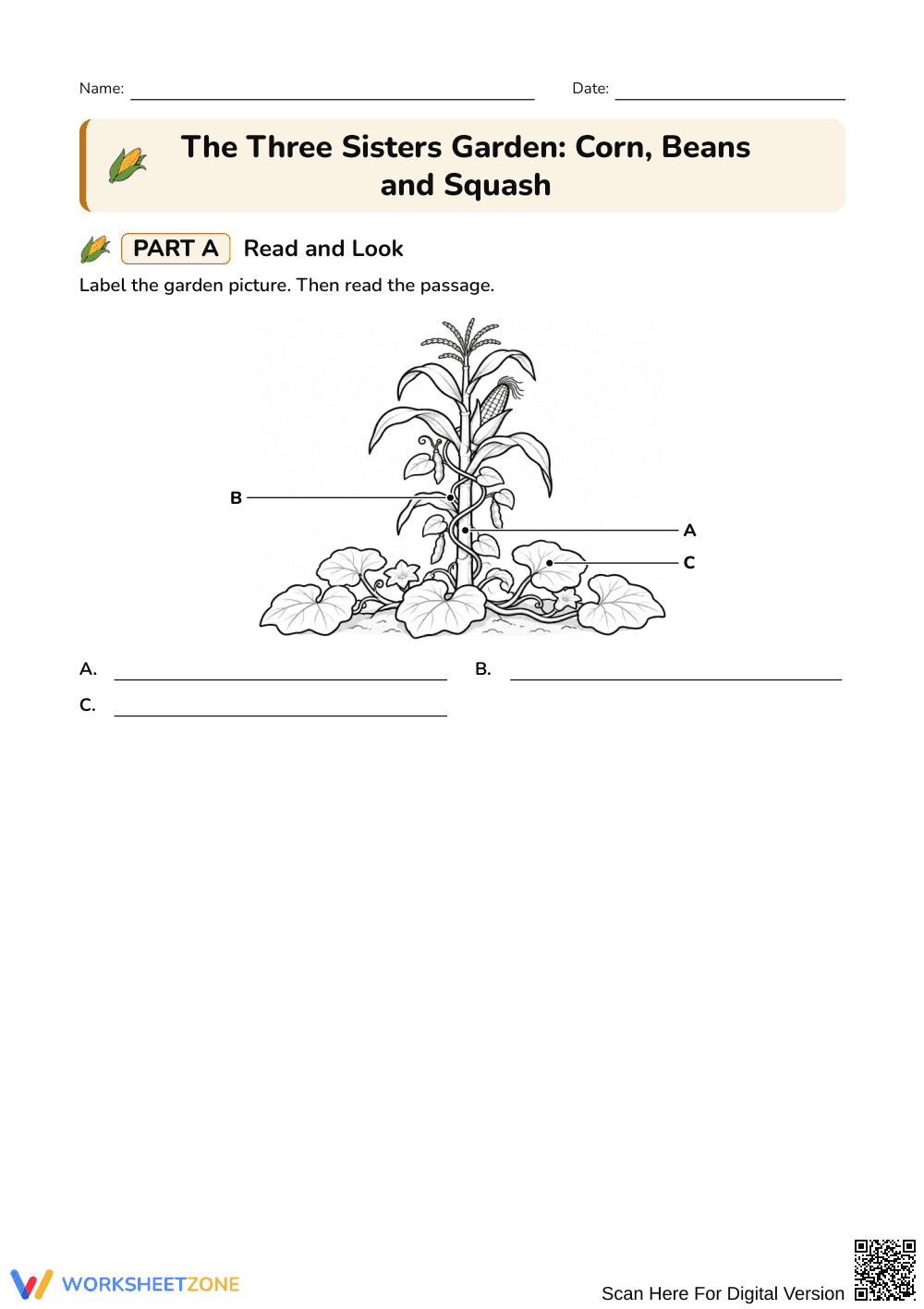
- Guided practice (Part A): Students examine a diagram of garden mounds and label plant parts alongside an informational text introducing reciprocal plant interactions (3 labeling items).
- Supported practice (Part B): Learners complete a 6-part comparison table and a 4-step cyclical diagram tracing specific resources exchanged among corn, bean, and squash plants.
- Independent practice (Part C): Four multiple-choice comprehension questions and an open-ended constructed response challenge students to articulate symbiotic mechanisms without scaffolds.
This sequence mirrors the gradual release of responsibility model, moving students from guided visual identification to confident scientific explanation.
Standards Alignment
This resource aligns with Grade 3 life science standards addressing plant needs, organism habitats, and interdependent relationships in ecosystems. Students examine how structural adaptations and nutrient cycling allow different plant species to survive collectively in a shared environment. This standard alignment can be copied directly into lesson plans, IEP goals, or district curriculum mapping tools.
How to Use It
Deploy this activity during direct instruction on plant adaptations to reinforce how physical structures fulfill life functions, or assign it after instruction as an independent consolidation task. During partner work, listen for students explaining why beans supply nitrogen while corn provides structural elevation. Plan for 30 to 45 minutes of total instructional time.
Who It's For
This activity is designed for Grade 3 general education science classrooms, inclusion settings requiring graphic scaffolds, and cross-curricular units connecting Indigenous agricultural traditions with botany. Pair this worksheet directly with a live seed-germination lab or a plant life-cycle anchor chart to reinforce foundational concepts.
According to Fisher & Frey (2014), structured scaffolds that transition from visual modeling to graphic organizers accelerate conceptual understanding in elementary science. This Grade 3 plant interdependence resource enables students to explain how companion crops support one another through mutual ecological relationships. Third-grade learners analyze how Haudenosaunee agricultural methods unite corn, climbing beans, and broad-leaf squash to conserve moisture, supply soil nitrogen, and provide physical structural support. By moving systematically from labeled diagrams to structured data tables and independent written analysis, students internalize how organisms interact within an ecosystem to meet basic survival needs. Teachers observing student discourse during the cycle completion phase can rapidly identify whether learners grasp mutualism or view plant growth as isolated occurrences. The structured format equips educators with clear observational data while reinforcing science literacy standards across diverse classroom settings and instructional arrangements.


