


























Views
Downloads

Printable Subtraction Dots Worksheet | Grade 1 Math
Paste this activity's link or code into your existing LMS (Google Classroom, Canvas, Teams, Schoology, Moodle, etc.).
Students can open and work on the activity right away, with no student login required.
You'll still be able to track student progress and results from your teacher account.
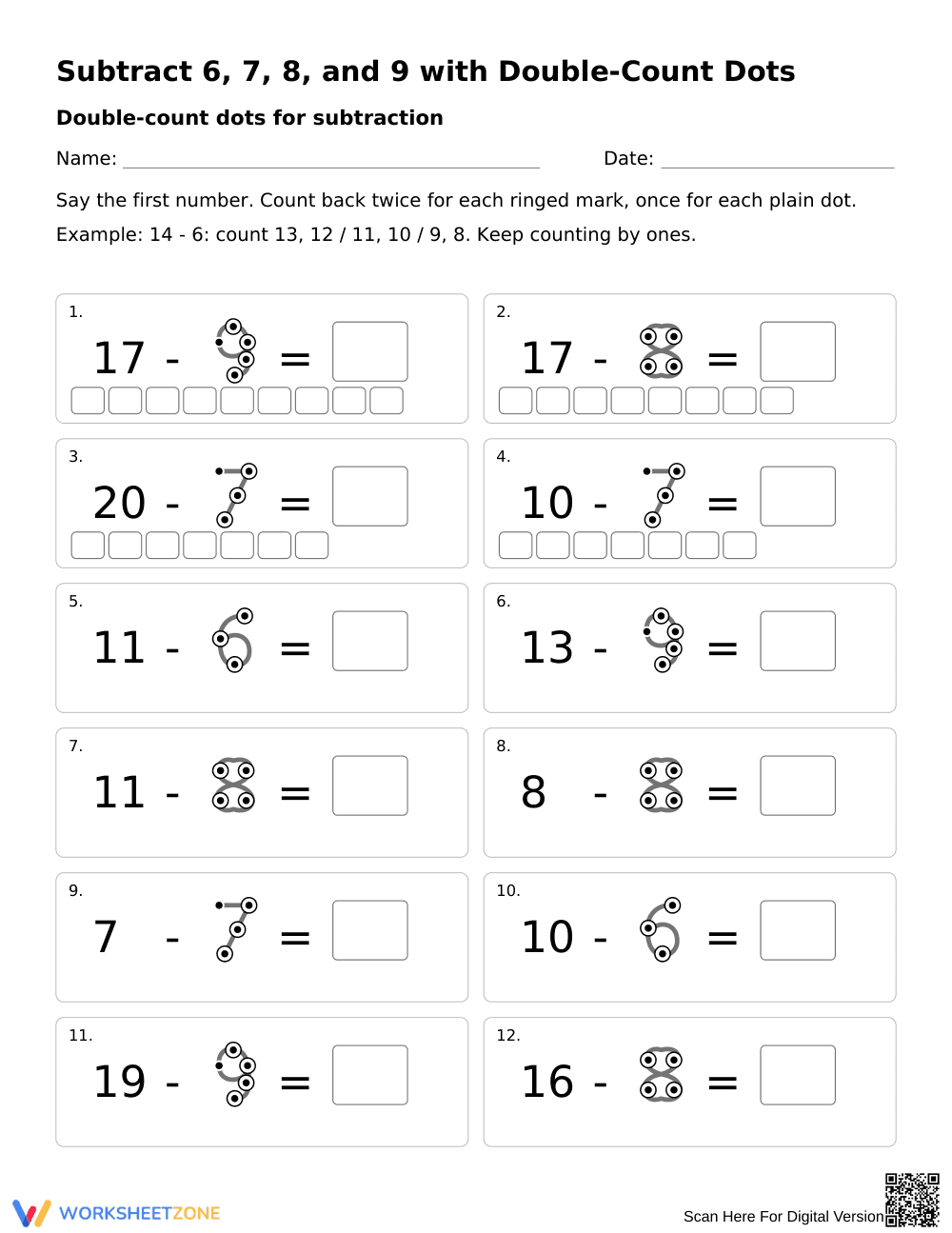
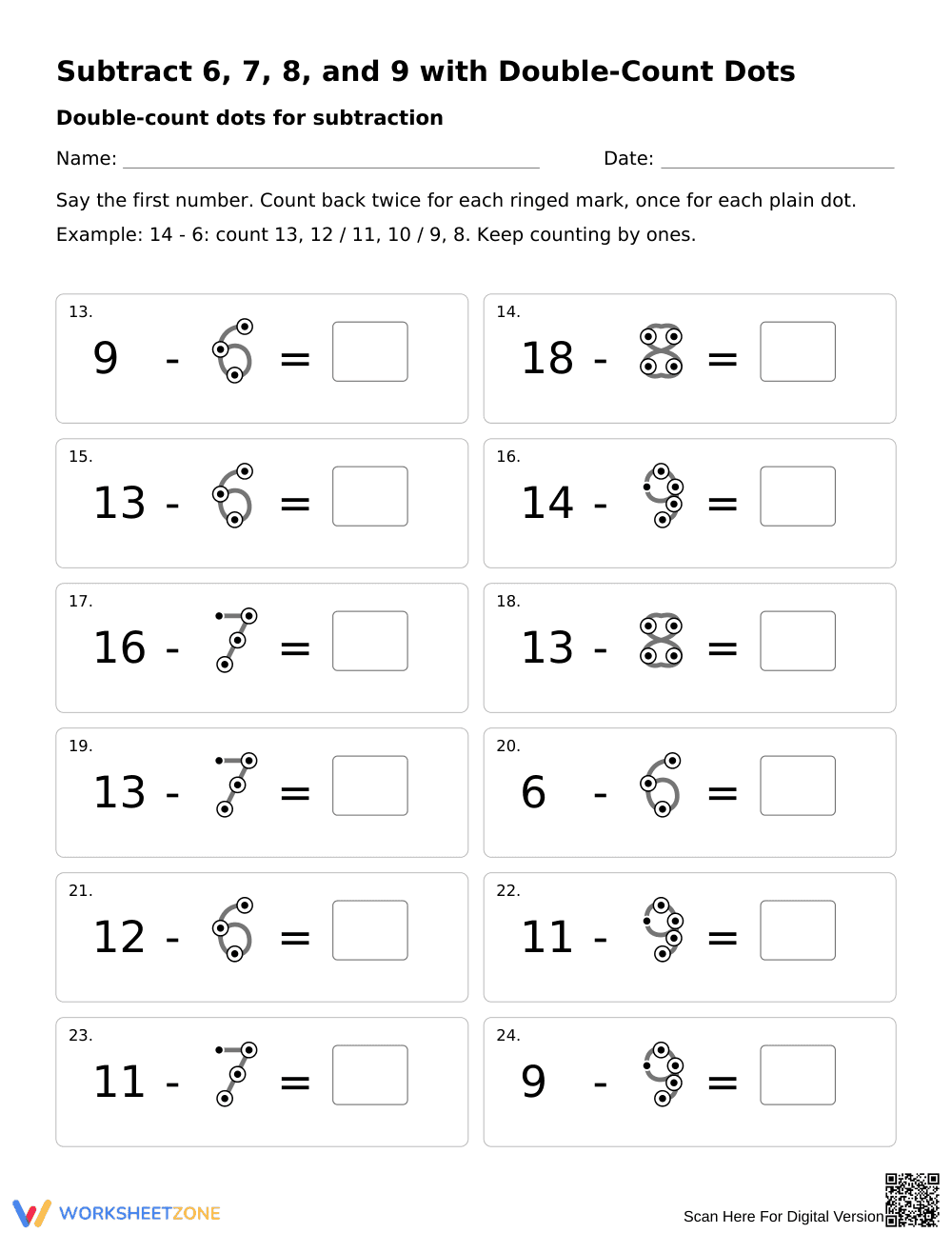
This focused subtraction worksheet helps first-grade students master counting back by using double-count dots. By visually guiding learners through the subtraction process for numbers 6, 7, 8, and 9, this resource builds foundational math fluency and ensures students can confidently solve equations within 20.
At a Glance
- Grade: 1 · Subject: Math
- Standard:
1.OA.C.6— Subtract within 20 using counting back strategies- Skill Focus: Subtracting 6, 7, 8, and 9 with dots
- Format: 3 pages · 24 problems · Answer key included · PDF
- Best For: Independent practice and math centers
- Time: 15–20 minutes
This printable PDF includes two pages of targeted subtraction practice and a complete answer key. Students will work through 24 carefully structured equations, each featuring a subtrahend (6, 7, 8, or 9) with specialized double-count dots. The first page provides an explicit example showing how to say the first number and count back twice for each ringed mark, setting up a clear visual scaffold for independent success.
- Guided practice: The worksheet opens with a clear, worked example demonstrating the counting-back method, allowing teachers to model the strategy effectively.
- Supported practice: The first 12 problems provide immediate application of the visual dot strategy, reinforcing the physical act of counting back for larger single digits.
- Independent practice: The final 12 problems on the second page build stamina, encouraging students to internalize the counting rhythm.
This layout perfectly supports a gradual-release model, moving from "I Do" to "We Do" to "You Do" within a single lesson.
This resource is directly aligned to 1.OA.C.6: Add and subtract within 20, demonstrating fluency for addition and subtraction within 10, using strategies such as counting on and counting back. It also supports second-grade review for fluently subtracting within 20 using mental strategies. Both standard codes can be copied directly into lesson plans, IEP goals, or district curriculum mapping tools.
Use this worksheet during math instruction after a mini-lesson on counting back. It serves as an excellent independent activity while the teacher pulls small groups for targeted intervention. Alternatively, use it as a focused morning work assignment to reinforce previously taught subtraction strategies. For formative assessment, observe students to ensure they touch the dots and count backward correctly, rather than guessing. Expect students to complete the 24 problems in approximately 15 to 20 minutes.
This is ideal for first graders developing subtraction fluency, and second graders needing scaffolding for subtracting within 20. The visual dot strategy is particularly beneficial for tactile and visual learners, or students receiving special education support who require concrete methods for abstract math concepts. Pair this worksheet with a classroom anchor chart demonstrating the double-count dot method for maximum impact.
Mastering subtraction strategies like counting back is a critical milestone in early elementary mathematics. This worksheet aligns with standard 1.OA.C.6, helping students subtract within 20 using counting back strategies. According to the RAND AIRS 2024 report on effective math interventions, providing explicit, visually scaffolded strategies significantly improves computational fluency and reduces cognitive load during independent problem-solving. By utilizing double-count dots, learners effectively bridge the gap between concrete manipulatives and abstract mental math, fostering deeper numerical comprehension. The structured repetition of 24 targeted problems ensures that students internalize the counting-back rhythm, ultimately leading to greater automaticity and math confidence. Incorporating these evidence-based visual cues into daily practice empowers young learners to tackle complex subtraction tasks with accuracy, laying a robust foundation for future algebraic thinking and advanced operations.


