





























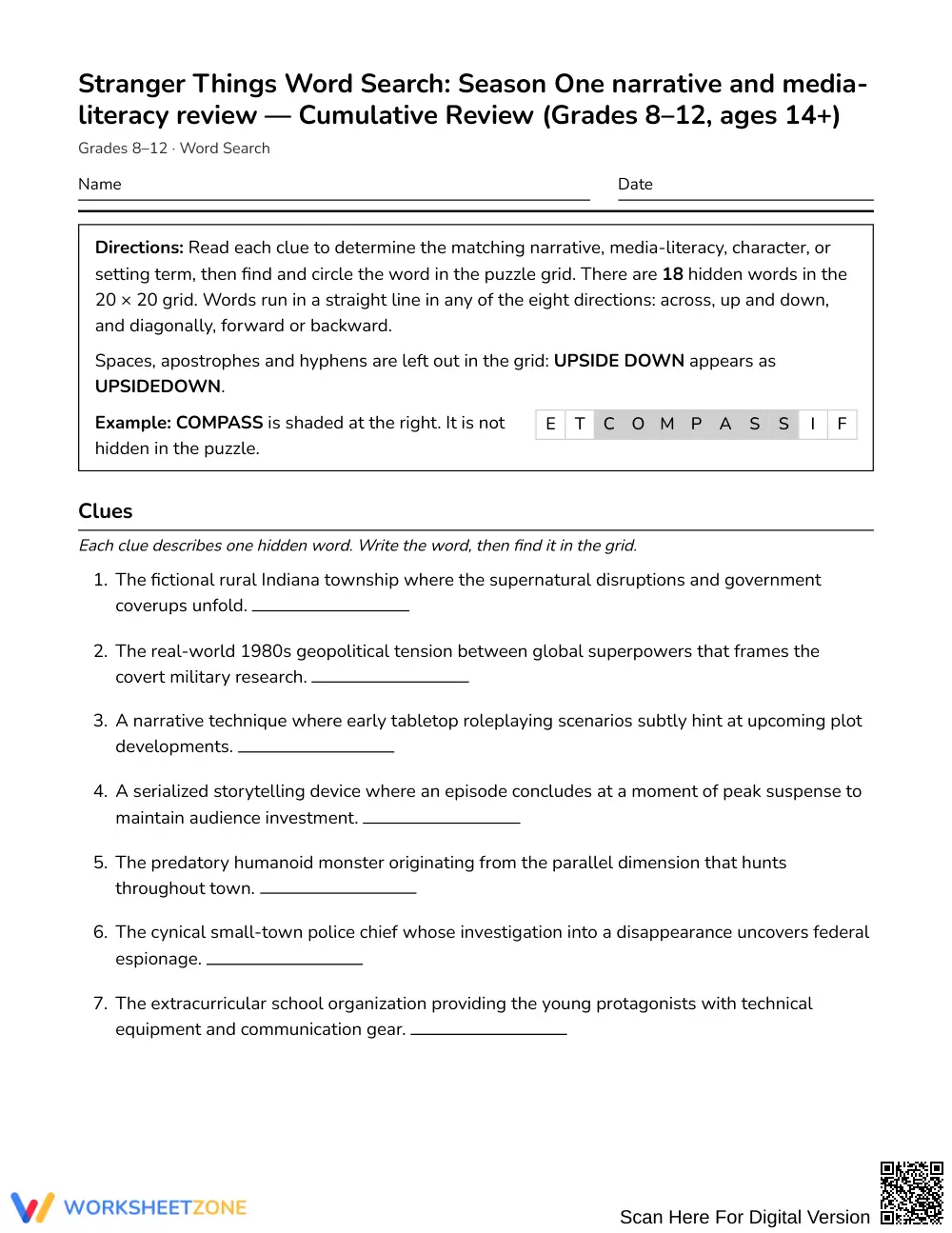


Printable Stranger Things Word Search | Grades 8–12 ELA

Paste this activity's link or code into your existing LMS (Google Classroom, Canvas, Teams, Schoology, Moodle, etc.).
Students can open and work on the activity right away, with no student login required.
You'll still be able to track student progress and results from your teacher account.
This Stranger Things word search reinforces season one narrative concepts and media-literacy vocabulary for Grades 8–12 English Language Arts students. Learners analyze descriptive clues to identify critical story elements, character arcs, and cinematic devices before locating each term in the puzzle grid, transforming passive word finding into an active vocabulary review.
At a Glance
- Grade: Grades 8–12 · Subject: English Language Arts (ELA)
- Standard: Not standards-assessed — vocabulary enrichment
- Skill Focus: Season one narrative review and media-literacy vocabulary
- Format: 3 pages · 18 words · Full answer key included · Printable PDF
- Best For: Post-viewing synthesis, narrative unit review, or substitute lesson plans
- Time: 25–35 minutes
What's Inside
This 3-page printable activity features 18 hidden vocabulary terms embedded within a dense word search accompanied by contextual clues. Rather than presenting a simple word search with an exposed list, this resource challenges students to read literary definitions covering devices like foreshadowing, cliffhangers, and motifs, alongside key historical references such as the Cold War. A shuffled word bank provides reference support, and a complete 4-page answer key provides immediate verification for teachers and students.
Puzzle Mechanics
The activity is built upon a 20 x 20 letter grid containing 18 hidden vocabulary words positioned across all eight compass directions: north, northeast, east, southeast, south, southwest, west, and northwest. Students read each clue to deduce the target narrative or media-literacy concept, check their thinking against a shuffled word bank, and track the word through horizontal, vertical, and diagonal paths.
Standards Alignment
This resource serves as targeted vocabulary enrichment and is not aligned to a specific academic standard. It provides cross-curricular enrichment connecting literary analysis, storytelling devices, and pop-culture media studies without requiring standardized code tracking.
How to Use It
Deploy this word search after completing a narrative reading or media-analysis unit to consolidate student mastery of storytelling conventions. Alternatively, assign it as a high-engagement substitute lesson plan that keeps learners focused on literary terminology. As students work, circulate to observe whether they deduce vocabulary terms directly from the clue descriptions or rely immediately on the shuffled bank. Students typically complete the puzzle in 25 to 35 minutes.
Who It's For
This activity is designed for Grades 8–12 English Language Arts students, elective film studies classes, and creative writing seminars. Teachers can differentiate by having advanced learners identify the 18 terms using only the clue definitions before consulting the shuffled word bank. Pair this activity naturally with a narrative elements anchor chart or a film-analysis graphic organizer exploring suspense and motifs.
Designed for Grades 8–12 English Language Arts classrooms, this non-standards-assessed vocabulary enrichment activity delivers a comprehensive season one narrative and media-literacy review. Students engage in purposeful vocabulary retrieval across an 18-word puzzle featuring literary devices, character functions, and historical motifs. According to Fisher & Frey (2014), intentional word-learning tasks that require learners to process conceptual definitions before conducting an orthographic search significantly improve domain-specific vocabulary retention compared to rote memorization worksheets. By embedding rich narrative clue definitions within a 20 x 20 puzzle grid, this learning resource prompts secondary students to connect theoretical storytelling terminology, such as foreshadowing, motifs, and cliffhangers, with concrete narrative examples. The format strengthens critical media analysis, supports high-interest review, and offers structured practice that bridges popular culture with rigorous English Language Arts vocabulary acquisition in secondary classrooms.


