































Printable Sonic Characters Word Search | Grades 2–3 ELA

Paste this activity's link or code into your existing LMS (Google Classroom, Canvas, Teams, Schoology, Moodle, etc.).
Students can open and work on the activity right away, with no student login required.
You'll still be able to track student progress and results from your teacher account.
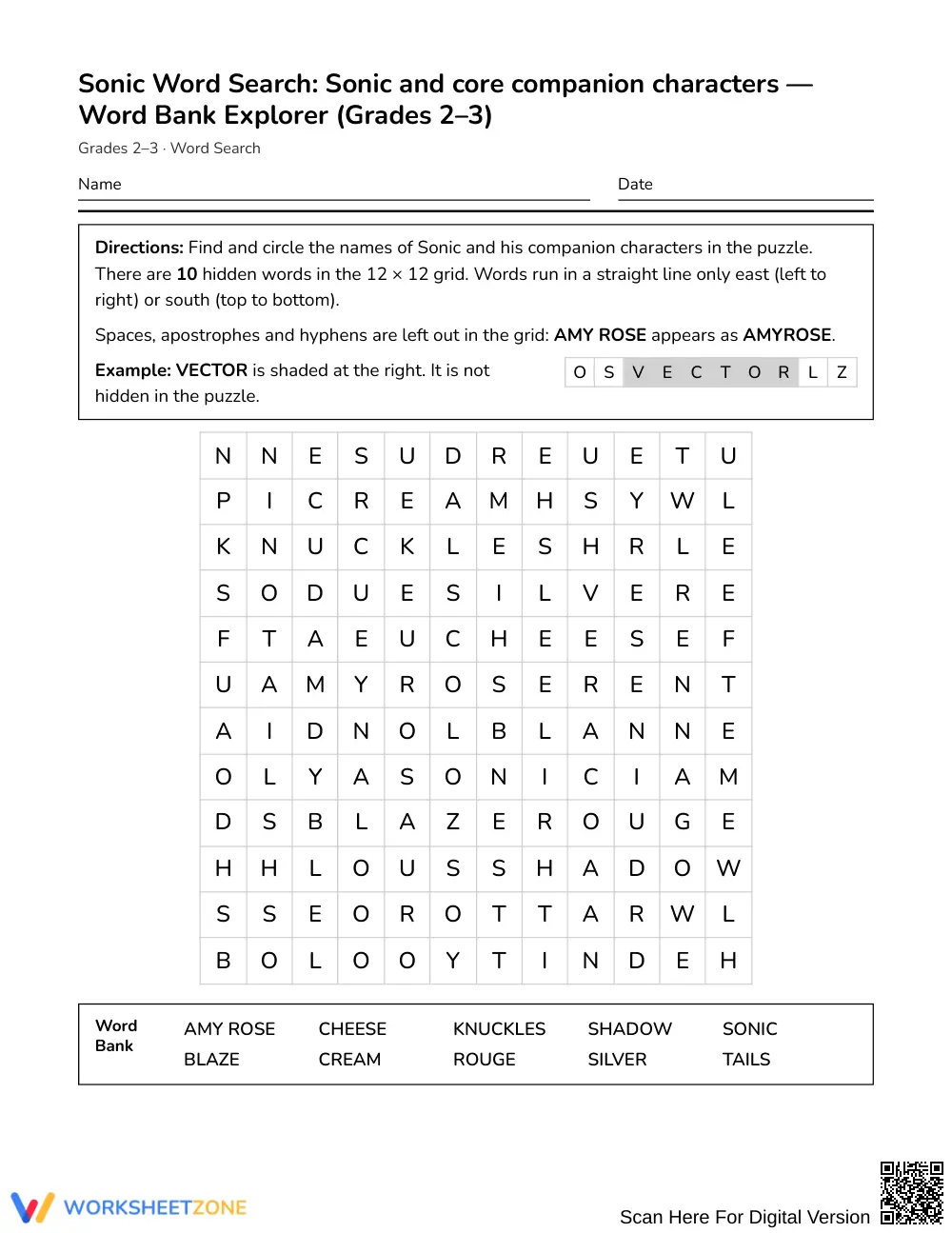
This Grades 2–3 English Language Arts word search engages young learners with 10 hidden vocabulary words celebrating Sonic and his companion characters. Students strengthen visual scanning, letter sequence recognition, and spelling retention as they locate each character name in an accessible, game-based format designed for immediate classroom participation.
At a Glance
- Grade: Grades 2–3 · Subject: ELA
- Standard:
N/A— Not standards-assessed — vocabulary enrichment- Skill Focus: Sonic and core companion characters
- Format: 1 pages · 10 words · Answer key included · PDF
- Best For: Early finisher and vocabulary enrichment activity
- Time: 15–20 minutes
What's Inside: The single-page puzzle presents a 12 by 12 letter grid containing 10 target character names. An alphabetical word bank guides student searching alongside descriptive character blurbs for added context. A clear 3-page solution key shows exact letter placements for swift checking.
Puzzle Mechanics
Designed specifically for emerging readers in second and third grade, this puzzle utilizes a friendly 12 by 12 grid layout. Hidden character names run in only two directions: horizontally from left to right (East) and vertically downward (South). No backwards or diagonal placements are used, preventing visual frustration while reinforcing standard reading orientations. Students reference an alphabetical word bank featuring heroes and companions such as Tails, Knuckles, Amy Rose, and Shadow.
Standards Alignment
This activity provides high-interest vocabulary enrichment and is not aligned to a formal academic standard. It supports foundational orthographic awareness and letter pattern recognition without requiring standardized testing metrics.
How to Use It
Distribute this printable during morning arrival, transitions, or post-testing quiet time to give students calm, focused language practice. Teachers can conduct a quick formative visual check by scanning completed highlighters across student papers to verify directionality tracking. The entire activity typically requires 15 to 20 minutes to complete.
Who It's For
This activity suits second and third graders building word-recognition fluency who benefit from engaging pop-culture connections. It pairs naturally with independent reading logs, character trait anchor charts, or creative writing mini-lessons exploring fictional heroes.
According to Fisher & Frey (2014), purposeful vocabulary exposure during low-stakes enrichment activities reinforces orthographic mapping and helps developing readers secure unfamiliar multi-syllabic letter sequences into long-term memory. While this puzzle serves as recreational vocabulary enrichment rather than a standards-assessed assessment, structured word searches actively recruit executive function through systematic horizontal and vertical visual scanning. Young learners in Grades 2–3 benefit from focused searches constrained to East and South directions, which mirror left-to-right and top-to-bottom print tracking. Locating high-interest proper nouns like Sonic, Knuckles, and Shadow builds spelling automaticity and pattern confidence. By integrating an alphabetical word bank and accompanying character descriptions, educators give emergent readers meaningful contextual anchors that support independent print interaction without cognitive overload.


