





























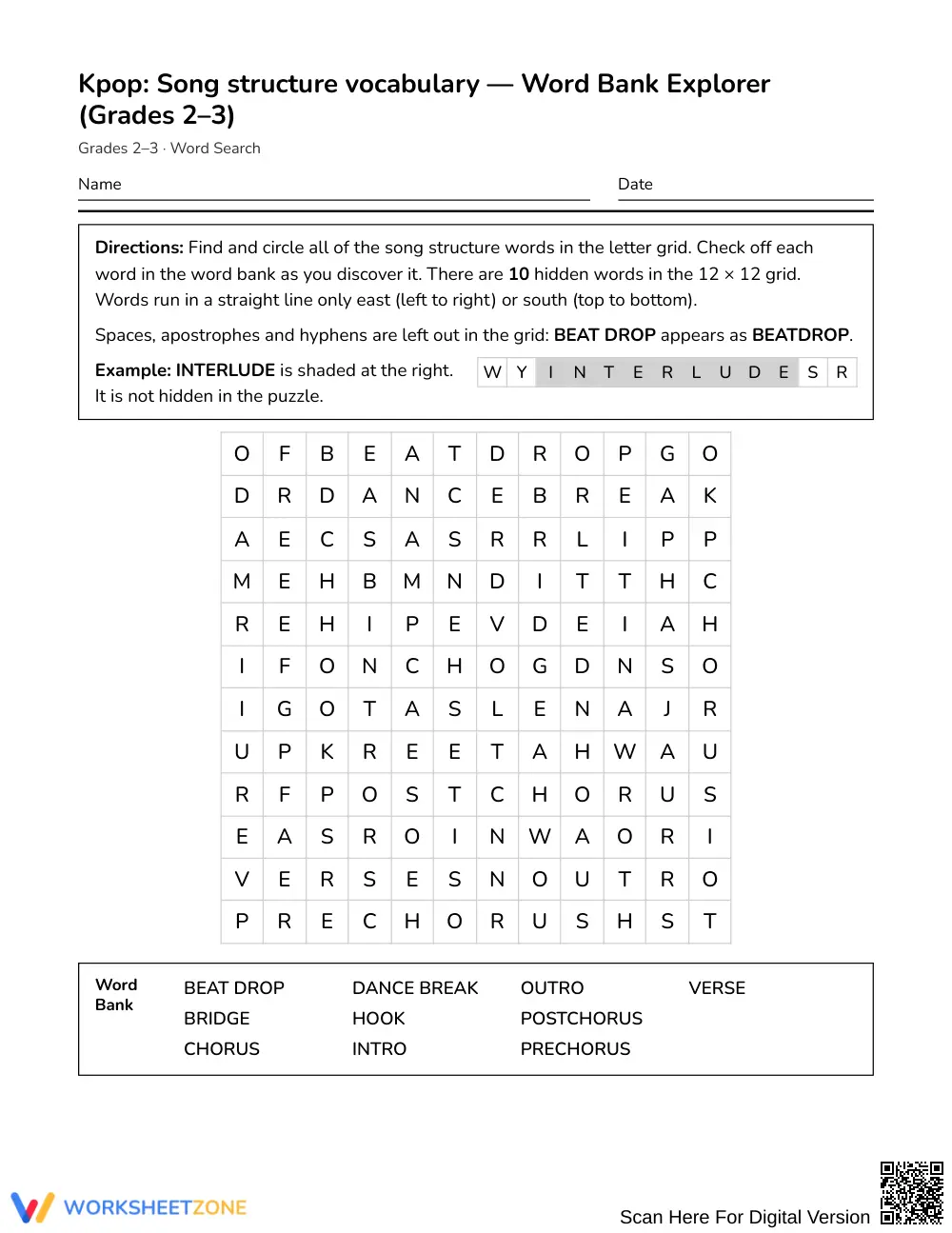


Printable Song Structure Word Search | Grades 2–3 Fine Art

Paste this activity's link or code into your existing LMS (Google Classroom, Canvas, Teams, Schoology, Moodle, etc.).
Students can open and work on the activity right away, with no student login required.
You'll still be able to track student progress and results from your teacher account.
This printable Fine Art word search introduces early elementary learners to foundational music terminology through modern popular music concepts. Students build recognition of ten essential arrangement elements—such as chorus, hook, and intro—while strengthening spelling and visual tracking skills. The self-guided format offers engaging vocabulary enrichment that connects classroom music concepts to songs students hear every day.
At a Glance
- Grade: Grades 2–3 · Subject: Fine Art
- Standard: Not standards-assessed — vocabulary enrichment
- Skill Focus: song structure vocabulary
- Format: 1 pages · 10 words · Answer key included · PDF
- Best For: Music centers, early finishers, sub plans
- Time: 15–25 minutes
What's Inside: The single-page activity sheet contains an organized letter search featuring 10 hidden vocabulary terms alongside student-friendly descriptions of each musical section. An alphabetical word bank supports tracking, and a comprehensive 3-page solution key provides complete letter-level coordinates for swift verification during independent or group work.
Puzzle Mechanics
Designed specifically for early readers in Grades 2–3, this puzzle utilizes a focused 12 x 12 letter grid. All 10 hidden terms run exclusively in two accessible directions: left-to-right horizontally (East) and top-to-bottom vertically (South). There are no backwards or diagonal placements, minimizing visual frustration. Students scan the grid using the alphabetical bank and review contextual clues that explain how parts like verses and beat drops function in contemporary songwriting.
Standards Alignment
This activity serves as supplemental vocabulary enrichment and is not aligned to a specific state or national fine arts standard. It enriches general music curricula by introducing contemporary music terminology in an accessible, low-stakes format suitable for interdisciplinary learning.
How to Use It
Deploy this activity during the listening portion of a music lesson or as an independent music station after introducing basic song forms. Teachers can invite learners to identify parts in an age-appropriate track before locating the terms in the grid. Formatively, observe whether students cross-reference the descriptive clues to reinforce their understanding of what each musical section does. Typical completion time spans 15 to 25 minutes.
Who It's For
This resource is tailored for elementary music classrooms, general elementary fine arts blocks, and homeschool units covering modern performance arts. It provides accessible reinforcement for emerging readers and English learners through predictable search directions and pairs naturally with a guided song-mapping listening lesson or anchor charts illustrating pop song anatomy.
According to research from Fisher & Frey (2014) on purposeful language instruction, integrating domain-specific terminology through motivating, thematic contexts accelerates receptive word acquisition in elementary learners. Providing explicit exposure to song structure vocabulary—including core terms such as bridge, intro, verse, and chorus—anchors abstract auditory concepts in visual, print-rich media. While non-evaluative word puzzles operate outside standardized testing frameworks, they offer crucial low-anxiety exposure that supports contextual retention and listening comprehension in fine arts education. Early learners benefit significantly from decoding subject-specific vocabulary in straightforward letter configurations that reinforce left-to-right and top-to-bottom spatial awareness without unnecessary visual clutter.


