





























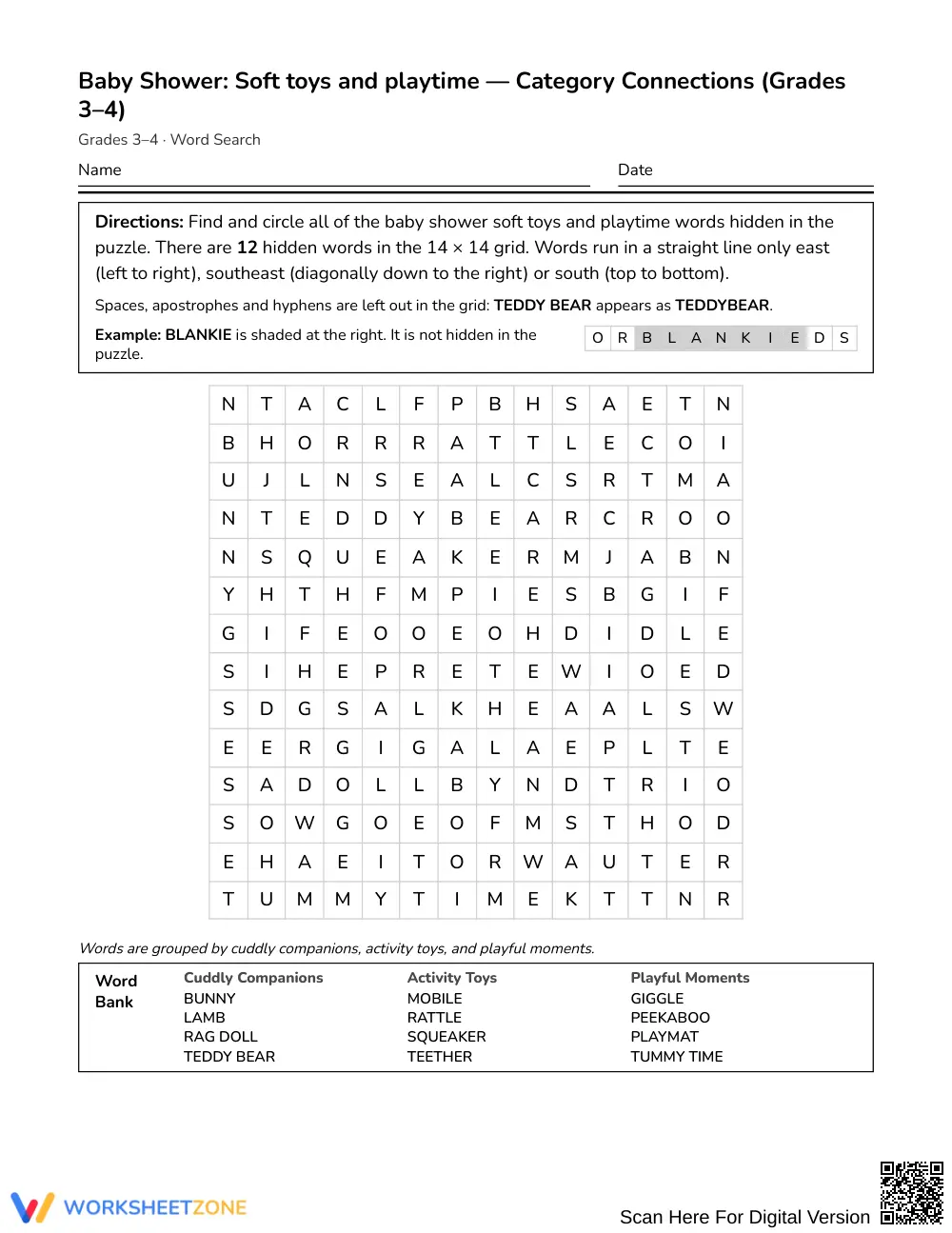


Printable Soft Toys Word Search | Grades 3–4 ELA

Paste this activity's link or code into your existing LMS (Google Classroom, Canvas, Teams, Schoology, Moodle, etc.).
Students can open and work on the activity right away, with no student login required.
You'll still be able to track student progress and results from your teacher account.
This printable Grades 3–4 ELA word search builds themed vocabulary recognition around soft toys and infant playtime. Students locate 12 essential terms organized into clear developmental categories, strengthening orthographic awareness and contextual association through focused word hunting. It provides engaging language reinforcement that supports spelling fluency, categorization habits, and active visual scanning.
At a Glance
- Grade: Grades 3–4 · Subject: English Language Arts (ELA)
- Standard: Not standards-assessed — vocabulary enrichment and spelling practice
- Skill Focus: Soft toys and playtime categorical vocabulary recognition
- Format: 1 student page · 12 words · 3-page answer key included · Printable PDF
- Best For: Vocabulary enrichment, independent literacy centers, and fast-finisher practice
- Time: 15–20 minutes
What's Inside
This single-page activity sheet features a 12-word vocabulary search supported by a 3-page answer key that displays exact letter placements for immediate verification. The student page organizes target vocabulary under three meaningful category headers: cuddly companions, activity toys, and playful moments. Each term is paired with a clear, kid-friendly definition clue that explains the item's function or sensory qualities, transforming a traditional letter hunt into an informative reading exercise.
Puzzle Mechanics and Structure
The puzzle is built on a compact 14 x 14 letter grid designed specifically for intermediate elementary learners. All 12 hidden terms run in three predictable orientations: East (horizontally from left to right), Southeast (diagonally downward), and South (vertically from top to bottom). Words never run backward or upward, maintaining an accessible search path that prevents frustration. Students refer to the categorized word bank and accompanying descriptive clues to confirm definitions before tracking letter sequences through the grid.
Standards Alignment
This resource serves as targeted vocabulary enrichment and is not aligned to a specific state or national curriculum standard. Instead of formal standards assessment, it provides supplemental lexical exposure that builds category knowledge, print awareness, and spelling confidence across general elementary language arts instruction.
How to Use It
Deploy this activity as an independent warm-up before a themed writing workshop or as quiet seatwork after direct instruction on sensory adjectives. As students work, circulate formatively to observe whether they scan using initial consonant blends or cross-check the category headings for contextual cues. Most third and fourth graders will finish the search within 15 to 20 minutes.
Who It's For
This word search is designed for students in Grades 3–4 developing spelling recall and conceptual grouping skills. It offers gentle scaffolding for emerging readers who benefit from constrained search directions and contextual definitions. Pair this puzzle with an informative mentor text about infant development or a descriptive writing mini-lesson on childhood toys.
While not tied to an individual standard code, this Grades 3–4 vocabulary enrichment word search reinforces domain-specific terminology through contextual categorization and orthographic scanning. According to Fisher & Frey (2014), intentional exposure to grouped Tier 2 and themed Tier 3 vocabulary accelerates lexical acquisition by anchoring novel terms within established conceptual frameworks. By organizing twelve play-related words into categories such as cuddly companions and activity toys, the activity guides learners to connect definitions with physical attributes rather than memorizing isolated letter strings. The unidirectional layout (East, Southeast, and South) reinforces standard left-to-right reading habits without visual fatigue, allowing third and fourth graders to consolidate spelling patterns independently. Whether utilized during morning entry routines, literacy stations, or sub plans, this one-page puzzle offers evidence-based vocabulary practice that builds word consciousness and reading engagement across diverse elementary learning environments.


