


























Views
Downloads

Printable Sign & Interval Error Worksheet | Grade 12 Physics
Paste this activity's link or code into your existing LMS (Google Classroom, Canvas, Teams, Schoology, Moodle, etc.).
Students can open and work on the activity right away, with no student login required.
You'll still be able to track student progress and results from your teacher account.
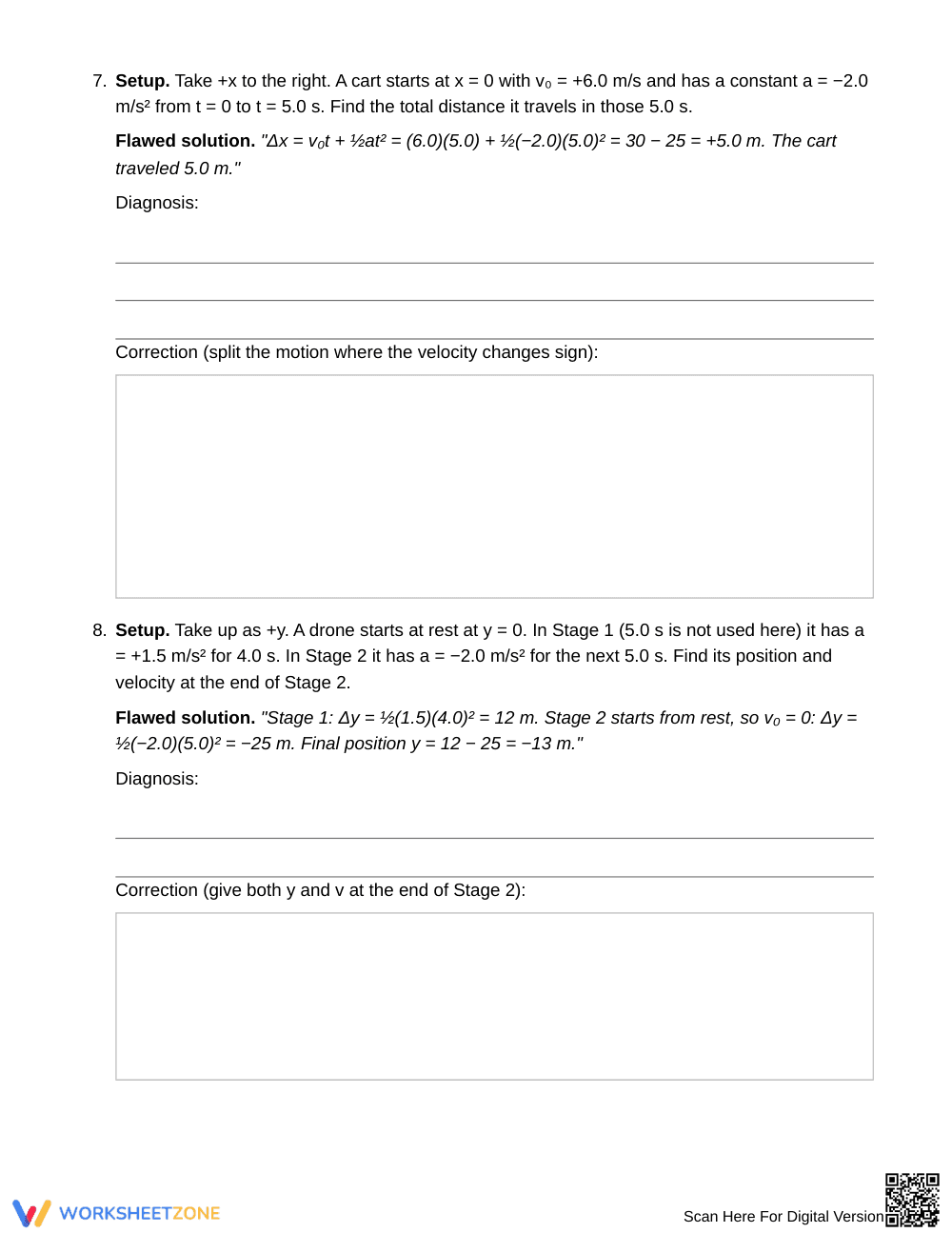
This Grade 12 physics worksheet teaches students to find and correct sign and interval errors in kinematics solutions. Students diagnose eight flawed solutions, explain each mistake, and write corrected work with units, building the habit of checking axis direction, time intervals, and stage boundaries before trusting an answer.
At a Glance
- Grade: 12 · Subject: Physics
- Standard: Kinematics, one-dimensional motion — students diagnose and repair flawed solutions
- Skill Focus: Correcting sign and interval errors in kinematics
- Format: 5 pages · 8 problems · Answer key included · PDF
- Best For: Error analysis after kinematics instruction
- Time: 40–50 minutes
What's Inside
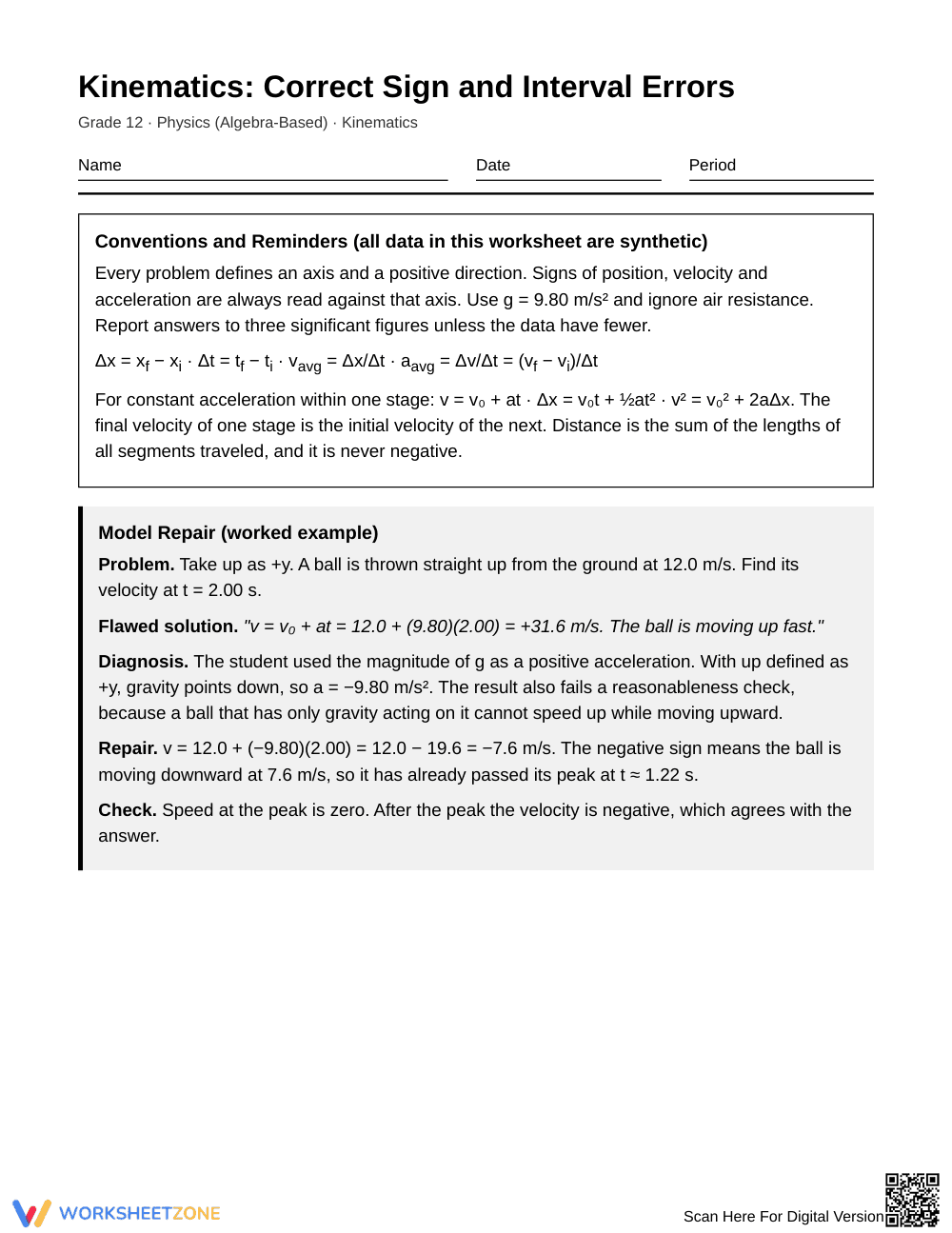
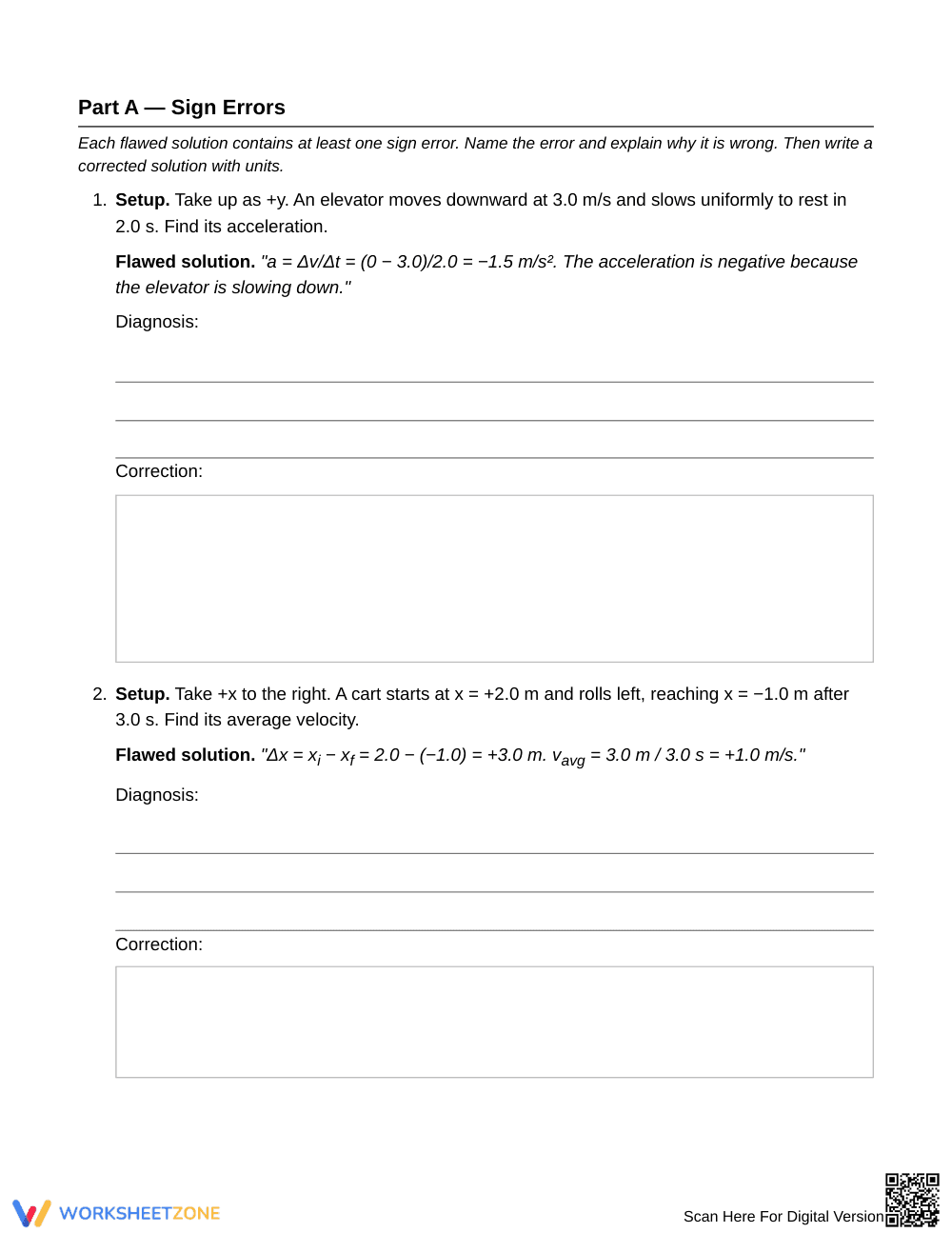
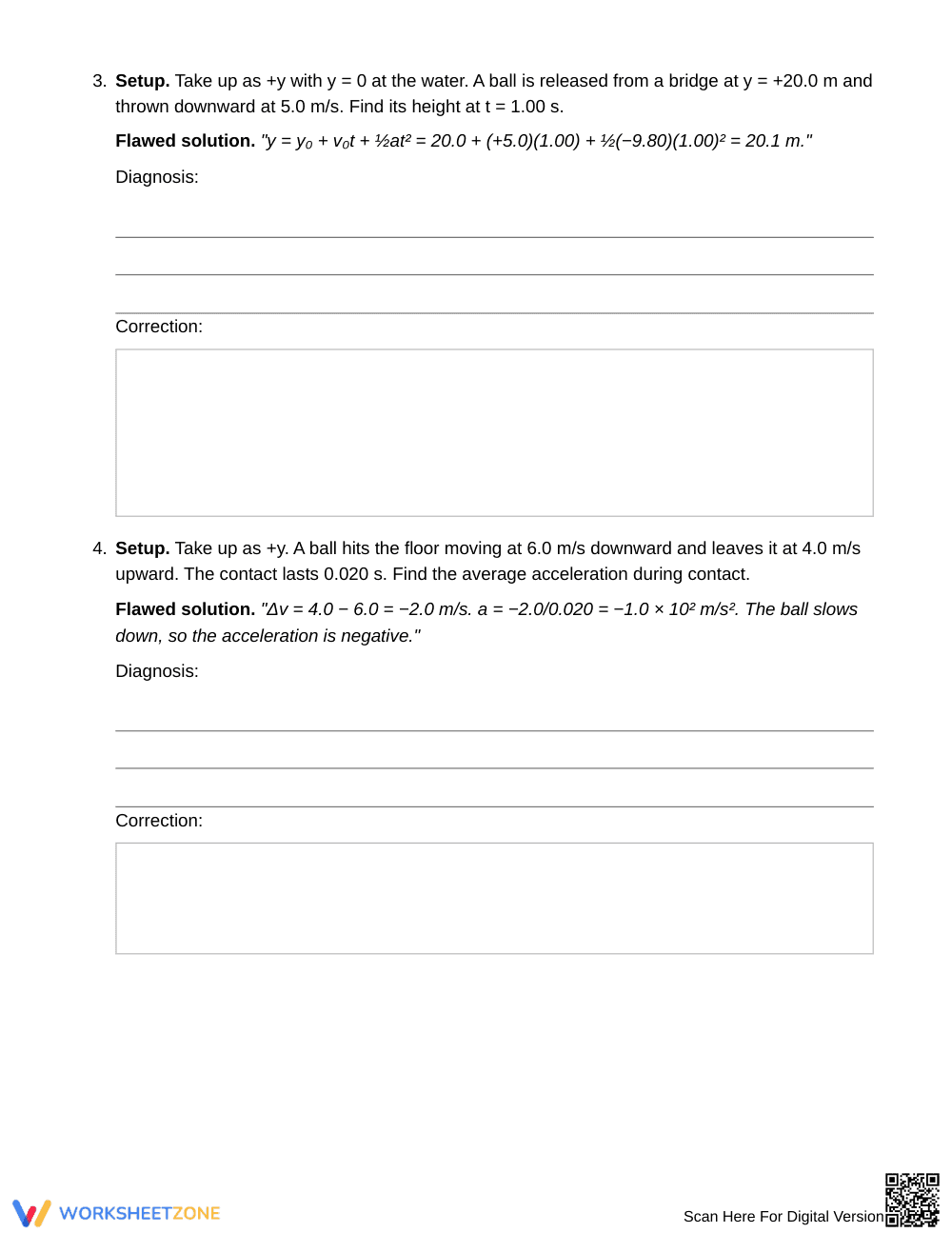
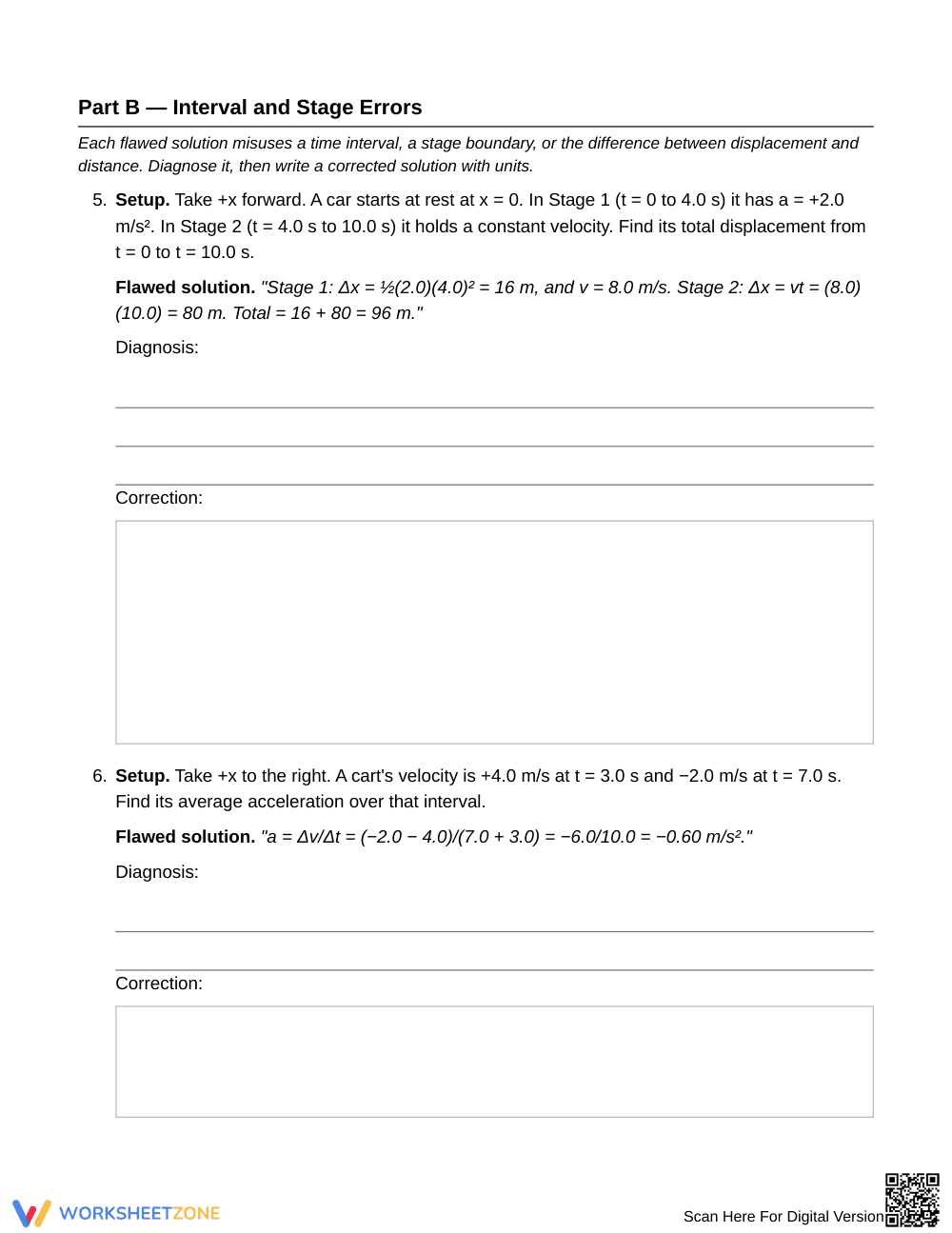
The 5-page PDF opens with a conventions box and one worked Model Repair example, then presents Part A (4 sign-error problems) and Part B (4 interval and stage problems). Each problem gives a setup, a flawed solution, and labeled lines for Diagnosis and Correction. A 3-page answer key is included.
Skill Progression
- Guided practice: 1 worked example shows the flawed solution, diagnosis, repair, and check.
- Supported practice: 4 Part A problems isolate sign errors in acceleration, displacement, position, and velocity change, with Diagnosis and Correction lines.
- Independent practice: 4 Part B problems add multi-stage motion, time intervals, and distance versus displacement, with only light prompts.
The sequence follows gradual release: I do, we do, you do.
Standards Alignment
No standard code was supplied for this worksheet. The tasks align with high school physics expectations for one-dimensional kinematics: treating displacement, velocity, and acceleration as signed quantities and applying constant-acceleration equations stage by stage. Add your district's code when copying into lesson plans, IEP goals, or curriculum maps.
How to Use It
- After direct instruction: assign as independent practice once students have seen the constant-acceleration equations. Expect 40–50 minutes.
- Before a unit test: use Part A and Part B in pairs as review, about 30–40 minutes.
Formative tip: while students work, check whether they sketch the axis and mark the positive direction before correcting the numbers.
Who It's For
Grade 12 algebra-based physics students who substitute into equations without checking direction. For extra support, complete the worked example together and assign Part A first. For extension, ask students to write their own flawed solutions. Pair with a velocity-time graph anchor chart.
Correct Sign and Interval Errors is a Grade 12 algebra-based physics worksheet on kinematics. Students analyze 8 flawed solutions, name each sign, interval, stage, or distance-versus-displacement error, and write a corrected solution with units. Every problem fixes an axis and positive direction, so students learn to read position, velocity, and acceleration signs against that axis and to carry the final velocity of one stage into the next. The format reflects the gradual release of responsibility described by Fisher & Frey (2014): a worked example, four supported problems, and four independent problems. The 5-page PDF includes a 3-page answer key and takes about 40 to 50 minutes. Teachers can use it after direct instruction, as test review, or as a formative check of whether students reason about direction before substituting numbers into equations.


