































Printable Series Circuit Worksheet | Grade 8–12 Science

Paste this activity's link or code into your existing LMS (Google Classroom, Canvas, Teams, Schoology, Moodle, etc.).
Students can open and work on the activity right away, with no student login required.
You'll still be able to track student progress and results from your teacher account.
Opening
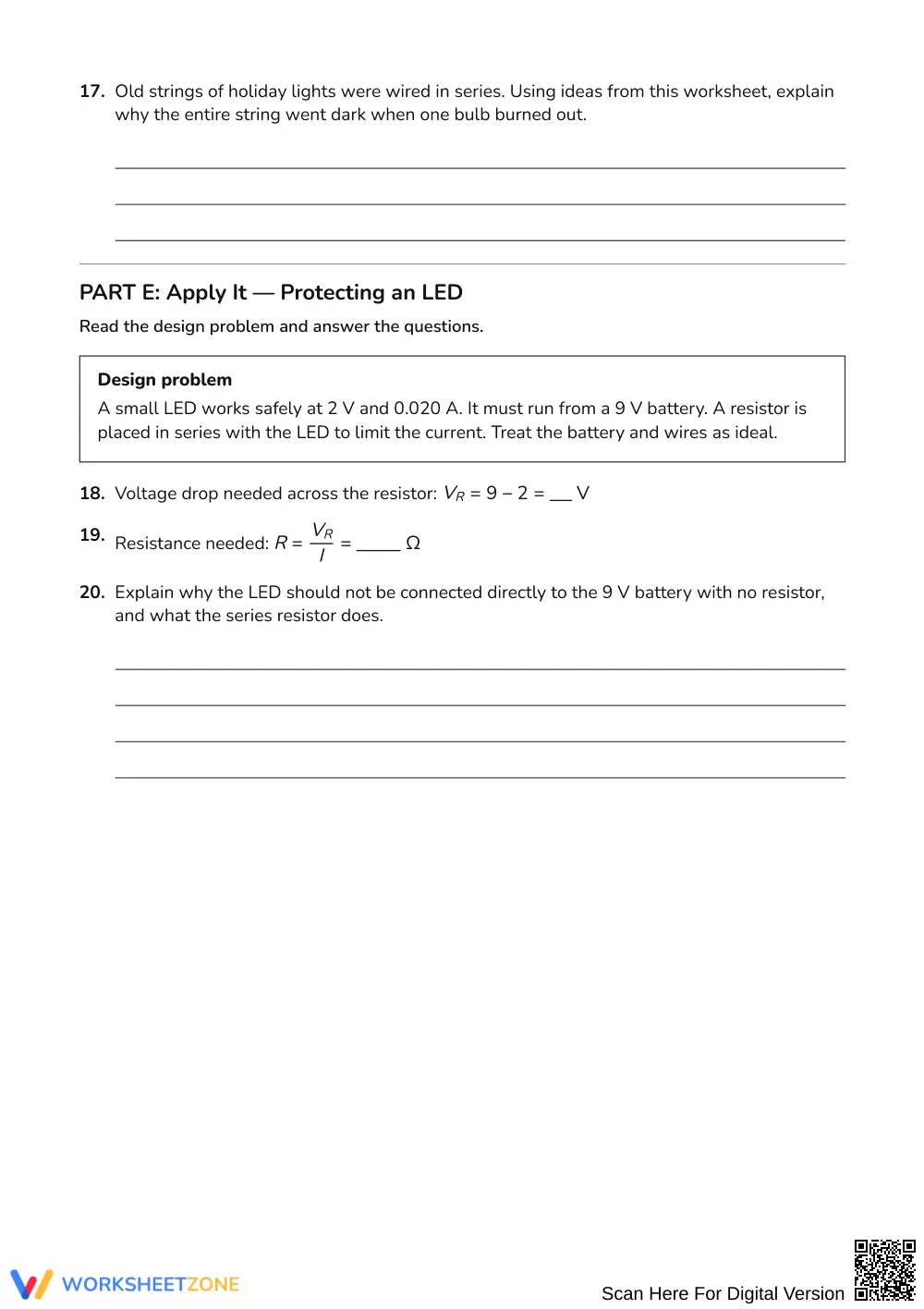
Students use this 4‑page worksheet to apply series‑circuit principles, calculate voltage drops, current, and power, and explain how adding components changes circuit behavior. The guided application builds confidence in quantitative reasoning and scientific explanation. It also connects real‑world examples like holiday lights to reinforce conceptual understanding.
At a Glance
At a Glance
- Grade: Grades 8–12 · Subject: Science
- Standard:
— Analyze series circuits to predict voltage, current, and power changes under ideal conditions- Skill Focus: Series Circuit: Guided Application
- Format: 4 pages · 28 problems · Answer key included · PDF
- Best For: Classroom practice after direct instruction in small groups
- Time: 15–20 minutes
What’s Inside
Part A walks students through reading a circuit diagram and using V = I × R to label resistance, current, and voltage relationships. Part B asks them to fill a data table, explain why a larger resistor drops more voltage, and predict circuit behavior when a component fails. Part C extends the model by adding a new resistor and requires cause‑and‑effect reasoning. Part D interprets a graph of current versus added resistors, and Part E challenges learners to design a safe LED circuit with a series resistor. An answer key on a separate 4‑page PDF provides step‑by‑step solutions.
Skill Progression
- Guided practice (6 problems): includes a worked example and sentence frames to model each calculation step.
- Supported practice (10 problems): provides a word bank and partial scaffolds, prompting students to select the correct formula before solving.
- Independent practice (12 problems): full release tasks requiring students to apply the concepts without prompts.
This three‑stage release follows the classic I Do, We Do, You Do structure, gradually shifting responsibility to the learner.
Standards Alignment
` ` Students analyze series circuits, calculate voltage drops, current, and power, and explain the impact of adding or removing components. Supporting standards on electrical energy and circuit safety are addressed in the design‑problem section. Both standard ideas can be copied directly into lesson plans, IEP goals, or district curriculum mapping tools.
How to Use It
Use the worksheet after a short direct‑instruction lesson on Ohm’s Law: first, have students complete Part A as a quick check for diagram literacy; then, let them work through Parts B‑D in small groups to reinforce data‑interpretation skills. Finally, assign Part E as an exit activity where students design an LED circuit, observing how accurately they apply series‑circuit reasoning. Teacher observation of group discussions provides immediate formative feedback, and the entire sequence fits within a 45‑minute class period.
Who It’s For
This resource targets Grades 8‑12 science students who are ready for quantitative circuit work. While no formal differentiation levels are provided, the built‑in scaffolds (sentence frames, word bank) support learners who need extra guidance, and the independent section challenges advanced students. Pair it with an anchor chart on Ohm’s Law or a short video demonstration of series‑circuit experiments for a cohesive lesson.
Citation Capsule
Research shows that explicit, scaffolded practice in physics promotes deeper conceptual understanding (Fisher & Frey, 2014). This worksheet aligns with that evidence by guiding students through a series of increasingly independent tasks that require them to calculate voltage, current, and power in series circuits. By connecting abstract formulas to real‑world contexts such as holiday lights and LED design, learners practice the plain‑English skill of applying series‑circuit concepts to predict circuit behavior. The inclusion of an answer key supports immediate feedback, reinforcing mastery of the targeted standard.


