




























Views
Downloads


Printable Seasonal Foods Word Search | Grades 6–7 ELA

Paste this activity's link or code into your existing LMS (Google Classroom, Canvas, Teams, Schoology, Moodle, etc.).
Students can open and work on the activity right away, with no student login required.
You'll still be able to track student progress and results from your teacher account.
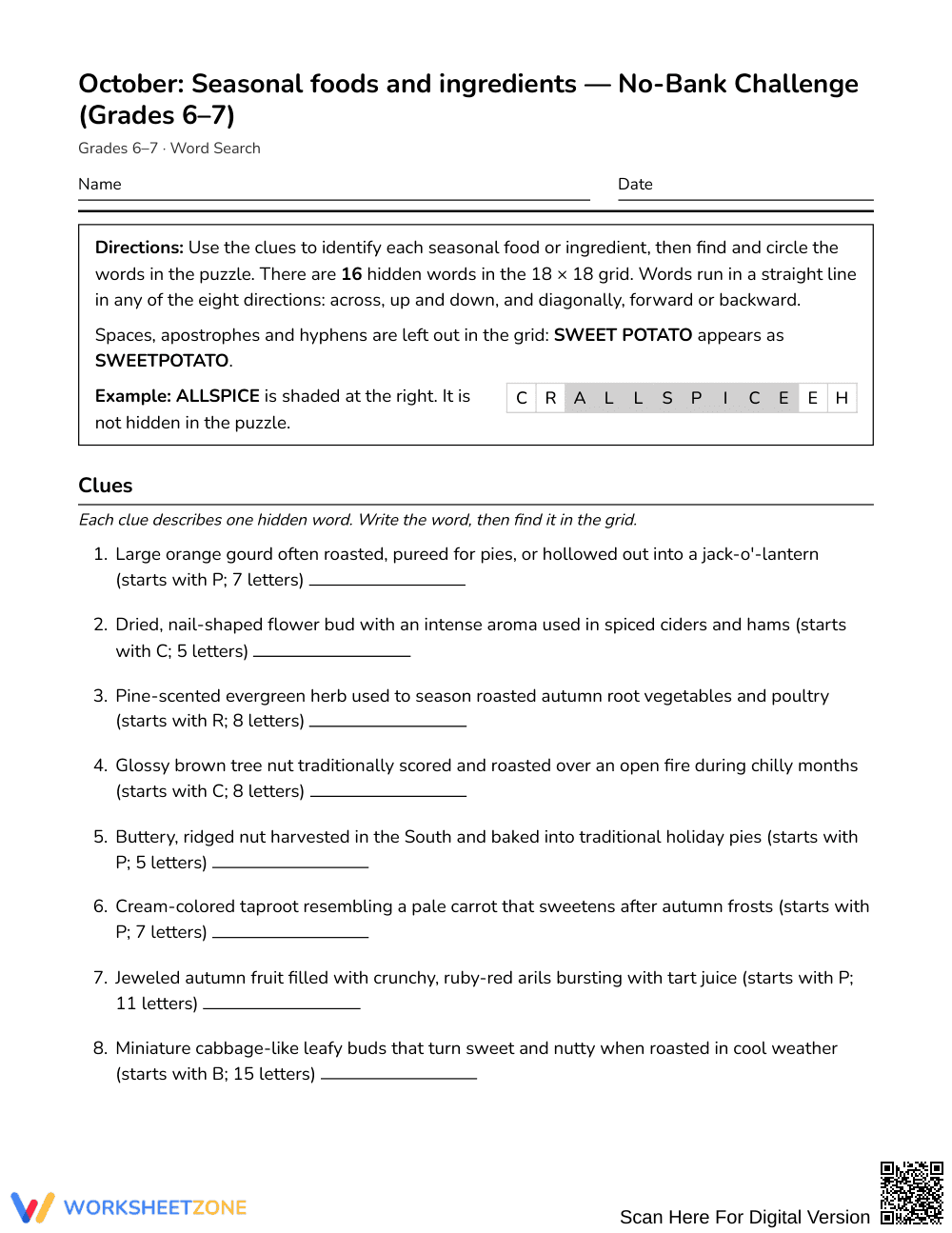
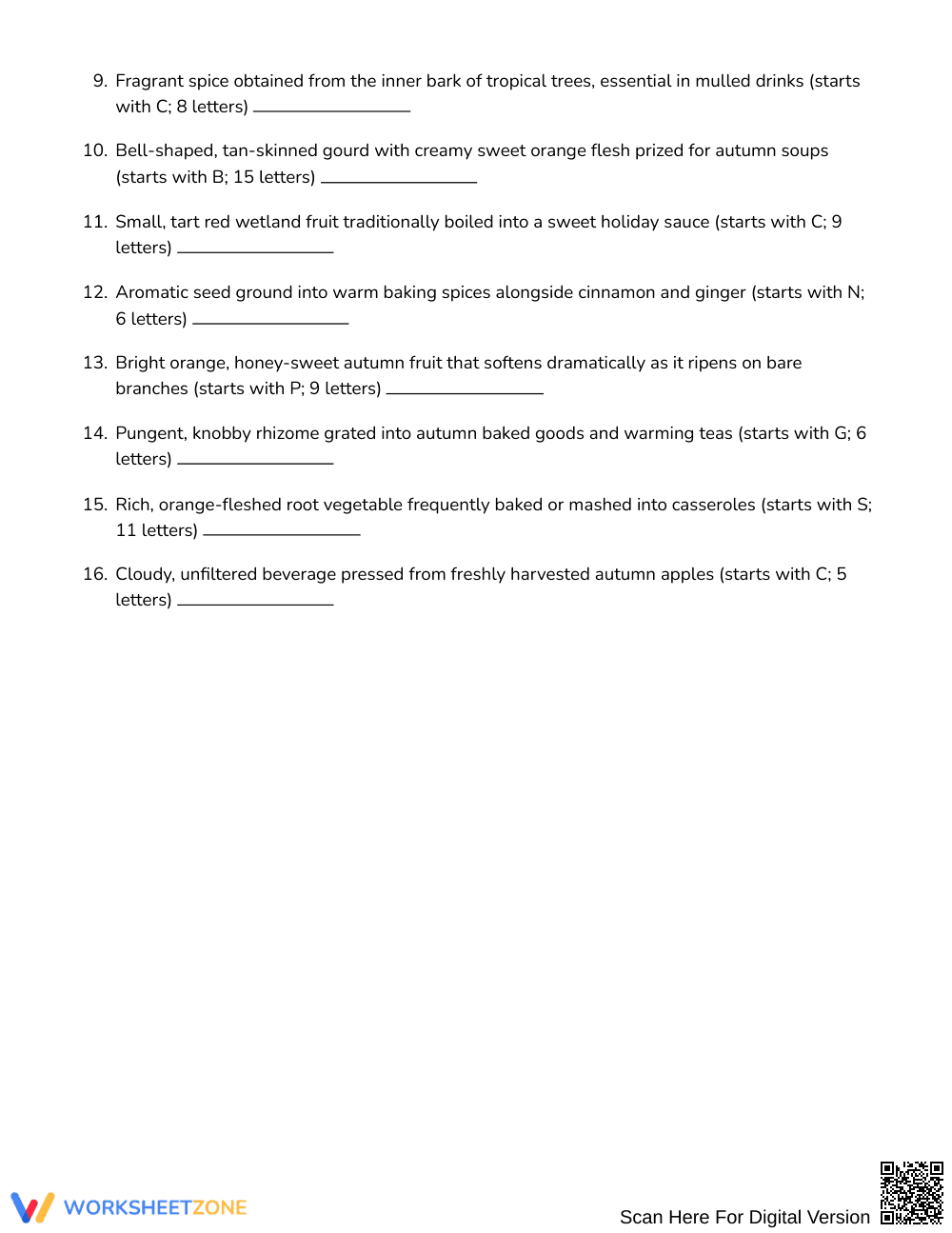
This Grades 6–7 English Language Arts word search challenges students to strengthen culinary and seasonal vocabulary through context clues. Rather than relying on a simple word bank, learners read descriptive clues to deduce 16 autumn ingredients before locating them in the puzzle grid. The activity reinforces reading comprehension, analytical inference, and contextual vocabulary acquisition.
At a Glance
- Grade: Grades 6–7 · Subject: English Language Arts
- Standard: Not standards-assessed — vocabulary enrichment
- Skill Focus: Seasonal foods and ingredients
- Format: 3 pages · 16 words · Answer key included · PDF
- Best For: October vocabulary enrichment and bell ringers
- Time: 20–35 minutes
What's Inside
This 3-page printable resource delivers an engaging no-bank challenge containing 16 hidden words related to autumn foods. Instead of scanning for listed terms, students read rich botanical and culinary clues describing produce such as persimmons, parsnips, and butternut squash. A comprehensive answer key highlights exact word placements across the puzzle layout for immediate verification.
Puzzle Structure and Mechanics
The activity operates on an 18 x 18 letter grid designed to test spatial and lexical recognition. Hidden vocabulary words run in all eight possible directions: north, northeast, east, southeast, south, southwest, west, and northwest. Because no pre-printed word bank appears on the student page, learners must solve each clue independently to identify target terms before searching the matrix.
Standards Alignment
This activity provides targeted vocabulary enrichment and is not aligned to a specific grade-level standard. It supports domain-specific terminology exploration, semantic reasoning, and context-dependent word discovery in middle school English Language Arts classrooms.
How to Use It
Deploy this puzzle as an independent bell ringer or early-finisher task during October seasonal thematic units. Alternatively, introduce it during small-group literacy stations after direct instruction on context clues. For formative assessment, observe whether students identify ingredients from clue definitions alone or require assistance decoding unfamiliar descriptors like arils or rhizomes. The activity typically takes 20 to 35 minutes to complete.
Who It's For
This resource is tailored for Grades 6–7 students expanding their descriptive and academic vocabulary. For differentiated support, provide striving readers with a partial initial-letter key, while allowing advanced learners to compose original complex sentences incorporating each discovered seasonal ingredient. Pair this puzzle naturally with an autumn descriptive writing lesson or an informational passage exploring harvest agriculture.
Vocabulary acquisition research highlights the instructional value of inferential puzzle solving over passive memorization. According to Fisher & Frey (2014), meaningful vocabulary development requires intentional engagement with rich descriptive contexts, semantic associations, and domain-specific terminology rather than rote definition copying. This Grades 6–7 seasonal foods word search operationalizes those principles by removing the traditional word bank and requiring students to deduce 16 distinct culinary terms through detailed botanical and culinary definitions. By connecting clue-based reading comprehension directly to an 18 x 18 letter grid spanning all eight directions, the activity prompts active mental retrieval and reinforces spelling patterns. Educators can integrate this self-contained puzzle into middle school literacy routines, bell ringer rotations, or October seasonal units to bolster language comprehension, deepen associative word memory, and sustain focused student engagement across independent learning blocks.


