


























Views
Downloads




Printable Seasonal Changes Word Search | Grades 7–8 Science
Paste this activity's link or code into your existing LMS (Google Classroom, Canvas, Teams, Schoology, Moodle, etc.).
Students can open and work on the activity right away, with no student login required.
You'll still be able to track student progress and results from your teacher account.
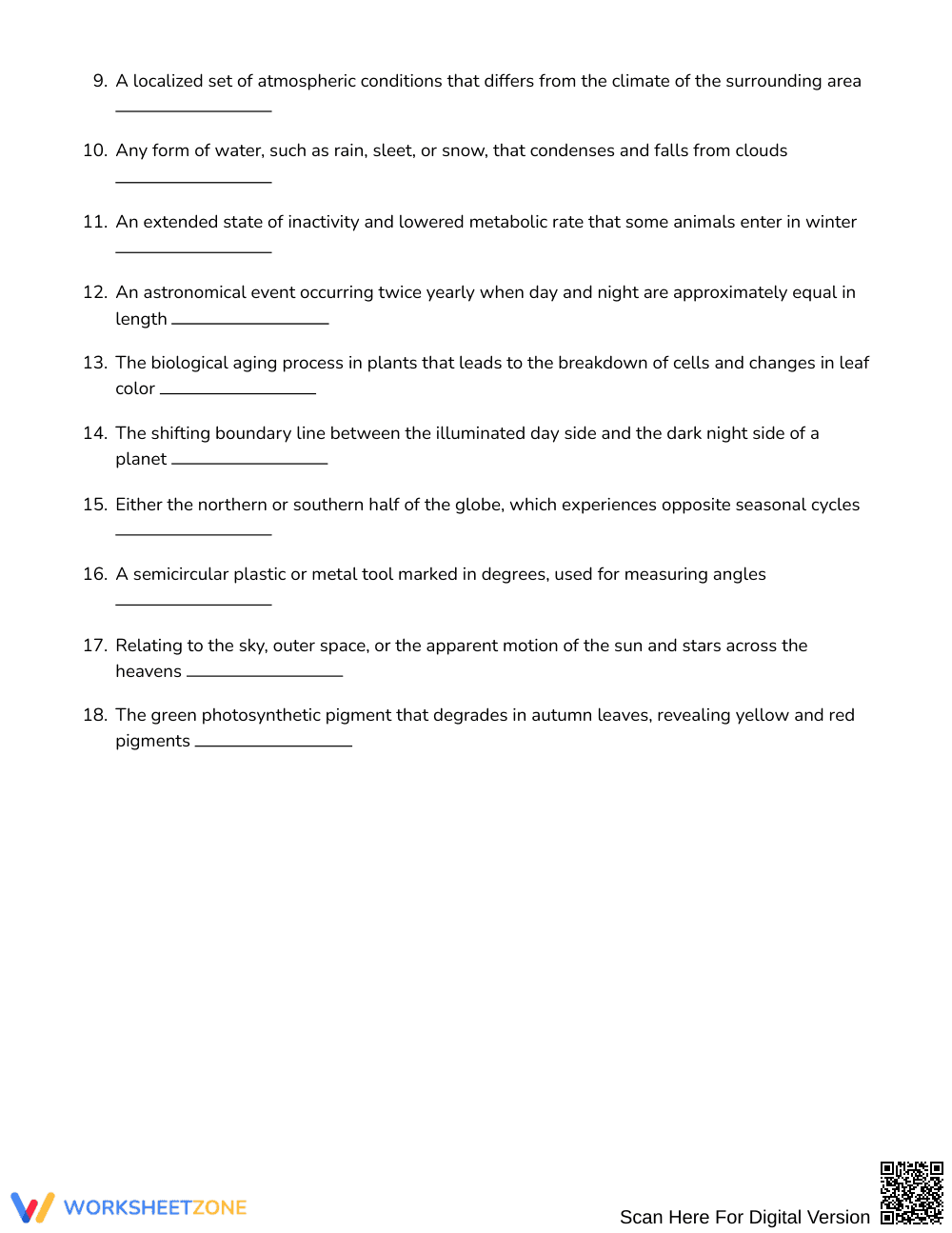
This Grades 7–8 science word search builds academic vocabulary around seasonal changes across regions. Students examine clue definitions to identify 18 essential earth and life science terms before locating them within the letter grid. The activity reinforces scientific terminology, supports reading comprehension, and provides an engaging review of seasonal climate systems.
At a Glance
- Grade: Grades 7–8 · Subject: Science
- Standard: Not standards-assessed — vocabulary enrichment
- Skill Focus: Seasonal changes across regions
- Format: 3 pages · 18 words · Answer key included · PDF
- Best For: Cumulative review and vocabulary reinforcement
- Time: 20–30 minutes
This 3-page printable resource includes an 18-word puzzle sheet featuring definitions for each seasonal science term, alongside academic tools and autumn concepts. Students read each targeted clue, determine the matching vocabulary word, and locate the term within the letters. A complete 4-page answer key displays highlighted letter positions for rapid checking.
The puzzle features a dense 20 by 20 letter grid designed to challenge middle school students. The 18 hidden vocabulary terms are placed in all eight possible directions: horizontally, vertically, and diagonally (running north, northeast, east, southeast, south, southwest, west, and northwest). Searching across multiple orientations develops spatial scanning skills while reinforcing correct orthographic letter patterns.
This activity serves strictly as vocabulary enrichment and is not aligned to a specific state or national science standard. Instead, it supports cross-curricular literacy by reinforcing domain-specific terms—such as equinox, microclimate, and senescence—that students encounter across middle school earth science and biology units.
Introduce this word search after direct instruction on Earth's axial tilt, biomes, and weather patterns to consolidate terminology. Alternatively, use it as a low-stress transition activity at the start of autumn. For formative assessment, observe whether students deduce terms directly from the contextual clues before searching the grid. Most students finish within 20 to 30 minutes.
This resource is crafted for Grades 7–8 general science students, early finishers, and English language learners needing targeted exposure to content vocabulary. Scaffold support by having students highlight roots within words like chlorophyll and hemisphere. Pair this activity with an informational reading passage on global seasonal variations or autumnal equinox diagrams.
Vocabulary acquisition in middle school science requires repeated exposure to specialized terminology across varied, meaningful contexts. According to Fisher & Frey (2014), intentional word study and schema-building activities significantly enhance domain-specific comprehension by moving scientific vocabulary from passive recognition to active recall. When Grades 7–8 students analyze descriptive clues to identify concepts such as equinox, microclimate, and senescence, they actively link formal definitions with conceptual models of planetary motion and biological cycles. Context-driven retrieval practice strengthens orthographic mapping and helps learners retain multifaceted terms necessary for reading complex informational texts. Because academic language serves as a primary gatekeeper to scientific literacy, low-stakes vocabulary consolidation tasks provide accessible entry points for diverse learners. Incorporating structured puzzle formats alongside rigorous science instruction ensures that middle school students build the foundational lexicon required for sustained achievement across secondary earth and life science coursework.


