

































Printable Scientific Notation Worksheet | Grade 8 Math

Paste this activity's link or code into your existing LMS (Google Classroom, Canvas, Teams, Schoology, Moodle, etc.).
Students can open and work on the activity right away, with no student login required.
You'll still be able to track student progress and results from your teacher account.
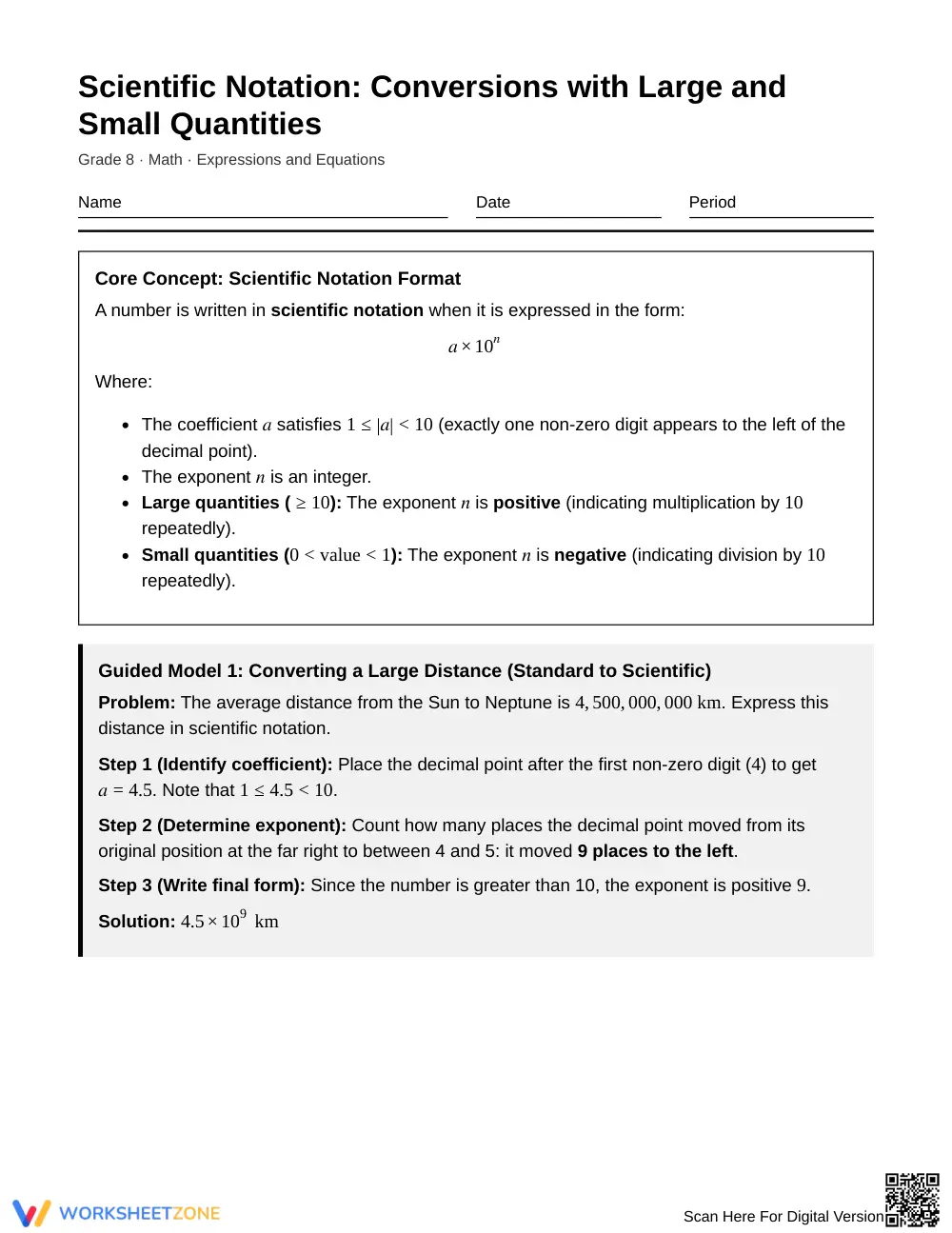
This Grade 8 mathematics worksheet develops student fluency in converting both large and small quantities between standard decimal form and scientific notation. Students analyze real-world scientific measurements—from planetary distances to atomic radii—while mastering coefficient rules, power-of-ten place value shifts, and rigorous mathematical error analysis to secure deep procedural and conceptual understanding.
At a Glance
- Grade: 8 · Subject: Math
- Standard: Convert very large and very small numbers between standard and scientific notation
- Skill Focus: Scientific Notation Conversions
- Format: 5 pages · 12 problems · Answer key included · PDF
- Best For: Core skill practice and error analysis
- Time: 30–45 minutes
What's Inside
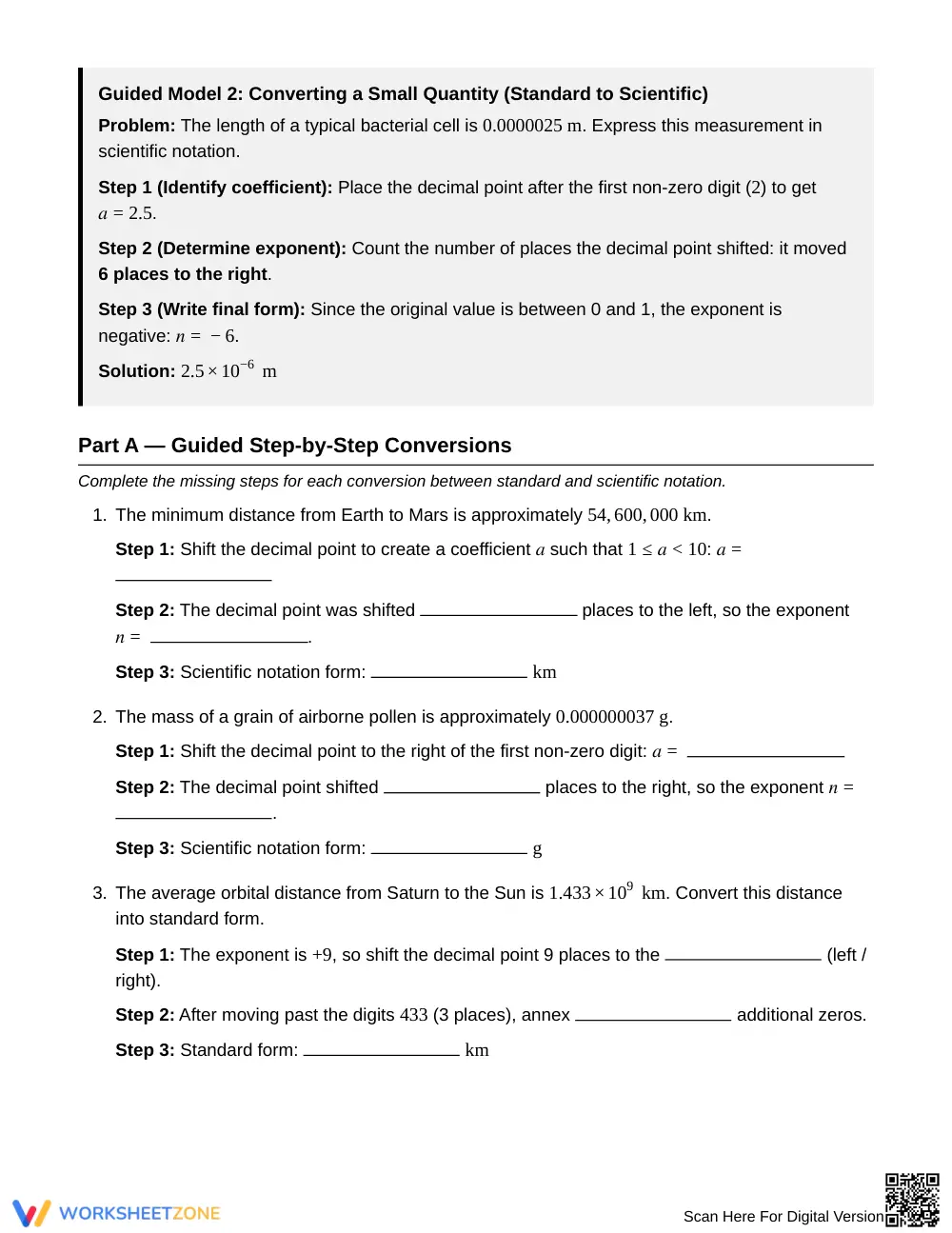
Inside this 5-page printable resource, students find visual reference boxes defining core notation rules, two fully worked guided models, and 12 tiered exercises spanning fill-in scaffolding, multi-step independent conversions, and written error-analysis prompts. A comprehensive 3-page answer key provides complete step-by-step solutions and model explanations for straightforward grading.
Skill Progression
- Guided Practice (Part A, Problems 1–4): Structured fill-in prompts break down coefficient identification and exponent direction for positive and negative powers of ten.
- Supported Practice (Part B, Problems 5–10): Unassisted conversion tasks require students to independently determine decimal place counts and exponents using authentic real-world contexts.
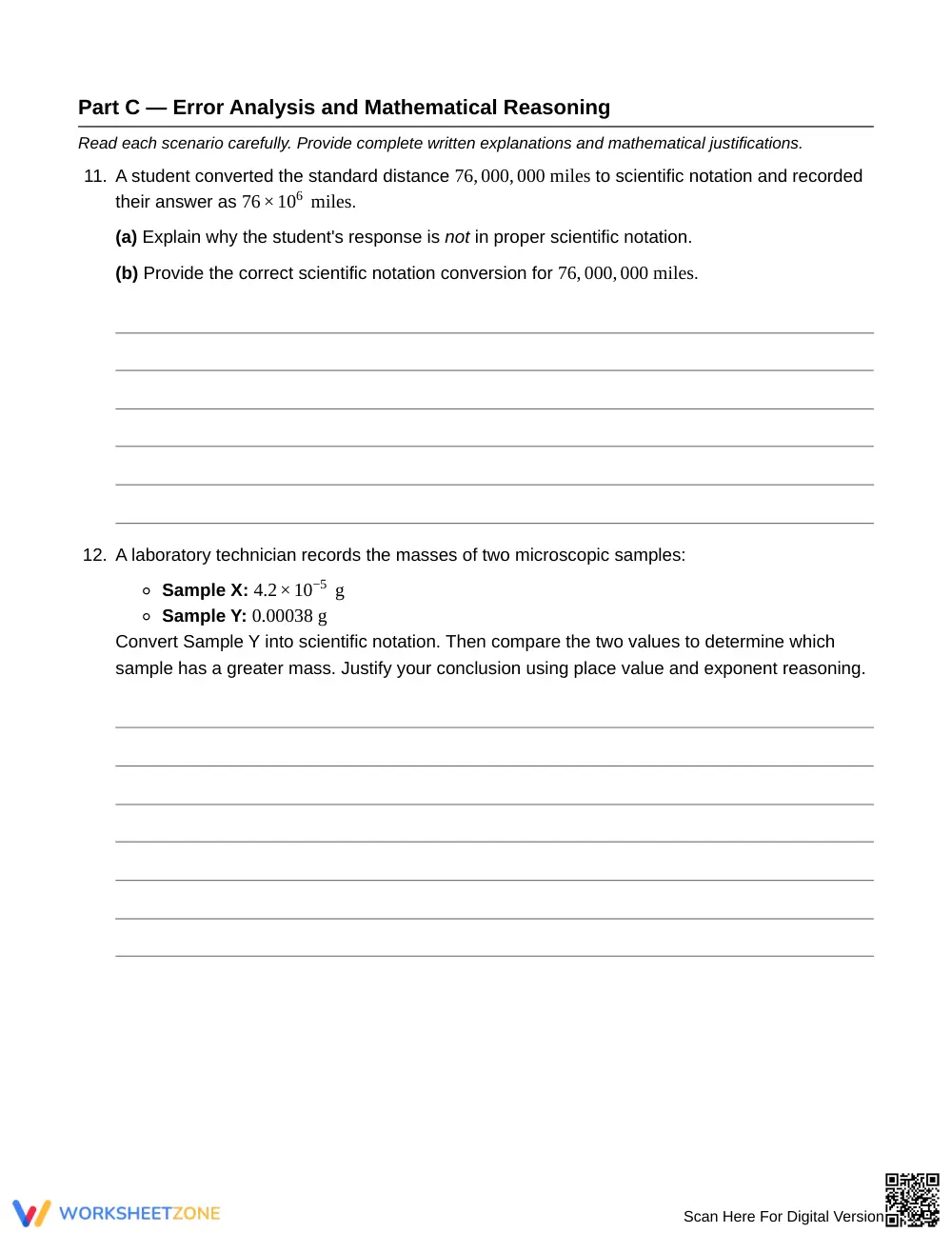
- Independent Practice & Reasoning (Part C, Problems 11–12): High-level error analysis and sample comparison tasks demand written mathematical justification of coefficient constraints and magnitude comparisons.
This intentional sequence follows the gradual release of responsibility model, ensuring students master foundational place-value movement before evaluating complex conceptual mistakes.
Standards Alignment
This resource aligns with middle school mathematics expectations for expressions and equations, requiring learners to use numbers expressed in the form of a single digit times an integer power of ten to estimate and represent very large or very small quantities. The supporting focus ensures students understand scientific notation as an efficient representation of magnitude. These standard concepts can be copied directly into lesson plans, IEP goals, or district curriculum mapping tools.
How to Use It
Deploy this worksheet during the direct practice phase following an introductory lesson on powers of ten. Alternatively, assign it as a targeted mid-unit review station to diagnose common misconceptions regarding negative exponents. During guided practice, observe whether students correctly identify that coefficients must remain strictly between 1 and 10. Expect the full 12-task activity to take approximately 30 to 45 minutes.
Who It's For
Designed for Grade 8 math students, this resource also supports Grade 9 Algebra I review and physical science students requiring scientific notation reinforcement. Pair this activity with an interactive place-value chart or physical powers-of-ten reference cards to support English learners and developing mathematicians.
According to research highlighted in Fisher & Frey (2014), structured instructional materials that systematically transition from guided problem frameworks to independent error analysis significantly enhance student retention and mathematical accuracy. This Grade 8 worksheet applies those principles directly to scientific notation conversions, providing explicit modeling before challenging students with independent tasks and non-example critique. When middle school learners actively justify why a coefficient like 76 violates standard mathematical conventions, they move past rote decimal counting toward genuine place-value comprehension. The structured 12-problem format and complete answer key make this instructional tool highly effective for formative evaluation, targeted intervention, and rigorous standards mastery in any secondary mathematics classroom.


