


























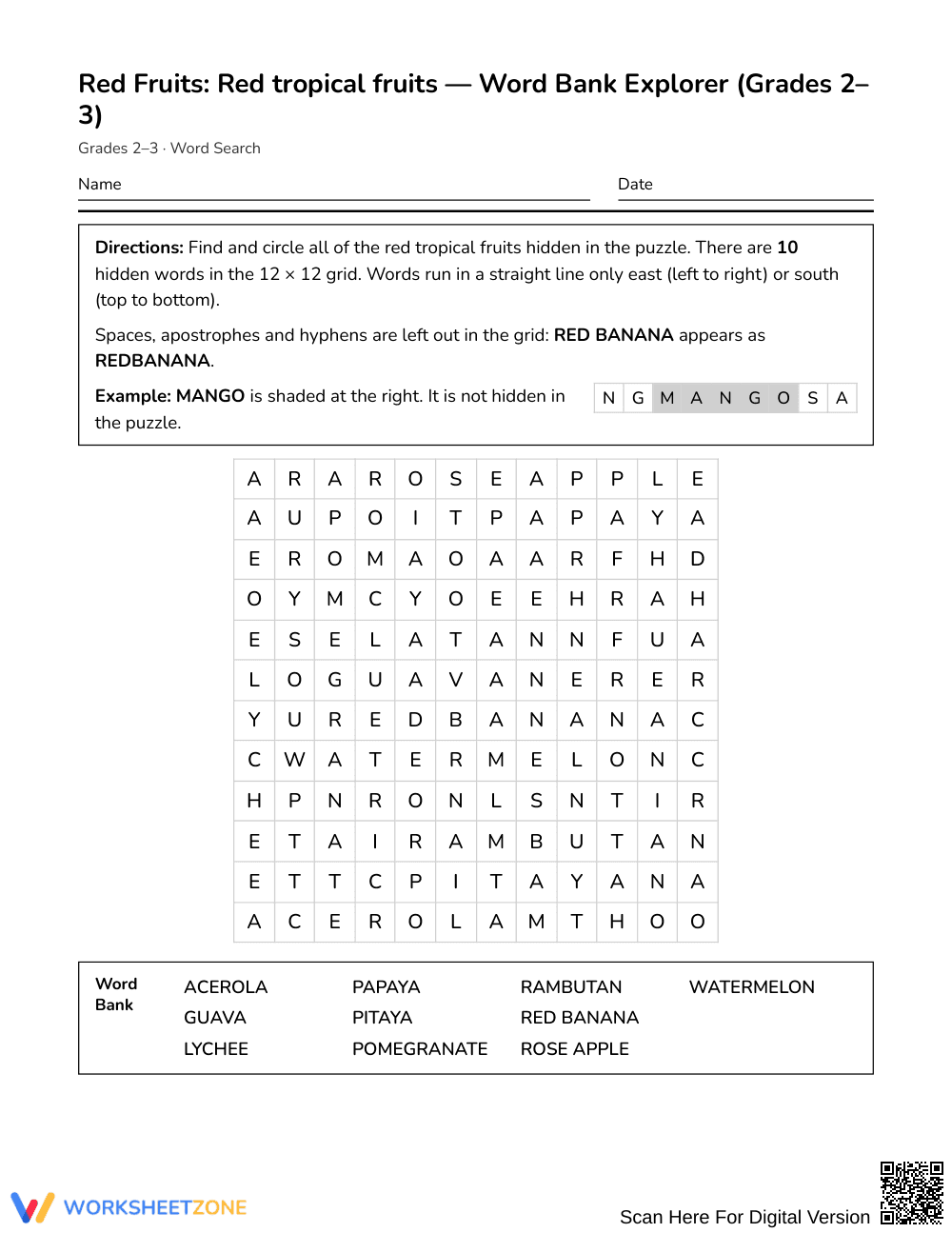

Printable Red Tropical Fruits Word Search | Grades 2–3 ELA
Paste this activity's link or code into your existing LMS (Google Classroom, Canvas, Teams, Schoology, Moodle, etc.).
Students can open and work on the activity right away, with no student login required.
You'll still be able to track student progress and results from your teacher account.
This Grades 2–3 word search introduces students to red tropical fruits through focused visual scanning and spelling reinforcement. Learners identify ten specialized produce terms, connecting botanical names to concise descriptive definitions. The activity builds word recognition and curiosity about global agriculture while delivering an engaging, low-stress literacy experience.
At a Glance
- Grade: Grades 2–3 · Subject: English Language Arts (ELA)
- Standard: Not standards-assessed — vocabulary enrichment and spelling pattern recognition
- Skill Focus: Red tropical fruits vocabulary and spelling
- Format: 1 printable page · 10 hidden words · Full answer key included · PDF
- Best For: Independent vocabulary enrichment, morning work, and early finisher practice
- Time: 15–20 minutes
What's Inside
This single-page puzzle presents a clean layout containing 10 hidden words accompanied by an alphabetical word bank and informative fruit clues. The resource features an uncluttered presentation designed specifically for primary-grade readers, paired with a complete 2-page answer key highlighting letter coordinates for fast verification.
How the Puzzle Works
The activity centers on a 12 by 12 letter grid where all 10 vocabulary terms run in only two directions: East (horizontally left to right) and South (vertically top to bottom). Students reference an alphabetical word bank to locate each fruit, supported by kid-friendly descriptive clues that define items like acerola, rambutan, and pitaya.
Standards Alignment
This word search serves strictly as vocabulary enrichment and is not aligned to a formal academic content standard. Teachers can integrate this supplemental resource into general literacy blocks, thematic science units on plant diversity, or seasonal nutrition centers without reporting formal standards benchmark data.
How to Use It
Introduce this puzzle after direct instruction on plant parts or food groups to reinforce descriptive adjectives and exotic fruit names. Alternatively, assign it during independent morning work or literacy stations to foster sustained visual attention. During seatwork, observe whether students scan sequentially by initial letter clusters or search haphazardly, guiding developing readers toward methodical left-to-right searching. Expected completion time is 15 to 20 minutes.
Who It's For
Designed for second- and third-grade learners expanding their descriptive vocabulary, this activity supports curious readers who enjoy word puzzles. For students requiring extra assistance, suggest highlighting initial consonants in the word bank before scanning the grid. Pair this activity naturally with an informational anchor chart depicting tropical plant zones and agricultural biomes.
This Grades 2–3 vocabulary enrichment resource builds word consciousness and orthographic mapping through ten targeted red tropical fruit names. Rather than evaluating formal state standards, the activity emphasizes print familiarity, letter sequence tracking, and domain-specific botanical terminology across a clean 12 by 12 grid. According to Fisher & Frey (2014), intentional word exposure coupled with supportive contextual clues accelerates lexical acquisition and strengthens reading stamina in elementary learners. By pairing an alphabetical word bank with clear definitions, the puzzle encourages self-directed exploration while reinforcing horizontal and vertical letter patterns. Students practice focused scanning routines that transfer directly into fluent text decoding and reference usage. Complete with a 2-page answer key for prompt visual verification, this printable activity functions as an effective, zero-prep instructional supplement for elementary classrooms seeking meaningful vocabulary enrichment during independent literacy centers.


