



























Printable Red Orchard Fruits Word Search | Grades 2–3 ELA
Paste this activity's link or code into your existing LMS (Google Classroom, Canvas, Teams, Schoology, Moodle, etc.).
Students can open and work on the activity right away, with no student login required.
You'll still be able to track student progress and results from your teacher account.
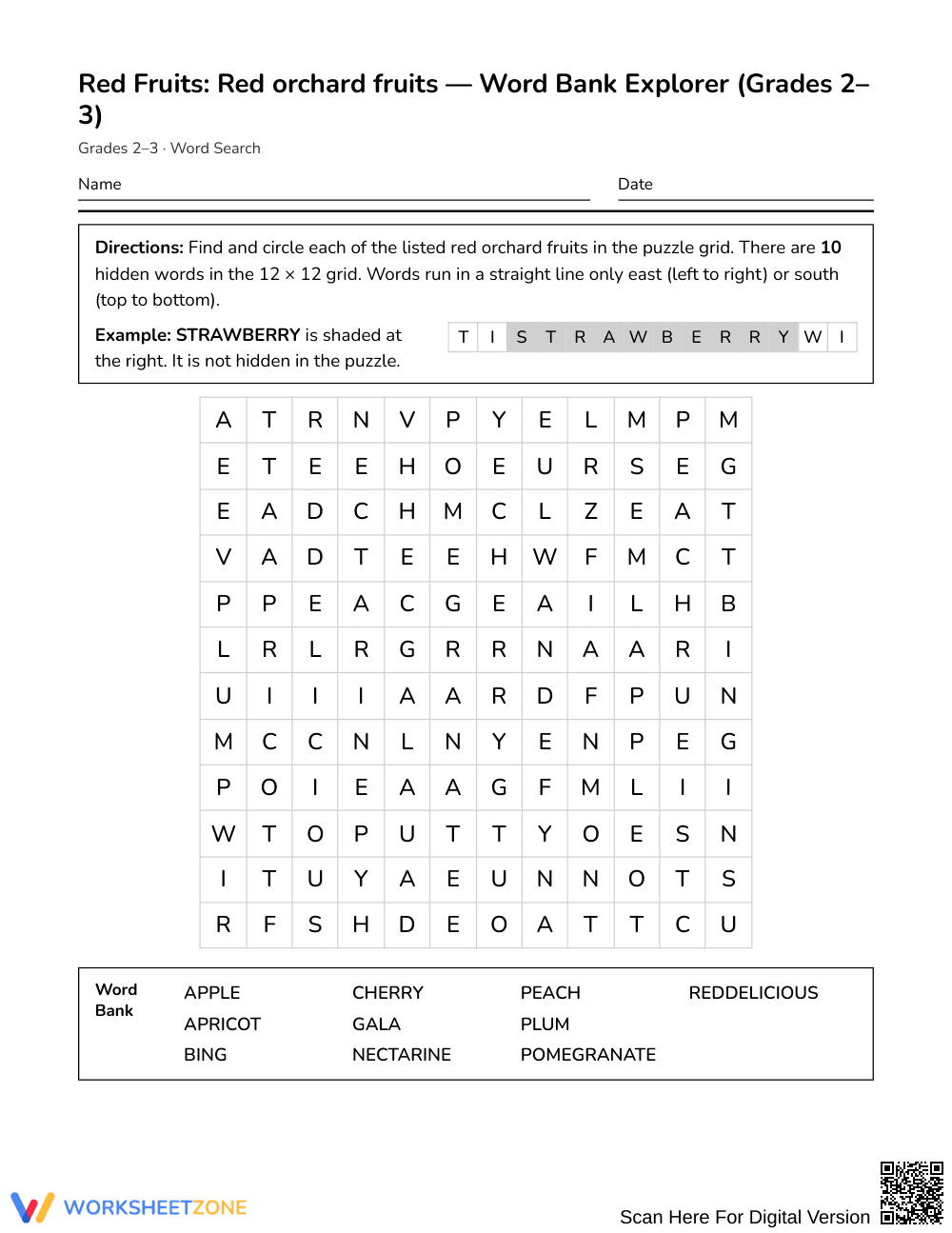
This Grades 2–3 vocabulary word search introduces learners to ten red orchard fruits through focused letter-recognition and word-identification practice. Students scan the grid to locate specific fruit names, reinforcing spelling patterns and expanding thematic agricultural vocabulary. The self-directed puzzle design encourages independent problem-solving and sustained visual attention without requiring advance teacher presentation.
At a Glance
- Grade: Grades 2–3 · Subject: ELA
- Standard: Not standards-assessed — vocabulary enrichment
- Skill Focus: Red orchard fruits
- Format: 1 pages · 10 words · Answer key included · PDF
- Best For: Early finishers, sub plans, centers
- Time: 15–20 minutes
What's Inside: The single-page activity features a clean 12 by 12 letter grid accompanied by an alphabetical word bank containing ten fruit terms, from common varieties like apple and peach to specific cultivars like gala and bing. The package includes an accurate two-page answer key highlighting exact coordinate locations for immediate self-checking or grading.
Puzzle Structure and Mechanics
Designed specifically for emerging readers in primary classrooms, this word search balances engagement with manageable difficulty. Key puzzle features include:
- Grid Layout: A compact 12 by 12 letter matrix sized to prevent visual fatigue while maintaining an appropriate search density for young elementary learners.
- Word Directions: Vocabulary terms run exclusively in two accessible directions: left-to-right (East) and top-to-bottom (South), avoiding backwards or diagonal orientations that frustrate second and third graders.
- Word Bank & Clues: An alphabetized word bank lists all 10 words alongside kid-friendly descriptive clues that connect names to real-world characteristics.
Standards Alignment
This resource serves as targeted vocabulary enrichment and is not aligned to a formal grade-level standard. It provides supplementary domain-specific language exposure that reinforces general orthographic mapping and thematic science or social studies units covering plant growth and farming.
How to Use It
Deploy this activity during independent literacy rotations or keep copies on hand as a no-prep sponge activity for fast finishers. For instructional use, assign the word search after reading a passage about orchards or autumn harvest cycles. Formative observation tip: notice whether students reference the alphabetical bank systematically or search randomly across the grid. The anticipated completion time is 15 to 20 minutes.
Who It's For
This puzzle supports general education learners in Grades 2–3, english language learners building concrete produce terminology, and students requiring fine-motor visual tracking support. Pair this printable with a nonfiction picture book about fruit orchards or a seasonal sensory writing lesson.
According to EdReports 2024, regular exposure to topical domain-specific words strengthens background knowledge and reading comprehension across elementary grade bands. Integrating accessible vocabulary tasks like word searches helps young readers solidify letter sequences, recognize high-utility spelling combinations, and build confidence with unfamiliar terminology. When students locate words such as pomegranate, nectarine, and apricot within a structured grid, they engage in visual scanning and orthographic processing that support fluent decoding skills. Furthermore, embedding purposeful word hunts into weekly literacy blocks encourages children to notice internal morphemes and sound-spelling correspondences without experiencing cognitive overload. This targeted exposure reinforces accurate orthographic memory as children transition from sounding out individual letters to recognizing full word units automatically. Consistent practice with thematic print materials ultimately fosters curiosity about language, strengthens vocabulary retention, and prepares primary learners for increasingly complex informational texts across diverse content areas.


