





























Paste this activity's link or code into your existing LMS (Google Classroom, Canvas, Teams, Schoology, Moodle, etc.).
Students can open and work on the activity right away, with no student login required.
You'll still be able to track student progress and results from your teacher account.


Printable Quadrant I Ordered Pairs Worksheet | Grade 5 Math

Paste this activity's link or code into your existing LMS (Google Classroom, Canvas, Teams, Schoology, Moodle, etc.).
Students can open and work on the activity right away, with no student login required.
You'll still be able to track student progress and results from your teacher account.
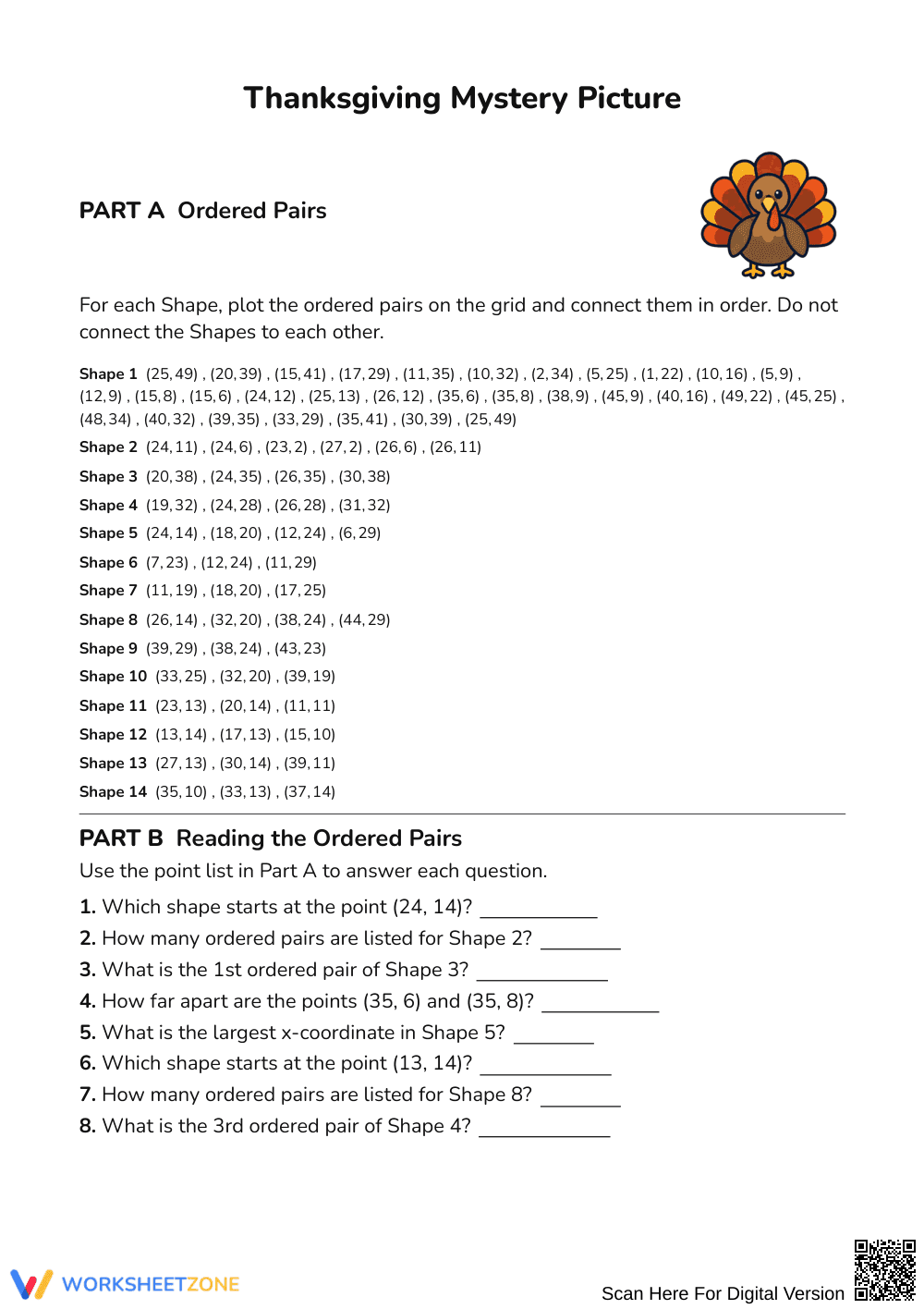
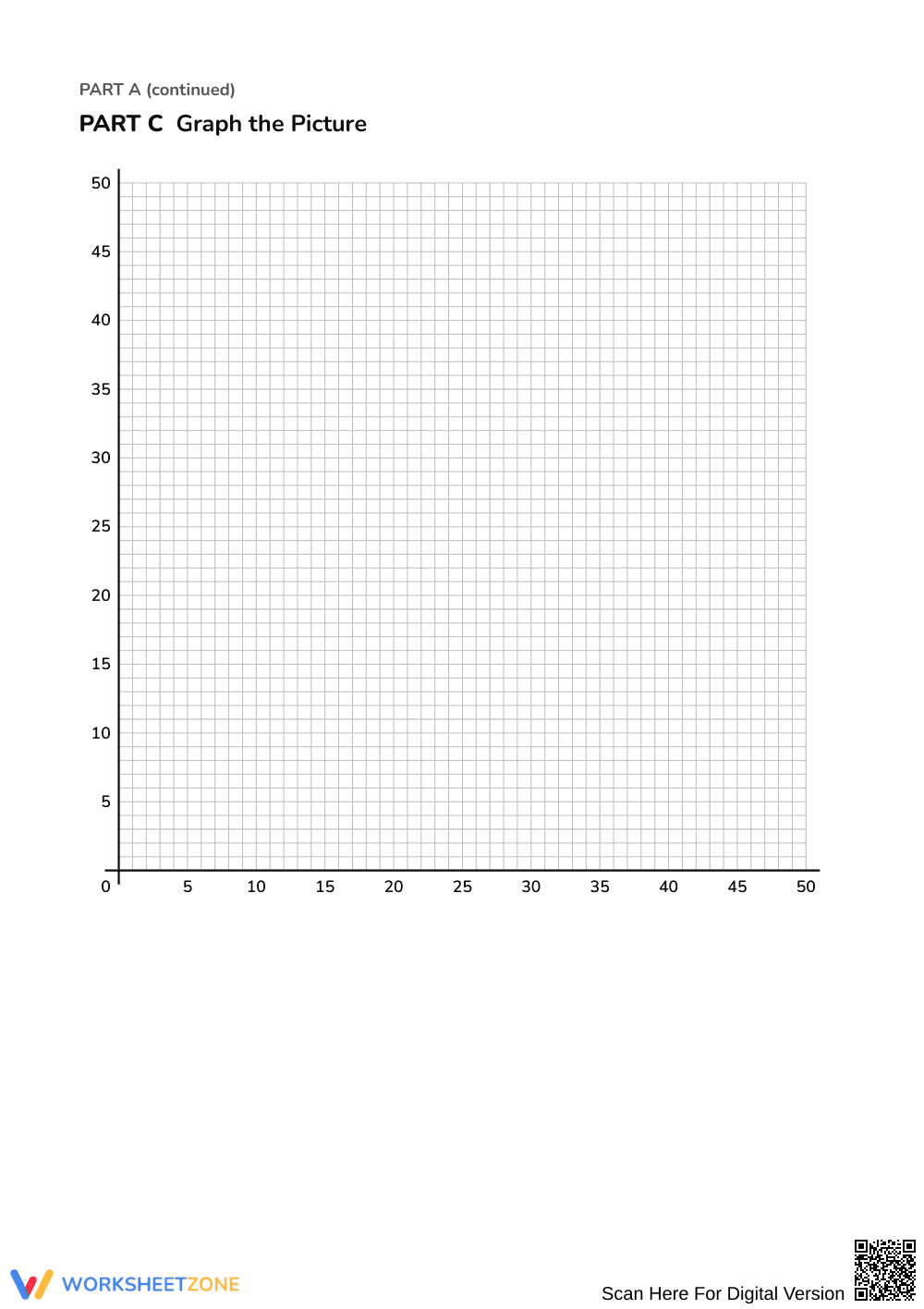
This Grade 5 Math worksheet helps students master Quadrant I coordinate graphing by plotting whole-number ordered pairs to reveal a Thanksgiving maple leaf. Designed around a single structured coordinate art task, learners connect points in sequence to build fluency with x- and y-coordinates while creating a seasonal five-lobed leaf with a stem.
At a Glance
- Grade: 5 · Subject: Math
- Standard:
5.G.A.1— Plot whole-number ordered pairs accurately in Quadrant I of the coordinate plane- Skill Focus: Plotting whole-number ordered pairs in Quadrant I
- Format: 2 pages · 1 task · Answer key included · PDF
- Best For: Seasonal Quadrant I coordinate plane graphing practice
- Time: 20–30 minutes
What's Inside
This 2-page student packet presents Part A: Ordered Pairs, a single coordinate art mystery picture task titled Thanksgiving Mystery Picture. Students plot sequential whole-number coordinates in Quadrant I to construct a maple leaf with five pointed lobes and a stem. A matching 2-page answer key is included for quick verification.
Skill Progression
- Guided practice: Model plotting the first few ordered pairs of Part A together, emphasizing moving right along the x-axis before moving up along the y-axis.
- Supported practice: Have students plot the initial lobe points with partner check-ins to verify axis order before connecting segments.
- Independent practice: Students complete the remaining 1 coordinate art task independently to reveal all five pointed lobes and the stem.
This sequence follows a gradual-release I Do, We Do, You Do structure within one cohesive graphing activity.
Standards Alignment
Aligned to 5.G.A.1, which requires students to use a pair of perpendicular number lines (axes) to define a coordinate system and locate points using ordered pairs. As a supporting connection, 5.G.A.2 extends this graphing skill to interpreting coordinate values in context. Both standard codes can be copied directly into lesson plans, IEP goals, or district curriculum mapping tools.
How to Use It
Assign this worksheet after direct instruction on ordered pairs as a 20–30 minute independent practice block or a seasonal math center. During circulation, watch for students reversing x- and y-coordinates, as an inverted point immediately distorts the maple leaf outline and prompts self-correction.
Who It's For
Ideal for Grade 5 classrooms studying Quadrant I graphing, as well as Grade 4 enrichment or Grade 6 review. Pair this activity with a coordinate-plane anchor chart showing x- and y-axis labels to support visual learners and multilingual students.
Aligned to Common Core standard 5.G.A.1, this Grade 5 Math coordinate art worksheet builds accuracy in plotting whole-number ordered pairs in Quadrant I of the coordinate plane. Rather than practicing isolated points without context, students work through a structured Thanksgiving Mystery Picture task that connects sequential coordinates to reveal a maple leaf with five pointed lobes and a stem. Because each misplaced point visibly alters the emerging shape, the activity provides immediate visual feedback alongside a complete 2-page answer key. Following the gradual-release instructional framework described by Fisher & Frey (2014), teachers can model initial coordinate plotting, support early lobe checkpoints, and transition students into independent graphing practice. Designed for 20 to 30 minutes of classroom or center work, this 2-page printable resource reinforces axis orientation, spatial reasoning, and procedural precision in upper-elementary geometry.


