


























Views
Downloads


Printable Position & Timing Worksheet | Grade 12 Physics
Paste this activity's link or code into your existing LMS (Google Classroom, Canvas, Teams, Schoology, Moodle, etc.).
Students can open and work on the activity right away, with no student login required.
You'll still be able to track student progress and results from your teacher account.
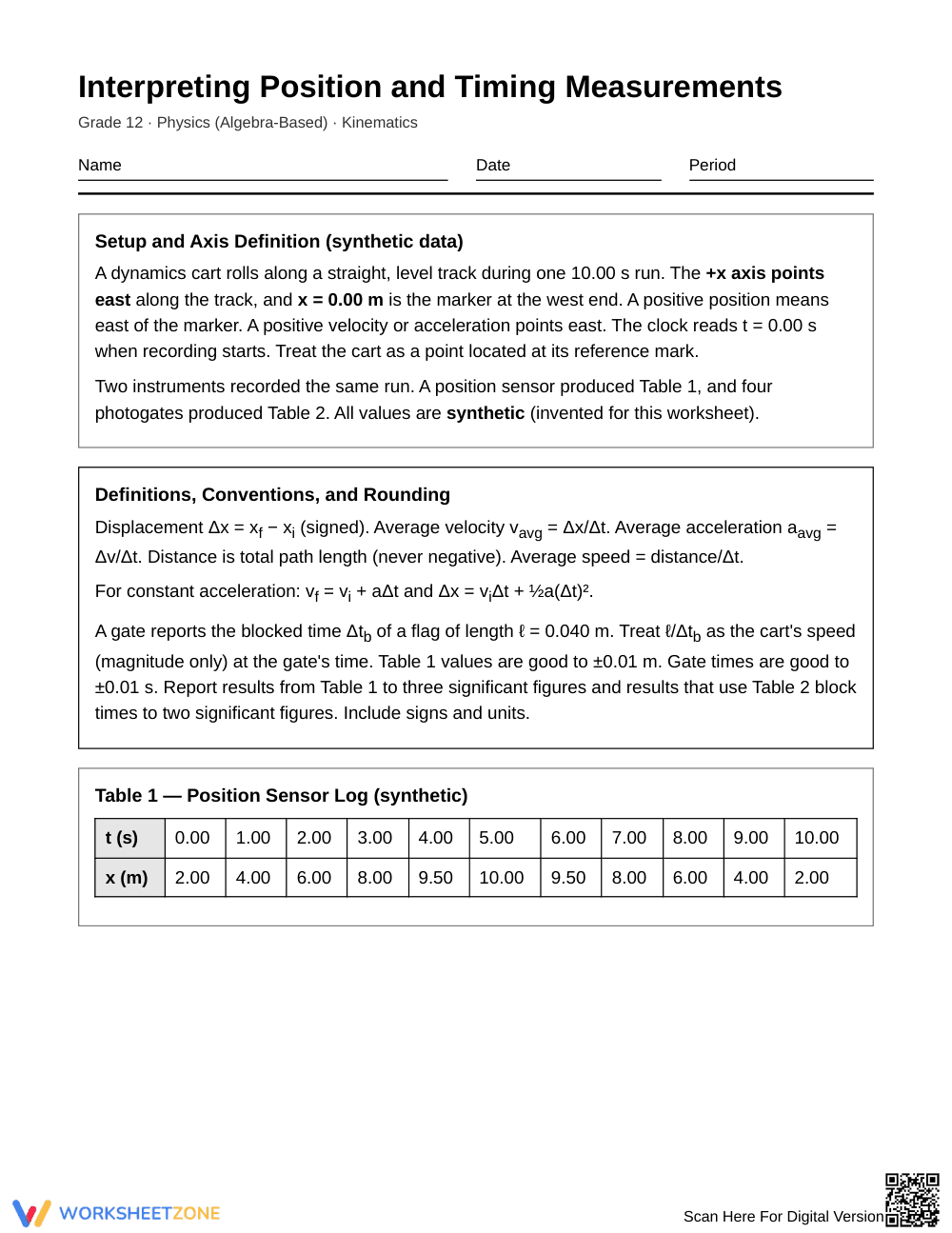
This Grade 12 physics worksheet teaches students to interpret position and timing measurements from a position sensor and a photogate log. Students read values, compute signed velocity and acceleration, and judge what each data set can and cannot support, using evidence from the tables.
At a Glance
- Grade: 12 · Subject: Physics
- Standard: Kinematics unit — read tables, compute signed velocity and acceleration, and judge data limits.
- Skill Focus: Interpret Position and Timing Measurements
- Format: 5 pages · 10 problems · Answer key included · PDF
- Best For: Kinematics data analysis and review practice
- Time: 40–50 minutes
What's Inside
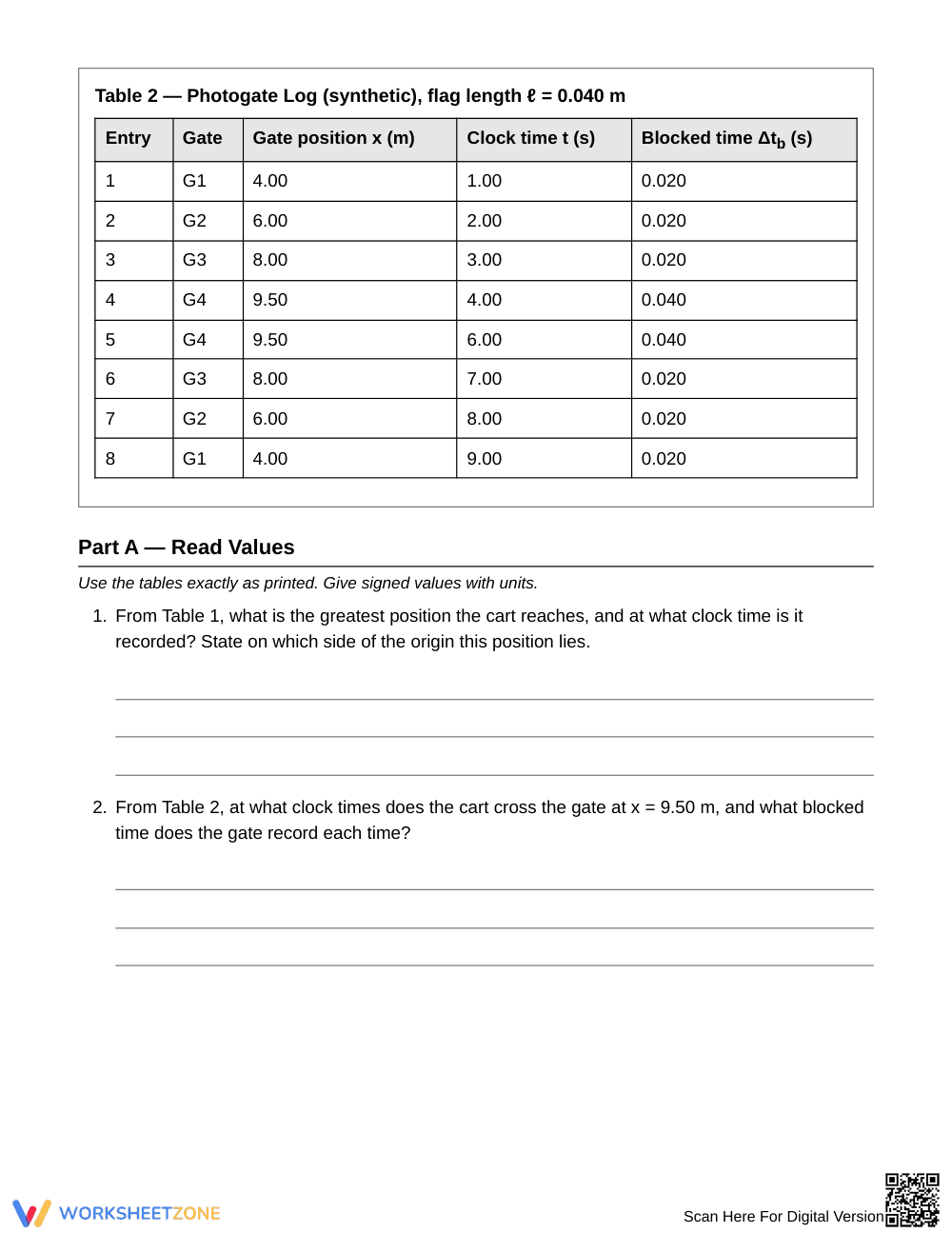
The 5-page worksheet follows one dynamics cart along a straight track. Two synthetic data sets describe the same 10.00 s run: a position sensor table and a four-gate photogate log. A setup box defines sign conventions, and a definitions box lists the equations and rounding rules. A 4-page answer key is included.
Skill Progression
- Guided practice (Part A, 2 problems): Students read the peak position, crossing times, and blocked times directly from the tables.
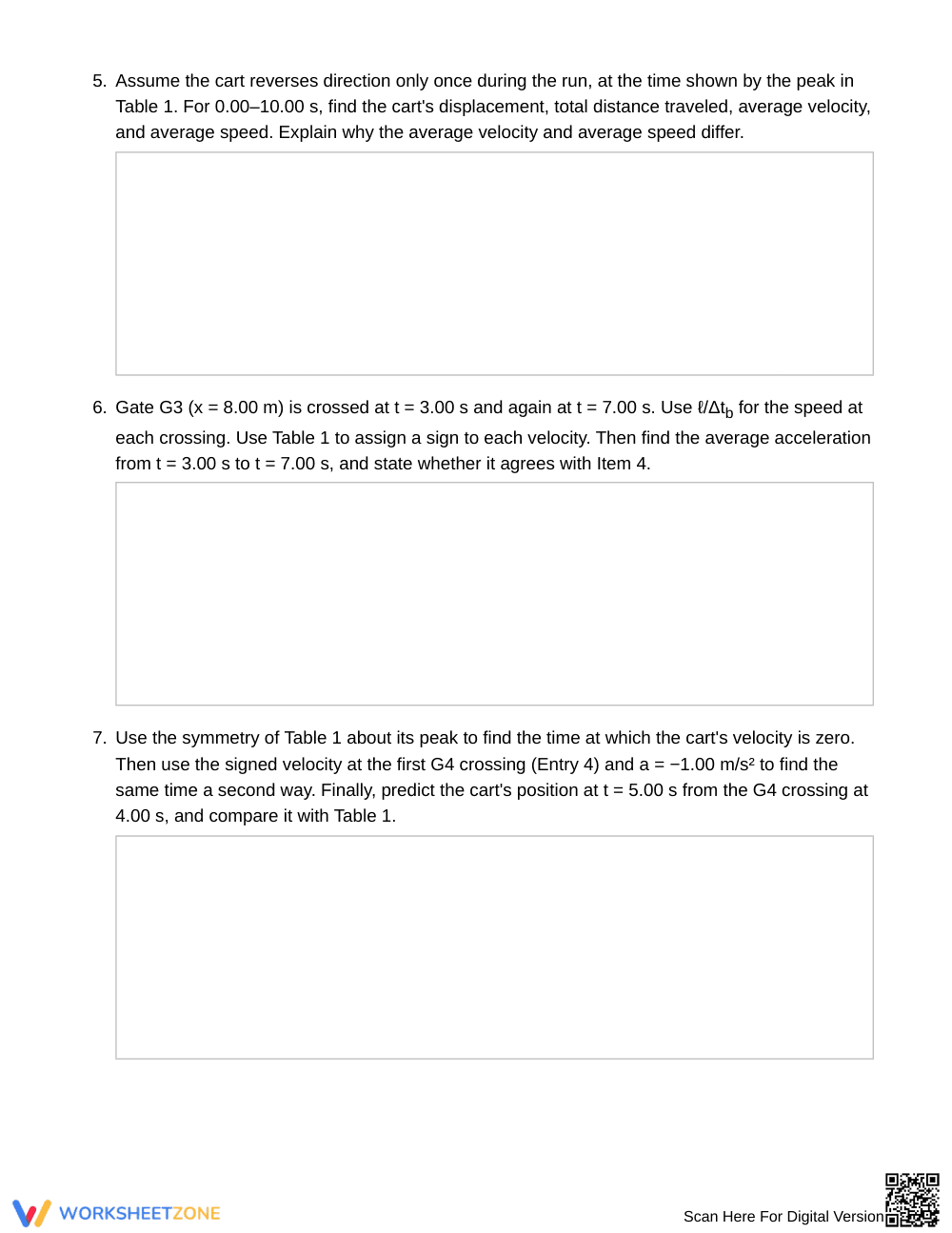
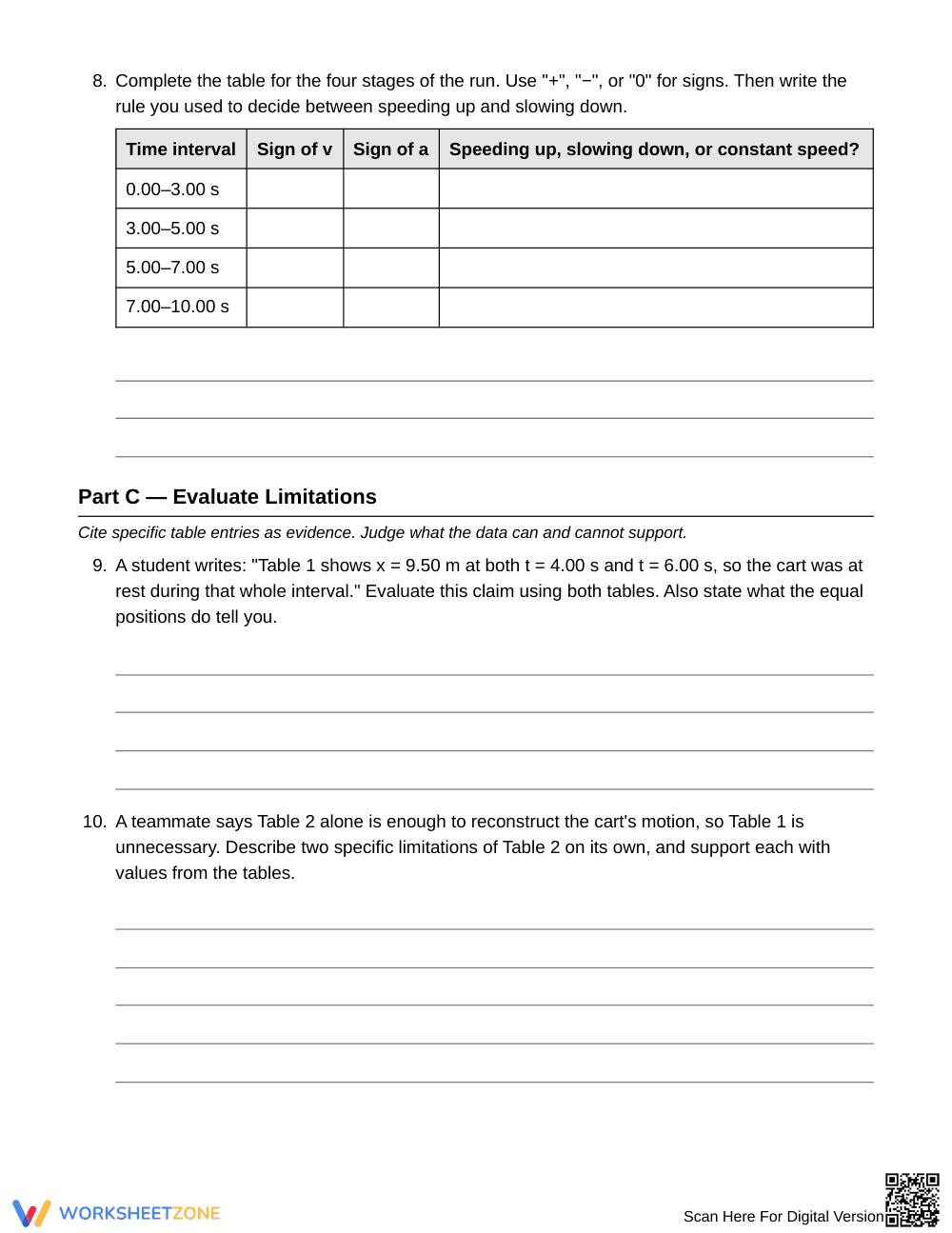
- Supported practice (Part B, 6 problems): Students calculate average velocity, acceleration, displacement, distance, and speed, compare gate-based and sensor-based values, find the turning time two ways, and complete a sign table.
- Independent practice (Part C, 2 problems): Students evaluate a flawed claim about the cart being at rest and describe the limits of the photogate data, citing table entries.
Standards Alignment
No standard code was supplied for this worksheet, so none is listed. The tasks address one-dimensional kinematics: displacement, distance, average velocity, average speed, constant acceleration, and the signs of velocity and acceleration. Add your local or state standard code when mapping this skill into lesson plans or curriculum tools.
How to Use It
- After direct instruction: Assign Parts A and B as classwork. Listen during the sign table for students who link positive velocity with speeding up.
- Before a unit test: Use all 10 problems as review, with Part C as a paired written discussion.
Expect 40–50 minutes for the full set.
Who It's For
This worksheet suits Grade 12 algebra-based physics students working on one-dimensional motion. Students who need support can start with Parts A and B; students ready for a challenge can focus on Part C and the two-method turning-time problem.
Interpreting Position and Timing Measurements is a Grade 12 physics worksheet for the kinematics unit that asks students to read a position sensor table and a photogate log, compute signed displacement, velocity, and acceleration, and evaluate what each instrument can and cannot show. Its 10 tasks move from reading values to multi-step analysis to critique of claims, following the gradual-release model described by Fisher & Frey (2014), in which teachers shift responsibility from modeling to guided practice to independent work. Students must report signs, units, and significant figures, and justify conclusions with specific table entries. The five-page worksheet includes a four-page answer key and fits a single class period. It works well as formative assessment after direct instruction or as review before a kinematics test, and it is easy to quote, adapt, or pair with your own anchor chart.


