




























Views
Downloads
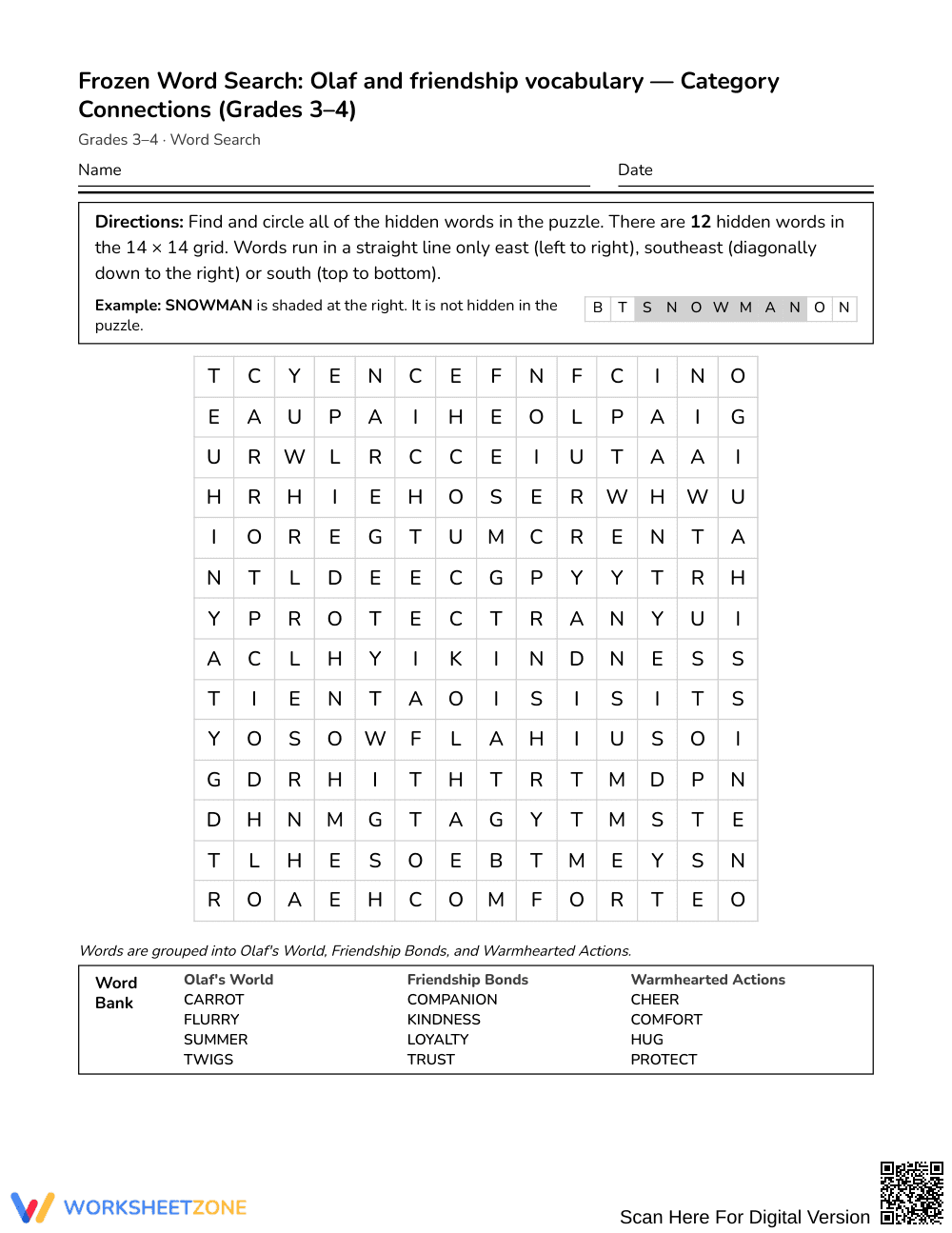

Printable Olaf Friendship Word Search | Grades 3–4 ELA

Paste this activity's link or code into your existing LMS (Google Classroom, Canvas, Teams, Schoology, Moodle, etc.).
Students can open and work on the activity right away, with no student login required.
You'll still be able to track student progress and results from your teacher account.
This Olaf and friendship vocabulary word search builds word recognition for Grades 3–4 students. By locating 12 targeted terms organized into thematic clusters, students reinforce orthographic awareness and contextual associations related to friendship, positive social values, and the snowman's winter world.
At a Glance
- Grade: Grades 3–4 · Subject: English Language Arts (ELA)
- Standard: Not standards-assessed — vocabulary enrichment
- Skill Focus: Olaf and friendship character-themed vocabulary
- Format: 1 page · 12 hidden words · Full answer key included · PDF
- Best For: Independent vocabulary review, morning work, and literacy stations
- Time: 15–20 minutes
This 1-page puzzle contains 12 vocabulary terms embedded within a 14 x 14 letter grid. The word bank is organized into three conceptual categories: Olaf's World, Friendship Bonds, and Warmhearted Actions. Students scan for each term, and a 3-page answer key provides complete letter coordinates for rapid checking.
Puzzle Structure and Mechanics
The word search is organized around clear visual specifications:
- Grid Dimensions: A 14 x 14 grid containing 196 total letter cells designed for Grades 3–4 learners.
- Word Orientations: Terms run East, Southeast, and South, eliminating backward words to support developing readers.
- Categorized Word Bank: Words are grouped under three thematic categories rather than a simple alphabetical list.
Standards Alignment
This word search provides vocabulary enrichment and is not aligned to an academic standard. While it reinforces spelling patterns and visual scanning, it serves as an engaging supplemental resource rather than a formal standards-based assessment tool.
How to Use It
This resource supports two practical classroom applications:
- After Direct Instruction: Distribute the puzzle after discussing character relationships to reinforce vocabulary terms like loyalty and comfort.
- Morning Work: Provide the sheet for independent practice over a 15–20 minute working window.
Formative Assessment Tip: Observe student visual scanning. Learners who track row-by-row show strong orthographic awareness, while those searching randomly may benefit from ruler tracking.
Who It's For
This activity is designed for Grades 3–4 students developing vocabulary recognition and reading stamina. Striving readers can be supported by highlighting the first letter of each target word in the grid. Pair this word search with a winter-themed character anchor chart during literacy blocks.
This Grades 3–4 vocabulary enrichment word search reinforces 12 thematic terms connected to character relationships and winter storytelling without a formal standards code. According to Fisher & Frey (2014), intentional word exposure through structured schema grouping accelerates domain-specific vocabulary acquisition and strengthens orthographic mapping for developing readers. By embedding high-utility vocabulary such as loyalty, companion, and comfort into an accessible 14 x 14 letter grid with East, Southeast, and South word paths, the puzzle promotes active letter-pattern recognition while preventing the disorientation often caused by reverse text. Furthermore, the accompanying 3-page answer key provides clear visual verification that builds student autonomy during independent literacy rotations. Structured vocabulary puzzles of this nature support semantic network development, enabling elementary learners to integrate character-focused concepts meaningfully into their broader reading comprehension and daily oral language use.


