


























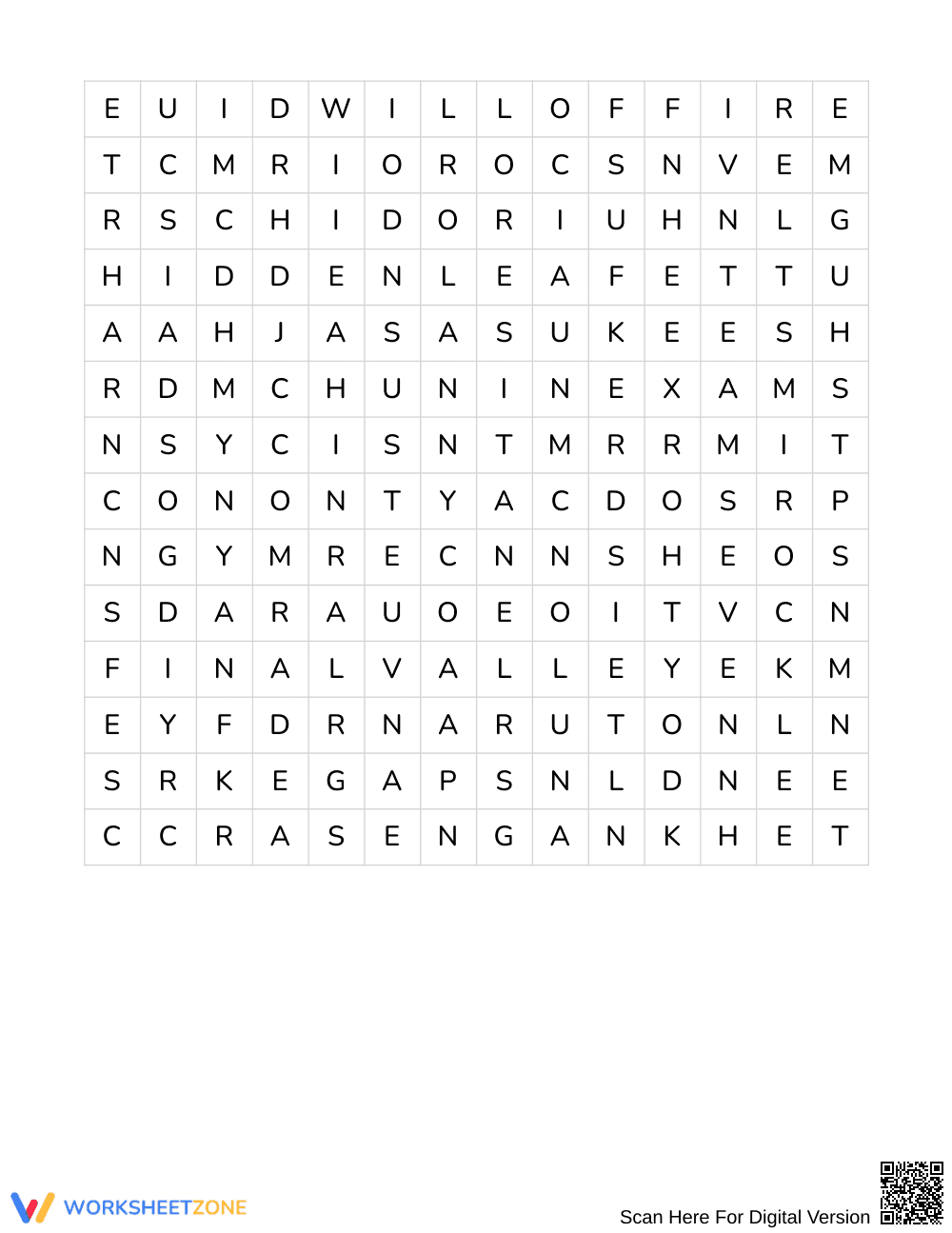

Printable Naruto Friendship Word Search | Grades 7–8 ELA
Paste this activity's link or code into your existing LMS (Google Classroom, Canvas, Teams, Schoology, Moodle, etc.).
Students can open and work on the activity right away, with no student login required.
You'll still be able to track student progress and results from your teacher account.
Engage middle school readers with this thematic word search focused on friendship and rivalry themes in popular literature. Students locate 12 core thematic vocabulary words categorized by character relationships, shared settings, and narrative ideals. This print-ready activity provides meaningful vocabulary reinforcement while connecting relatable character dynamics to broader literary discussions.
At a Glance
- Grade: Grades 7–8 · Subject: English Language Arts (ELA)
- Standard: Not standards-assessed — vocabulary enrichment
- Skill Focus: Friendship and rivalry themes
- Format: 2 pages · 12 words · Answer key included · PDF
- Best For: Independent vocabulary enrichment and early finishers
- Time: 15–25 minutes
What's Inside
This 2-page resource contains an engaging word search puzzle paired with a comprehensive 3-page answer key showing exact letter coordinates. Students navigate a structured word bank organized into three thematic categories: Iconic Rivals, Shared Grounds & Units, and Principles & Techniques. The categorized bank encourages students to analyze semantic connections between narrative concepts rather than scanning for isolated terms.
Puzzle Structure and Mechanics
The activity is built on a 14 x 14 letter grid designed to balance accessible searching with focused cognitive attention. All 12 hidden words are positioned running strictly East (horizontal left-to-right), Southeast (diagonal downward), or South (vertical downward). Limiting word directions eliminates frustrating backward orientations while maintaining an authentic challenge. Students reference the categorized word bank to identify key thematic terminology, reinforcing spelling and visual discrimination across each category.
Standards Alignment
This activity serves as supplemental vocabulary enrichment and is not aligned to a formal academic standard. It supports general middle school literacy development by reinforcing thematic terminology, attention to detail, and word recognition within an engaging pop-culture framework.
How to Use It
Deploy this word search during an introductory thematic unit on rivalries and allies, or assign it as an independent task for early finishers. During completion, observe whether students identify words by scanning first letters or by grouping associated terms from the categorized bank. Expect students to complete the puzzle in 15 to 25 minutes.
Who It's For
Designed for Grades 7–8 learners, this resource suits general education classrooms, reluctant readers motivated by graphic novels, and advisory periods. It pairs naturally with a character-analysis lesson or an introductory discussion on thematic conflict in fiction.
Secondary vocabulary enrichment activities provide low-stakes opportunities for adolescent learners to engage with domain-specific language and thematic concepts. According to findings from Fisher & Frey (2014), intentional word exposure through diverse print formats strengthens lexical retrieval and deepens conceptual understanding across collaborative literary themes. When middle grade students interact with vocabulary arranged by conceptual categories—such as contrasting character dynamics, shared settings, and core behavioral principles—they process relational meaning beyond superficial word recognition. Structured puzzles that constrain search trajectories to predictable forward and downward paths minimize extraneous cognitive load while sustaining active student focus on targeted terminology. Offering structured thematic puzzles alongside core reading instruction encourages autonomous engagement, reinforces spelling patterns, and fosters peer discussions regarding character motivations and relational growth.


