































Printable Morning Routine Word Search | Grades 2–3 ELA

Paste this activity's link or code into your existing LMS (Google Classroom, Canvas, Teams, Schoology, Moodle, etc.).
Students can open and work on the activity right away, with no student login required.
You'll still be able to track student progress and results from your teacher account.
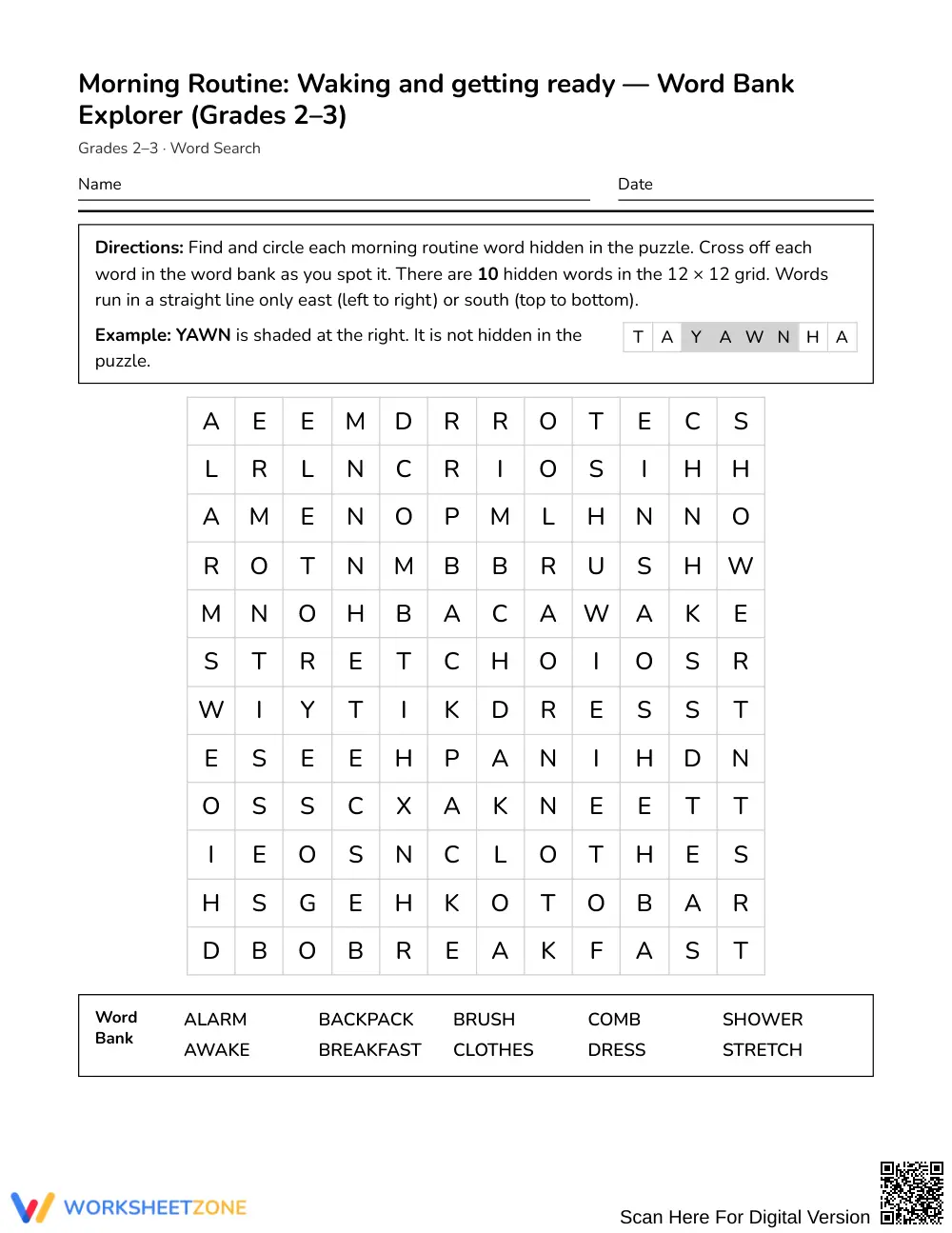
This Grades 2–3 morning routine word search reinforces functional vocabulary by guiding students to identify 10 words related to waking and getting ready. Learners locate vocabulary terms across a grid, strengthening word recognition and letter scanning. The activity provides purposeful, independent practice that builds daily routine comprehension.
At a Glance
- Grade: Grades 2–3 · Subject: English Language Arts (ELA)
- Standard: Not standards-assessed — vocabulary enrichment
- Skill Focus: Daily morning routines: waking and getting ready
- Format: 1 page · 10 words · Answer key included · PDF
- Best For: Independent morning arrival work and vocabulary centers
- Time: 15–20 minutes
This printable activity includes 1 student page featuring 10 target vocabulary words focused on morning routines. Below the letter grid, an alphabetical word bank pairs every word with a clear definition clue. A complete 2-page answer key provides quick visual verification of all hidden word placements.
Puzzle Mechanics and Structure
The puzzle utilizes a 12 × 12 grid suited for early elementary learners. All 10 hidden words appear in two reading directions: horizontally from left to right (East) and vertically downward (South). Without backwards or diagonal words, students focus successfully on orthographic tracking while crossing items off the alphabetical word list.
Standards Alignment
This word search provides vocabulary enrichment and is not aligned to a formal academic standard. It reinforces contextual literacy, spelling recognition, and functional living concepts, offering valuable supplementary practice for primary English Language Arts classrooms.
How to Use It
Use this resource as an independent morning arrival task or during literacy centers following direct instruction on daily routines. During the 15–20 minute activity, observe whether learners read definition clues to identify words or search exclusively for letter sequences.
Who It's For
This activity serves Grades 2–3 students developing print awareness. Support emerging readers by highlighting first letters in the word bank, or challenge advanced students to write descriptive sentences on the back. It pairs naturally with a morning routine visual schedule anchor chart.
Designed for Grades 2–3 English Language Arts, this 10-word morning routine vocabulary enrichment activity reinforces the foundational skill of identifying and reading words related to waking and getting ready. While designated as non-standards-assessed vocabulary enrichment rather than linked to an isolated state code, purposeful word puzzles play a documented role in early literacy development. According to Fisher & Frey (2014), intentional word exposure and morphological familiarity enhance orthographic mapping, allowing elementary learners to recognize high-frequency terms more automatically across diverse instructional contexts. By embedding explicit definition clues directly beside the alphabetical word bank, this activity links visual letter search with semantic meaning rather than isolated letter hunting. Educators can deploy this zero-prep puzzle during morning soft starts or independent reading blocks to build print awareness, fine-motor visual scanning, and daily routine comprehension among developing primary readers.


