
































Printable Migrating Birds Word Search | Grades 4–5 Science

Paste this activity's link or code into your existing LMS (Google Classroom, Canvas, Teams, Schoology, Moodle, etc.).
Students can open and work on the activity right away, with no student login required.
You'll still be able to track student progress and results from your teacher account.
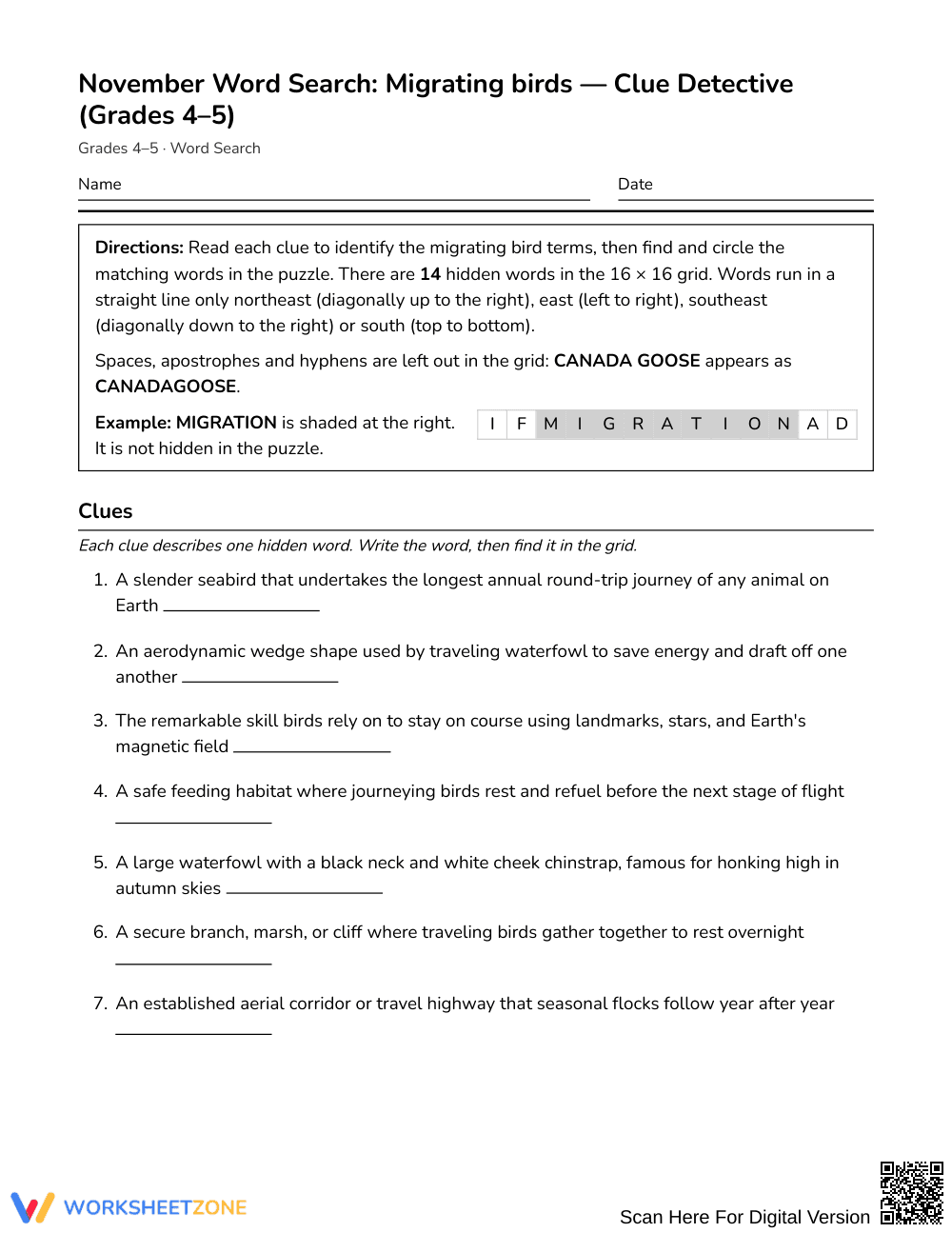
This migrating birds word search reinforces upper-elementary life science concepts through active vocabulary retrieval. Students read 14 informative clues about bird species and migration behaviors, determine the matching scientific terms, and locate each word within the letter grid, strengthening both domain-specific vocabulary and reading comprehension.
At a Glance
- Grade: Grades 4–5 · Subject: Science
- Standard: Not standards-assessed — vocabulary enrichment
- Skill Focus: Migrating birds
- Format: 3 pages · 14 words · Answer key included · PDF
- Best For: Science vocabulary reinforcement and early finishers
- Time: 20–30 minutes
What's Inside
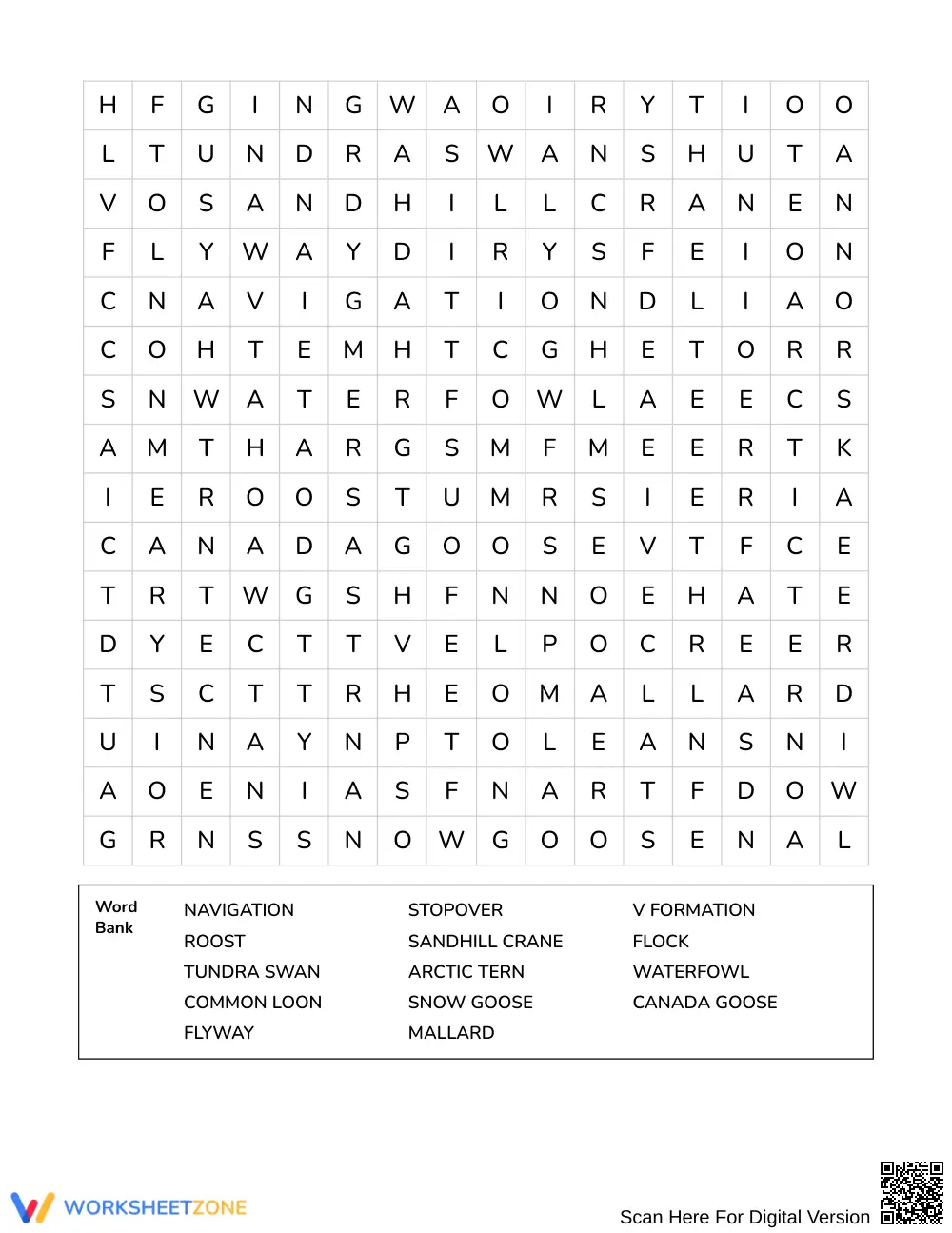
This 3-page science resource features a Clue Detective word search containing 14 hidden vocabulary words related to seasonal migration. Rather than simply copying words from a simple list, learners read descriptive clues detailing adaptations, flight patterns, and bird species to identify each term before searching. The download includes a complete 3-page answer key showing exact word locations and completed clue pairings.
Puzzle Mechanics and Structure
The puzzle is built around a challenging 16 x 16 letter grid designed specifically for intermediate elementary learners. Words are hidden across four distinct directional paths: northeast (diagonal up-right), east (horizontal forward), southeast (diagonal down-right), and south (vertical downward). Students use the provided clue sheet to identify 14 target words, including waterfowl species like the Canada Goose, Mallard, and Tundra Swan, as well as ecological concepts such as flyways, stopovers, navigation, and V formations.
Standards Alignment
This resource is designed strictly for vocabulary enrichment and is not aligned to a specific state or national content standard. It provides supplementary life science enrichment that supports broader units on animal adaptations and seasonal ecosystem dynamics.
How to Use It
Deploy this activity during an animal adaptations unit immediately after direct instruction on seasonal migration behaviors. It functions effectively as an independent practice station or as an engaging extension for early finishers. For formative assessment, circulate as students analyze the clues and verify whether they can explain why specific adaptations, such as drafting in a V formation or resting at stopover habitats, are critical for survival during long journeys. Expect completion to take between 20 and 30 minutes.
Who It's For
This word search is tailored for students in Grades 4–5 exploring ornithology, animal behavior, and seasonal environmental changes. It accommodates varied reading levels through descriptive context clues and pairs naturally with informational reading passages or anchor charts on North American migratory flyways.
Vocabulary acquisition in upper-elementary science requires repeated, contextual exposure to specialized terms. Fisher & Frey (2014) emphasize that intentional word-learning tasks that require students to connect definitions to conceptual terms enhance long-term retention and academic reading proficiency. This migrating birds activity supports that pedagogical goal by challenging students to interpret biological descriptions before locating 14 target words within a 16 x 16 grid. By reinforcing foundational terminology such as stopover habitats, navigation methods, and aerodynamic flight formations, the activity helps intermediate learners internalize the core mechanisms of seasonal animal adaptations without requiring separate preparatory instruction.


