




























Views
Downloads


Printable Magical Objects Word Search | Grades 6–7 ELA

Paste this activity's link or code into your existing LMS (Google Classroom, Canvas, Teams, Schoology, Moodle, etc.).
Students can open and work on the activity right away, with no student login required.
You'll still be able to track student progress and results from your teacher account.
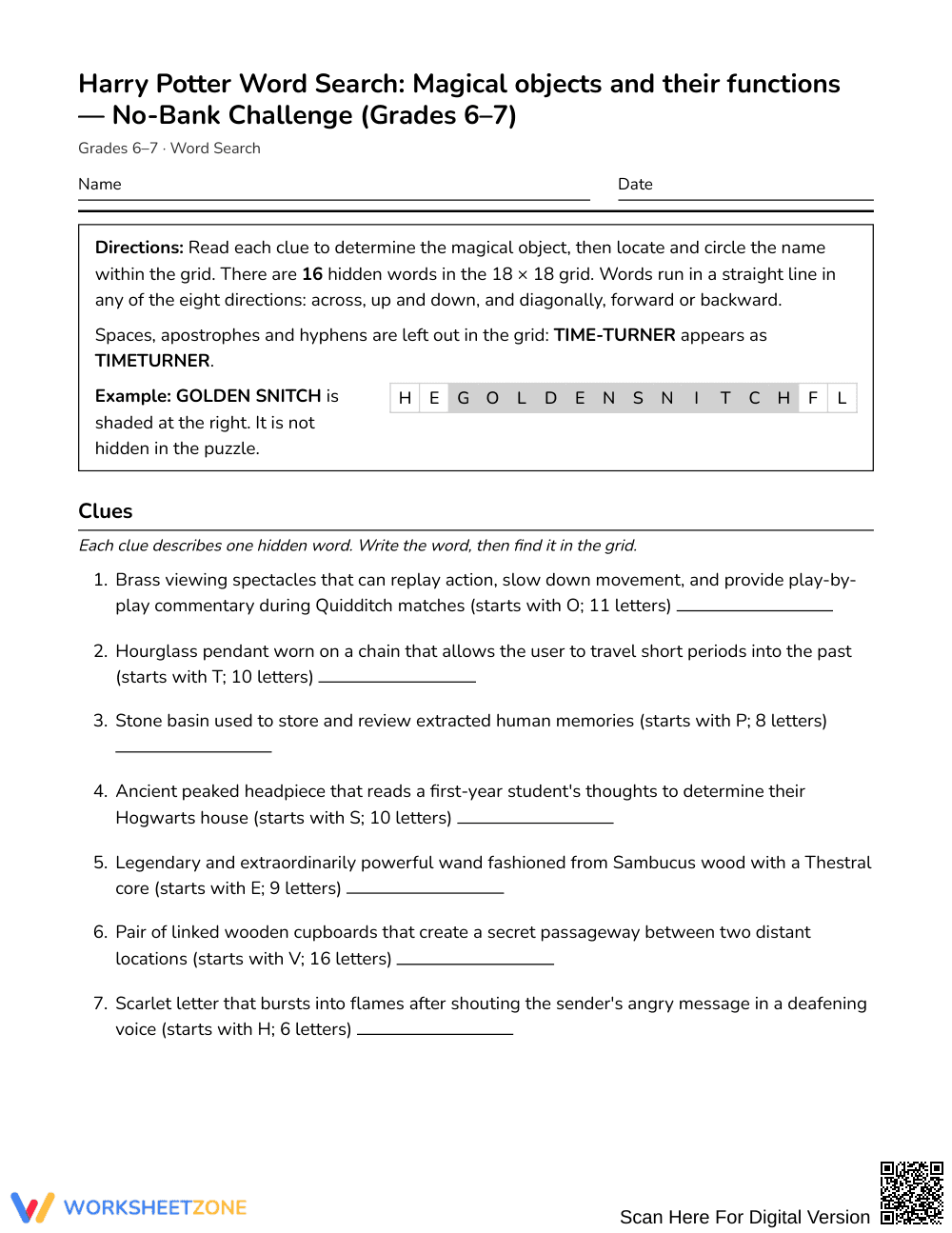
This Grades 6–7 English Language Arts word search reinforces descriptive vocabulary through literary context. Students analyze functional definitions of sixteen enchanted items from fantasy literature to deduce target terms before searching the letter grid. The no-word-bank format prompts active recall, context clue interpretation, and spelling precision during independent or partner literacy practice.
At a Glance
- Grade: Grades 6–7 · Subject: English Language Arts
- Standard: Not standards-assessed — vocabulary enrichment and context clue application
- Skill Focus: Magical objects and their narrative functions in fantasy texts
- Format: 3 student pages · 16 words · Complete answer key included · Printable PDF
- Best For: Literary vocabulary review, independent stations, or sub plans
- Time: 25–35 minutes
What's Inside
This 3-page printable activity features 16 literary vocabulary terms embedded within a letter grid alongside descriptive definitions. Rather than scanning a word list, learners read functional clues to deduce each term. The download includes a 4-page answer key showing exact letter coordinates and highlighted word paths for quick verification.
Puzzle Mechanics
The activity centers on an 18 x 18 grid designed to build spatial reasoning. Because no word bank is provided, students must actively interpret clues to deduce the 16 target words independently. Words run in eight directions: horizontal, vertical, and diagonal across N, NE, E, SE, S, SW, W, and NW orientations. Both forward and backward placements challenge visual discrimination.
Standards Alignment
This resource provides targeted vocabulary enrichment and is not aligned to a specific standard. It emphasizes morphological awareness, contextual inference, and fantasy literature terminology. Teachers can integrate this activity into novel study units to reinforce text-based vocabulary acquisition without testing pressure.
How to Use It
Deploy this word search during independent reading stations after introducing fantasy texts, or assign it as a mid-unit vocabulary review. For formative assessment, circulate as students analyze the clues to check whether they struggle with recalling terms from descriptions or locating letter sequences in the 18 x 18 grid. Most middle school learners finish in 25 to 35 minutes.
Who It's For
Designed for Grades 6–7 English Language Arts learners, this puzzle offers stimulating practice for general education classrooms, gifted clusters, and literature circles. For students needing support, pair partners collaboratively or provide the first letter of challenging terms. Pair this activity naturally with a fantasy character analysis chart or a descriptive writing lesson examining author craft.
Grounded in literacy research on contextual vocabulary learning, this Grades 6–7 English Language Arts word search engages students in retrieving domain-specific terminology through functional descriptions rather than rote memorization. According to Fisher & Frey (2014), purposeful word-solving strategies that require students to connect definitions, contextual clues, and orthographic patterns substantially reinforce long-term lexical retention. By eliminating the passive word bank, this activity transforms a standard recreational puzzle into a rigorous cognitive retrieval task across an 18 x 18 grid. Middle school learners analyze 16 narrative items, infer meaning from detailed descriptive clues, and apply visual scanning across eight directional axes to solidify word recognition. Because it operates as vocabulary enrichment without formal standards alignment, educators can implement the 3-page exercise flexibly for novel studies, differentiated enrichment, or review stations to support reading comprehension and student engagement.


