




























Printable K‑Pop Vocabulary Word Search | Grades 7–8 ELA
Paste this activity's link or code into your existing LMS (Google Classroom, Canvas, Teams, Schoology, Moodle, etc.).
Students can open and work on the activity right away, with no student login required.
You'll still be able to track student progress and results from your teacher account.
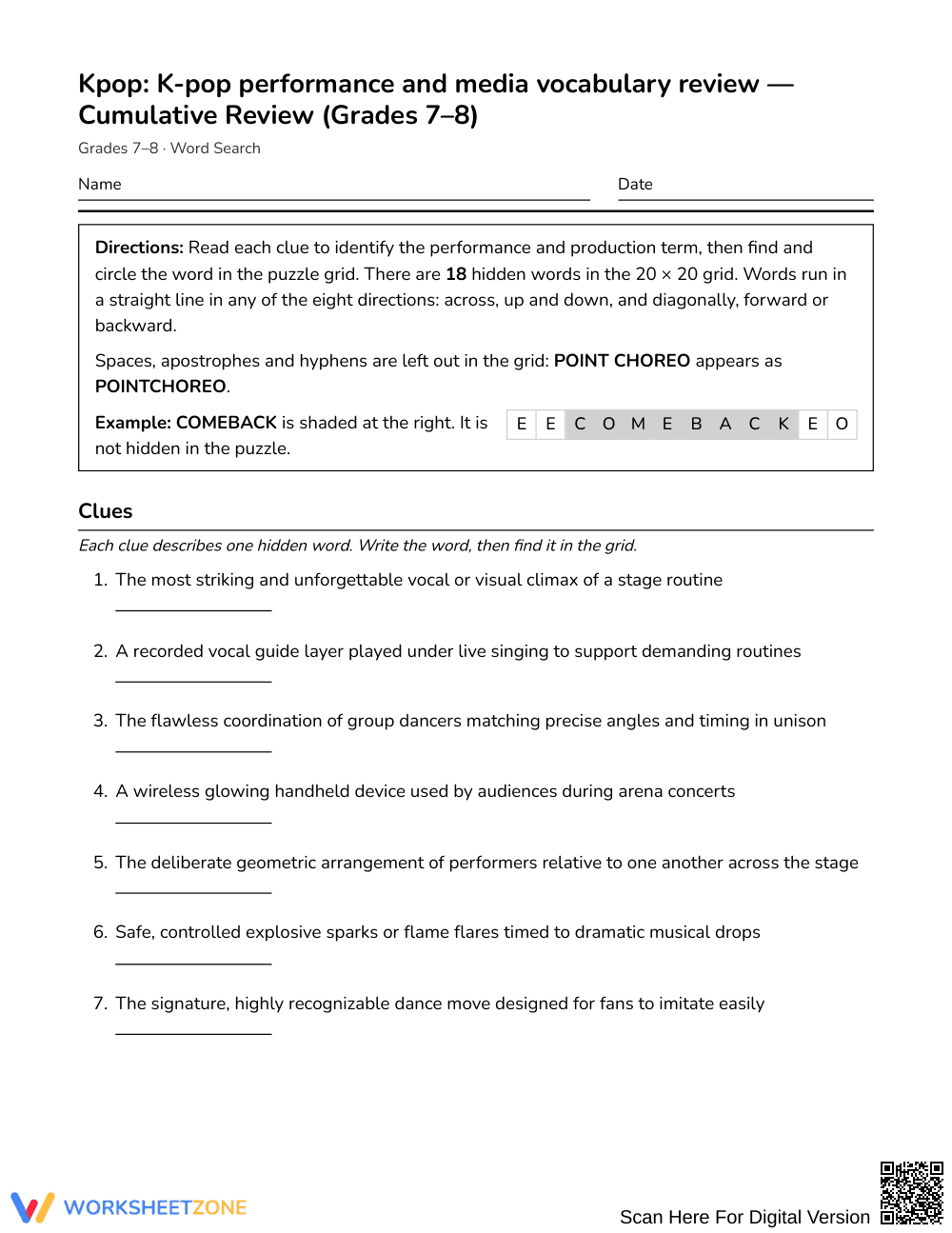
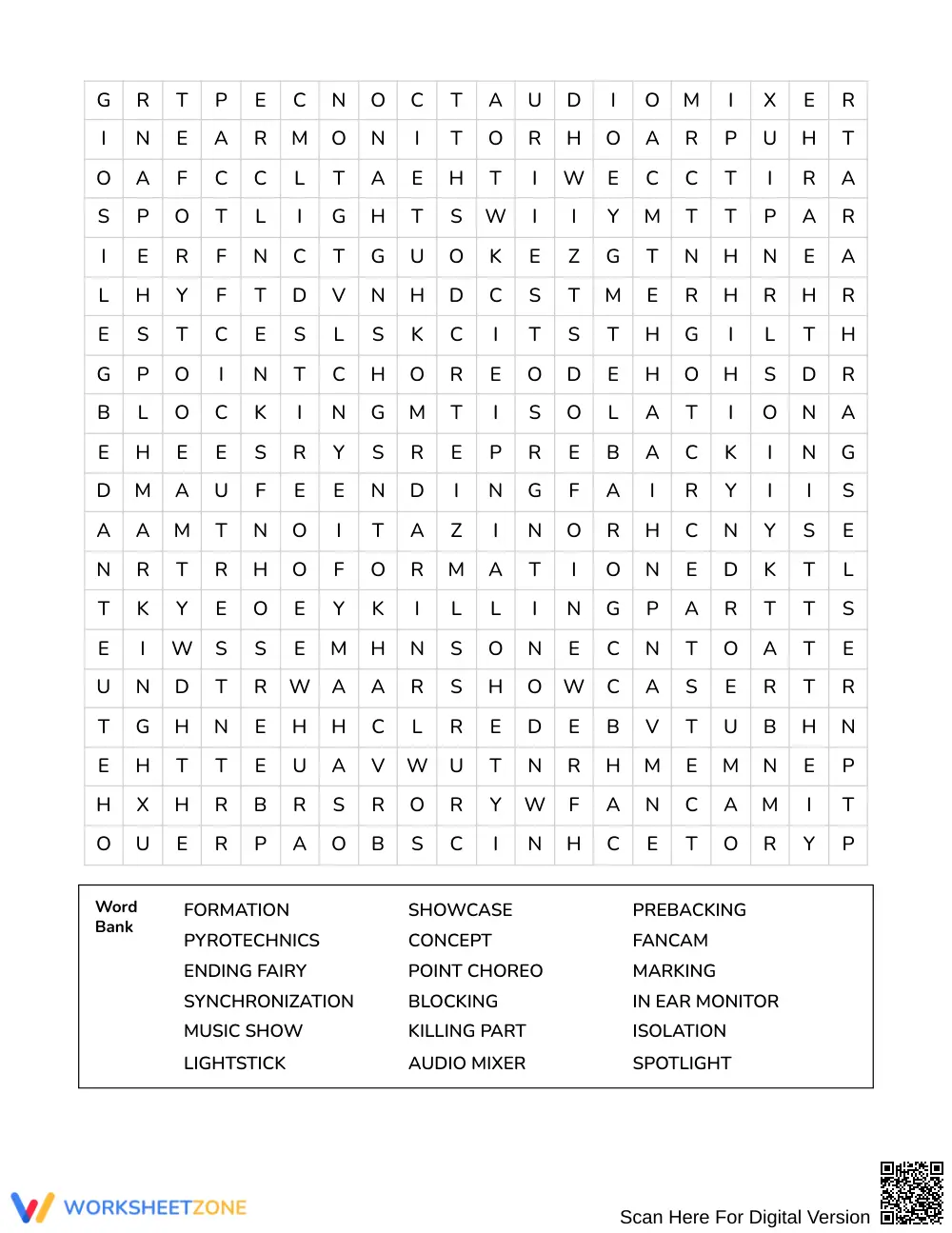
Students will reinforce key K‑pop performance and media vocabulary by locating 18 hidden terms in a 20 × 20 word search. The activity sharpens spelling, visual scanning, and contextual understanding, giving learners a fun, cumulative review that prepares them for upcoming unit assessments.
At a Glance
- Grade: Grades 7–8 · Subject: English Language Arts
- Standard:
Not standards-assessed — vocabulary enrichment— students explore and label K‑pop performance and media terminology while strengthening spelling- Skill Focus: K‑pop performance, production, and media vocabulary review
- Format: 3 printable pages · 18 hidden words · Answer key included · PDF ready for instant download
- Best For: Quick classroom review, homework enrichment, or after‑school club activity
- Time: Approximately 10–15 minutes per class session
What's Inside
The search spans three printable pages, each featuring a 20 × 20 grid filled with letters. Eighteen target words are listed in a shuffled word bank, and each term is accompanied by a concise clue that defines the K‑pop performance or media concept. An answer key on a separate page shows the completed grid for quick verification.
Puzzle Mechanics
Students scan the 20 × 20 grid to locate each hidden term. Words may run horizontally, vertically, or diagonally in any of the eight directions—north, northeast, east, southeast, south, southwest, west, or northwest. The shuffled word bank prevents pattern guessing, while the clues guide learners toward the correct spelling and meaning of each term.
Standards Alignment
This activity is designed solely for vocabulary enrichment and does not map to any state or national standard. It offers a focused, engaging way for students to reinforce domain‑specific terminology without the pressure of formal assessment criteria.
How to Use It
Use the word search as a warm‑up before a lesson on K‑pop media, allowing students to activate prior knowledge while you observe scanning strategies. Alternatively, assign it as a low‑stakes homework task; collect completed grids to gauge which terms need reteaching, noting any missed words during a quick exit ticket. Each session typically lasts 10–15 minutes.
Who It's For
The word search targets Grades 7–8 learners in ELA classes who are studying contemporary music culture. No differentiation levels are built in, but teachers can easily adjust difficulty by providing the clue list only or by removing the answer key for independent practice. Pair the activity with a short K‑pop performance video or an anchor chart of media vocabulary for a multimodal experience.
Research shows that word‑search puzzles can boost incidental vocabulary acquisition when paired with meaningful context (Fisher & Frey, 2014). By confronting learners with 18 K‑pop performance and media terms, this activity encourages students to expand domain‑specific vocabulary through engaging, low‑stakes practice. The shuffled word bank and clue‑driven format require active decoding, reinforcing spelling patterns and conceptual understanding without overt testing pressure. Although not tied to a formal standard, the exercise aligns with best practices for vocabulary enrichment in middle‑school ELA curricula, supporting the development of both oral‑language fluency and reading comprehension. Teachers report increased student motivation and quicker mastery of niche terminology when such interactive tasks are incorporated regularly. The activity also provides immediate feedback via the answer key, allowing teachers to quickly identify gaps and plan targeted follow‑up lessons that reinforce the newly learned terms.


