
































Printable Justify Equivalence Worksheet | Grade 7 Math

Paste this activity's link or code into your existing LMS (Google Classroom, Canvas, Teams, Schoology, Moodle, etc.).
Students can open and work on the activity right away, with no student login required.
You'll still be able to track student progress and results from your teacher account.
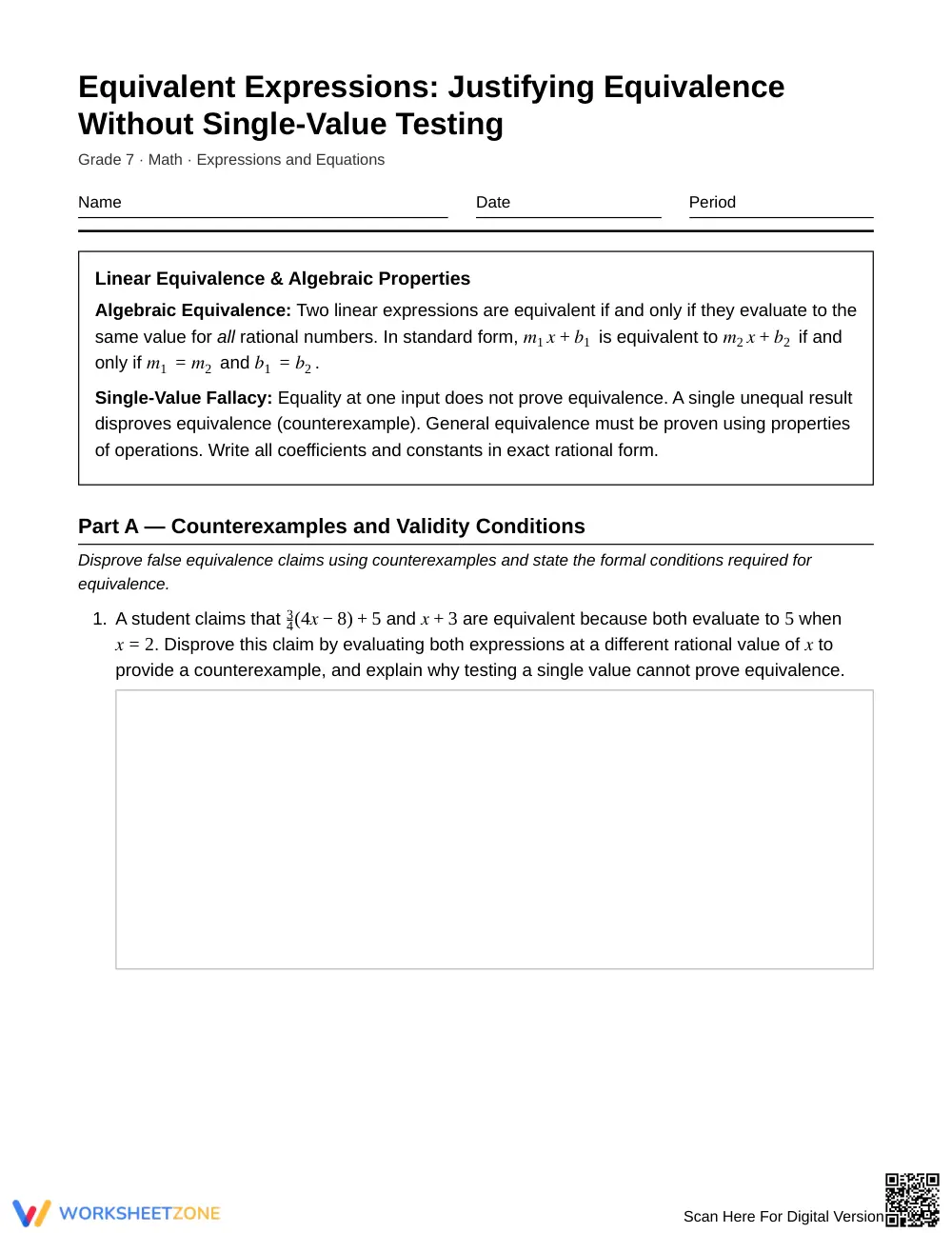
This Grade 7 worksheet builds students' ability to prove that two linear expressions are equivalent for all rational numbers using properties of operations — not single-value substitution. Across 8 carefully sequenced tasks, students construct counterexamples, critique flawed reasoning, and produce formal algebraic justifications involving the Distributive Property, combining like terms, and factoring.
At a Glance
- Grade: 7 · Subject: Math
- Standard:
7.EE.A.1— Apply properties of operations to add, subtract, factor, and expand linear expressions- Skill Focus: Justifying expression equivalence without single-value testing
- Format: 5 pages · 8 problems · Answer key included · PDF
- Best For: Guided practice after direct instruction on equivalence
- Time: 35–50 minutes
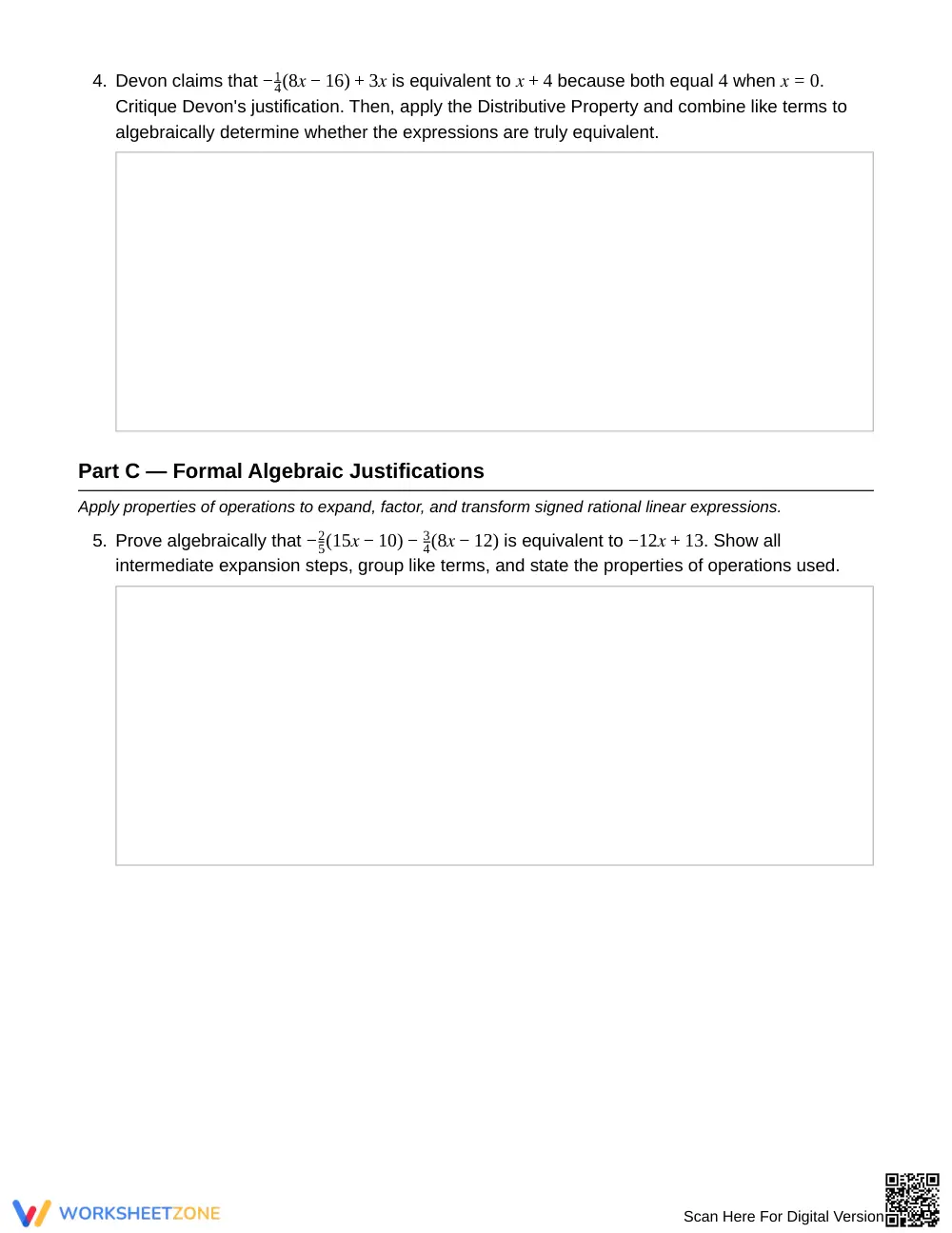
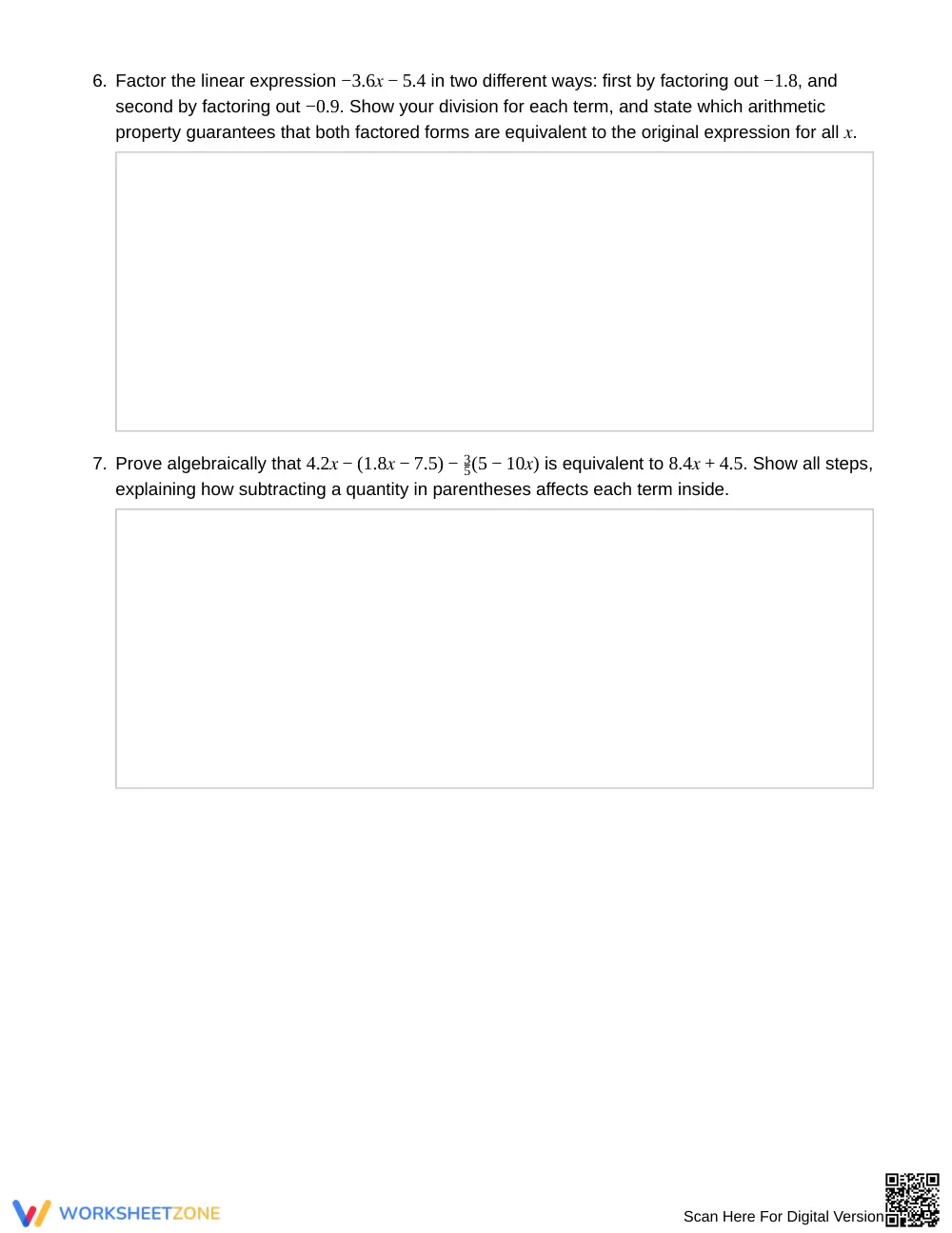
The worksheet spans 5 pages across three parts. Part A presents two counterexample and validity tasks. Part B asks students to analyze and correct peer simplifications. Part C contains four formal proof tasks, including multi-step expansion with signed rational coefficients, two-way factoring, and a structured justification table with missing expressions and property labels. A 3-page answer key provides worked solutions for every item.
- Guided practice (Parts A–B, 4 tasks): A rule box at the top defines linear equivalence in standard form and names the Single-Value Fallacy, giving students a reference frame before evaluating claims.
- Supported practice (Part C, tasks 5–7): Students expand and simplify expressions with fractions and decimals, naming properties to maintain algebraic rigor.
- Independent practice (Part C, task 8): The justification table removes scaffolding cues: students supply missing expressions and property labels, then explain why deductive proof guarantees equivalence.
Standards Alignment
Primary standard: 7.EE.A.1 — Apply properties of operations as strategies to add, subtract, factor, and expand linear expressions with rational coefficients. Counterexample tasks target the logical conditions for equivalence, while simplification and factoring tasks require students to apply and reverse the Distributive Property. A supporting connection to 7.EE.A.2 appears in the peer-critique tasks.
How to Use It
Assign Parts A and B after initial instruction to ensure students do not conflate single-value equality with general equivalence. Use Part C for independent practice or a formative checkpoint: difficulty with property names indicates vocabulary needs rather than calculation errors. Expected completion time is 35–50 minutes.
Who It's For
Designed for Grade 7 classrooms, this resource supports students moving from arithmetic evaluation to algebraic proof. It pairs well with anchor charts detailing the Distributive, Commutative, and Associative properties.
Aligned to 7.EE.A.1, this worksheet targets a core skill that national assessments consistently flag as a seventh-grade gap: students can evaluate expressions but struggle to reason about equivalence across all values. Research by Fisher and Frey (2014) identifies structured justification tasks, where students name properties alongside each algebraic step, as a high-leverage practice for closing this gap because they require students to make implicit reasoning explicit. By requiring learners to state operational properties and definitions, this activity transforms routine arithmetic into formal deductive proof. The 8-problem progression moves from counterexample construction through peer critique to independent proof, giving teachers a complete formative picture of student mastery. These diagnostic steps help educators identify whether errors stem from arithmetic or conceptual misunderstandings. In addition, the included answer key allows immediate scoring, supports self-assessment routines, and can be referenced in IEP progress notes tied directly to algebraic reasoning goals.


