


























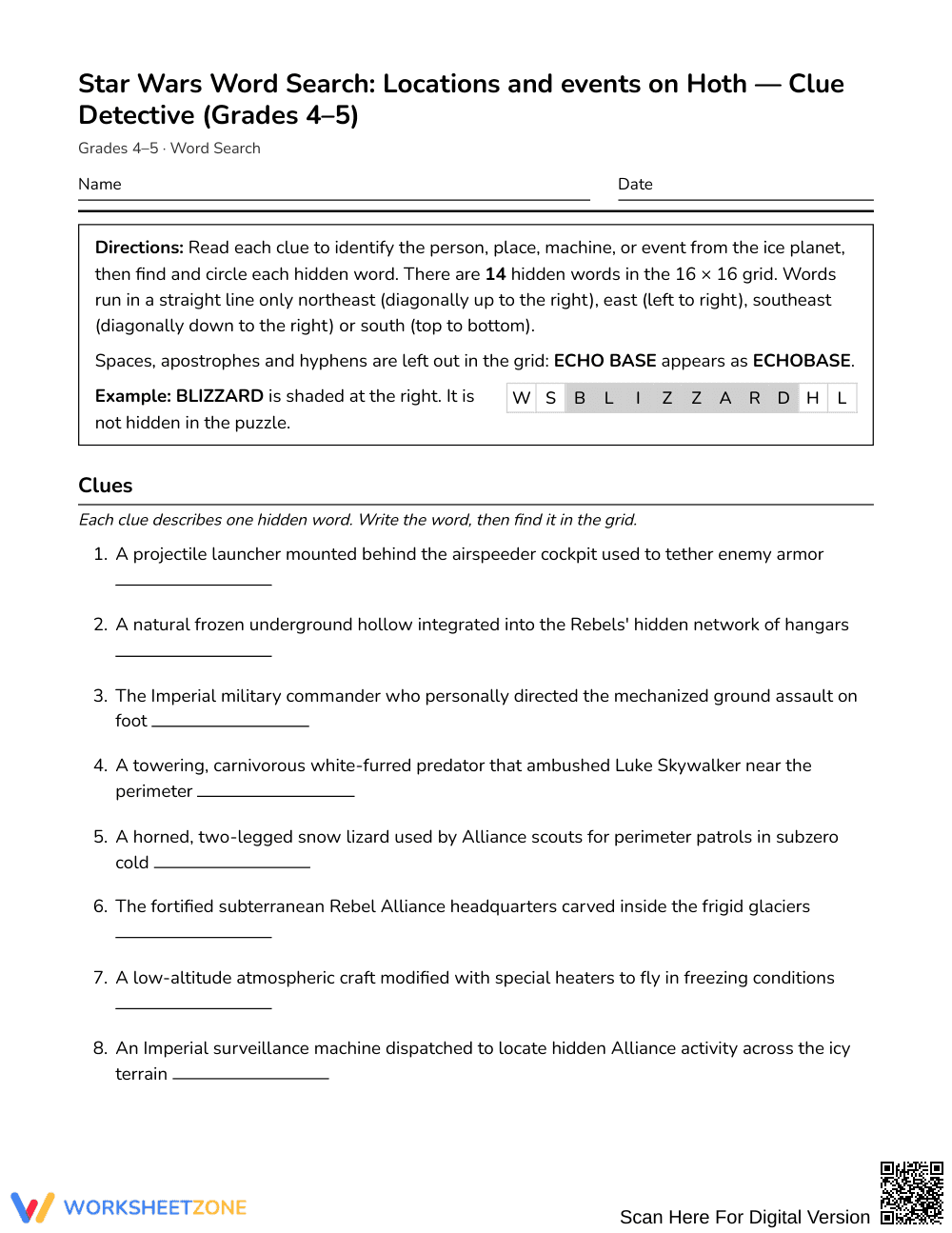


Printable Hoth Locations Word Search | Grades 4–5 ELA
Paste this activity's link or code into your existing LMS (Google Classroom, Canvas, Teams, Schoology, Moodle, etc.).
Students can open and work on the activity right away, with no student login required.
You'll still be able to track student progress and results from your teacher account.
This Grades 4–5 English Language Arts word search challenges students to decode 14 science-fiction vocabulary terms focused on the frozen world of Hoth. Students read context clues to identify key places, vehicles, creatures, and tactical events before locating each term in the puzzle grid, strengthening context-clue reading and descriptive vocabulary recall.
At a Glance
- Grade: Grades 4–5 · Subject: English Language Arts (ELA)
- Standard: Not standards-assessed — vocabulary enrichment
- Skill Focus: Locations and events on Hoth
- Format: 3 pages · 14 words · Answer key included · PDF
- Best For: Early finishers and themed vocabulary enrichment
- Time: 20–35 minutes
What's Inside: The printable PDF activity features a 3-page student layout paired with a comprehensive 3-page solution key. Students engage with an organized clue detective format containing 14 rich descriptive clues rather than a simple word list, requiring learners to read definitions closely to deduce hidden target terms including Echo Base, Ion Cannon, and Snowspeeder.
How the Puzzle Works: Words are arranged inside a 16 × 16 letter grid. Hidden words run across four designated orientations: northeast, east, southeast, and south. Learners read each narrative clue to identify the correct person, place, machine, or event, then scan the letter matrix in those four directions to locate and circle each target entry.
Standards Alignment: This activity is designed strictly for vocabulary enrichment and is not aligned to a specific grade-level standard. It supports cross-curricular literacy engagement by encouraging careful text analysis, contextual inference, and spelling reinforcement through high-interest informational clues.
How to Use It: Deploy this puzzle during independent work time after a whole-class reading lesson on setting and descriptive adjectives, or use it as an engaging Friday literacy center. As a formative check, circulate while students match clues to determine whether they can explain which keywords in the prompt led them to identify items like Bacta Tank or Shield Generator. Most upper-elementary learners will finish the search in 20 to 35 minutes.
Who It's For: This resource is tailored for fourth and fifth grade readers who benefit from gamified vocabulary acquisition, including reluctant readers motivated by popular media themes. Pair this printable puzzle with an anchor chart on context clues or a creative writing prompt describing extreme planetary environments.
Vocabulary acquisition research highlighted by Fisher & Frey (2014) emphasizes that intentional word-learning tasks succeed when students engage with explicit definitional clues rather than memorizing isolated lists. This Grades 4–5 enrichment activity operationalizes that principle by presenting 14 vocabulary clues that require learners to synthesize contextual details about terrain, technology, and tactical events. Instead of merely hunting for arbitrary character strings across a 16 × 16 grid, students actively practice reading comprehension by interpreting descriptive sentences before executing visual searches. Connecting definitional inference with orthographic recognition strengthens word-retention pathways and spelling awareness for intermediate elementary learners. By combining high-interest thematic content with analytical clue reading, the 3-page layout provides purposeful, screen-free enrichment that bolsters text-based deduction, visual discrimination, and sustained focus across diverse classroom literacy blocks.


