





























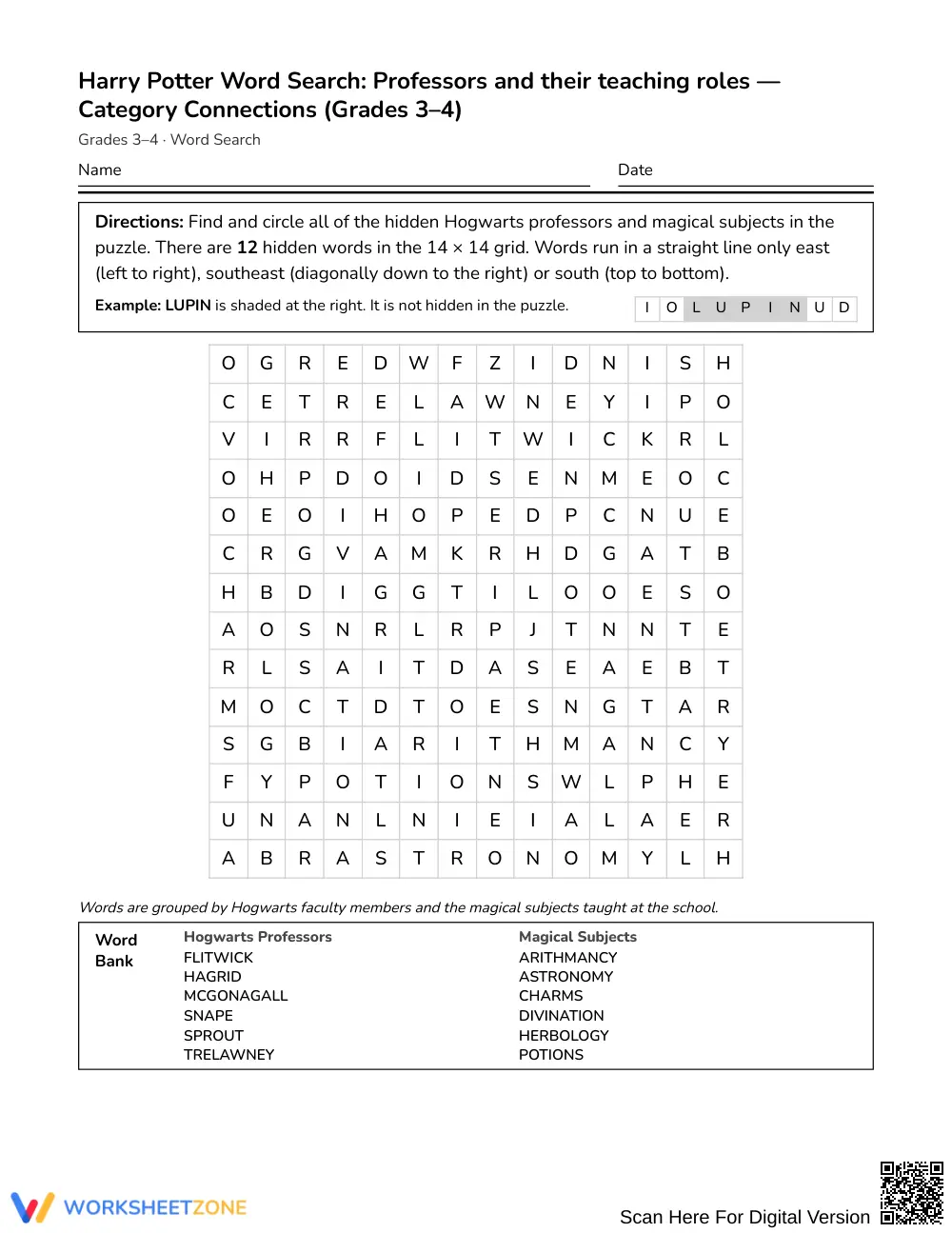


Printable Hogwarts Professors Word Search | Grades 3–4 ELA

Paste this activity's link or code into your existing LMS (Google Classroom, Canvas, Teams, Schoology, Moodle, etc.).
Students can open and work on the activity right away, with no student login required.
You'll still be able to track student progress and results from your teacher account.
This Grades 3–4 ELA word search builds reading vocabulary by challenging students to identify Hogwarts professors and their corresponding magical teaching subjects. Students discover twelve themed terms while reinforcing character roles and subject-matter associations. The engaging puzzle format promotes spelling accuracy, pattern recognition, and literary recall across an accessible fantasy novel context.
At a Glance
- Grade: Grades 3–4 · Subject: English Language Arts (ELA) Vocabulary
- Standard: Not standards-assessed — targeted vocabulary enrichment and thematic reading engagement
- Skill Focus: Identifying Hogwarts professors and their teaching roles
- Format: 1 student page · 12 words · 3-page answer key included · Printable PDF
- Best For: Independent vocabulary enrichment, literacy centers, or early finisher practice
- Time: 15–25 minutes of focused puzzle solving
What's Inside
This resource includes a 1-page student word search featuring 12 target vocabulary words organized into two clear categories: Hogwarts Professors and Magical Subjects. A dedicated word bank groups the names alongside brief descriptive clues that define each character and course. The resource also provides a comprehensive 3-page answer key highlighting exact word placements for rapid checking.
How the Puzzle Works
The activity centers on a 14 x 14 letter grid designed for accessible upper-elementary scanning. Hidden vocabulary terms run in three primary directions: horizontally from left to right (East), diagonally downward (Southeast), and vertically downward (South). Students reference a categorized word bank containing six faculty members and six magical classes, using thematic clues to confirm spellings as they search.
Standards Alignment
This activity serves strictly as vocabulary enrichment and is not formally aligned to a specific Common Core or state academic standard. Instead, it provides supplemental practice in word recognition, thematic categorizing, and orthographic visual scanning to bolster general reading confidence during English Language Arts instruction.
How to Use It
Deploy this word search during independent literacy stations following a novel study chapter, or assign it as an engaging fast-finisher activity after direct reading instruction. For formative assessment, observe whether students actively connect faculty names to their respective academic subjects using the clue definitions, rather than hunting for random letter clusters. Typical completion requires 15 to 25 minutes.
Who It's For
This puzzle is tailored for Grades 3–4 students developing foundational scanning skills and reading stamina through popular literature themes. The directional limitations protect emerging readers from backward letter confusion, while the categorized layout scaffolds concept sorting. Pair this activity naturally with a character-tracking graphic organizer or classroom read-aloud discussion.
Designed for Grades 3–4 English Language Arts enrichment rather than formal standard-based evaluation, this 12-word search reinforces thematic vocabulary acquisition by connecting Hogwarts professors directly to their specialized instructional fields. While not assessed under formal curriculum codes, structured orthographic puzzles build essential visual discrimination, lexical familiarity, and domain-specific classification. According to Fisher & Frey (2014), intentional word exposure through categorized associations strengthens student lexical retention and facilitates deeper reading comprehension during independent literacy tasks. By searching for twelve terms across a 14 x 14 letter grid running only East, Southeast, and South, learners actively rehearse correct letter sequences without encountering backward directional interference. The resource pairs categorized word banks with concise narrative clues, allowing elementary educators to provide targeted spelling reinforcement, positive literary engagement, and low-stress visual processing practice within a focused 15-to-25-minute instructional window.


