





























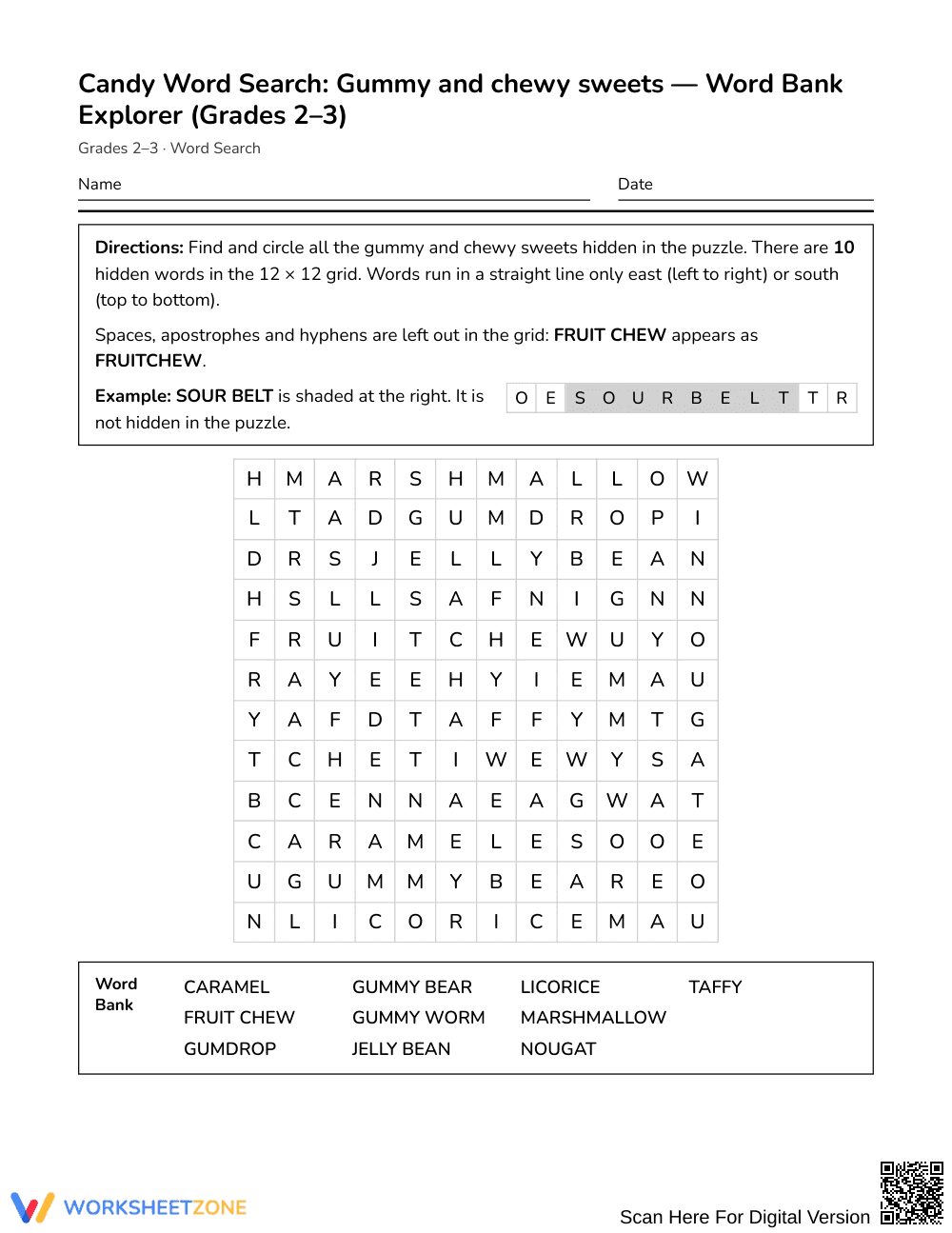


Printable Gummy Sweets Word Search | Grades 2–3 ELA

Paste this activity's link or code into your existing LMS (Google Classroom, Canvas, Teams, Schoology, Moodle, etc.).
Students can open and work on the activity right away, with no student login required.
You'll still be able to track student progress and results from your teacher account.
This Grades 2–3 vocabulary word search introduces learners to descriptive confectionery terms through an engaging print-and-go puzzle. Students search for 10 themed words centered on gummy and chewy sweets, building word recognition, letter pattern awareness, and visual scanning skills without requiring any teacher preparation.
At a Glance
- Grade: Grades 2–3 · Subject: English Language Arts (ELA)
- Standard: Not standards-assessed — vocabulary enrichment
- Skill Focus: Gummy and chewy sweets vocabulary
- Format: 1 page · 10 words · Answer key included · PDF
- Best For: Early finishers, morning work, sub plans
- Time: 15–20 minutes
What's Inside
The activity sheet contains a single-page puzzle featuring an alphabetical word bank of 10 vocabulary terms alongside an accessible letter matrix. The package includes a clear two-page answer key showing exact letter coordinates for quick checking or independent student self-correction.
Puzzle Structure and Mechanics
Designed specifically for emerging readers in primary elementary grades, the puzzle utilizes a compact 12×12 grid. All 10 hidden words run in only two intuitive directions: East (left to right) and South (top to bottom). Omitting diagonal and backwards placements prevents visual frustration while reinforcing standard English reading tracking. Students reference the alphabetized list of words, which includes terms such as caramel, marshmallow, licorice, and gumdrop, crossing off entries as they locate each item in the letter array.
Standards Alignment
This activity is designed purely for vocabulary enrichment and thematic word exploration; it is not aligned to a formal state or national content standard. It provides supplemental language exposure that supports orthographic mapping and spelling pattern recognition in early elementary classrooms.
How to Use It
Distribute this puzzle during literacy centers or as an engaging sponge activity after direct phonics instruction. For an effective formative check, circulate while students search and ask them to read discovered words aloud, verifying that they connect letter sequences with accurate pronunciation. Most learners will complete the search within 15 to 20 minutes.
Who It's For
This resource is tailored for Grades 2–3 students developing fluent print tracking and spelling confidence. For emerging readers needing extra support, provide a highlighter to trace starting letters across the grid. Pair this activity naturally with a descriptive writing lesson about sensory details or a shared read-aloud about confectioneries.
According to research highlighted by Fisher & Frey (2014), purposeful word-play tasks and print-rich puzzles support orthographic familiarity by prompting students to analyze orthographic patterns in low-stakes contexts. While this 10-word puzzle functions primarily as an enjoyable vocabulary enrichment resource rather than a formal assessment tool, the structured search task actively reinforces linear scanning from left to right and top to bottom. Engaging with thematic terms like nougat, taffy, and jelly bean in an organized 12×12 grid helps young learners solidify visual memory for multisyllabic spellings without overwhelming developing cognitive loads.


