


























Views
Downloads
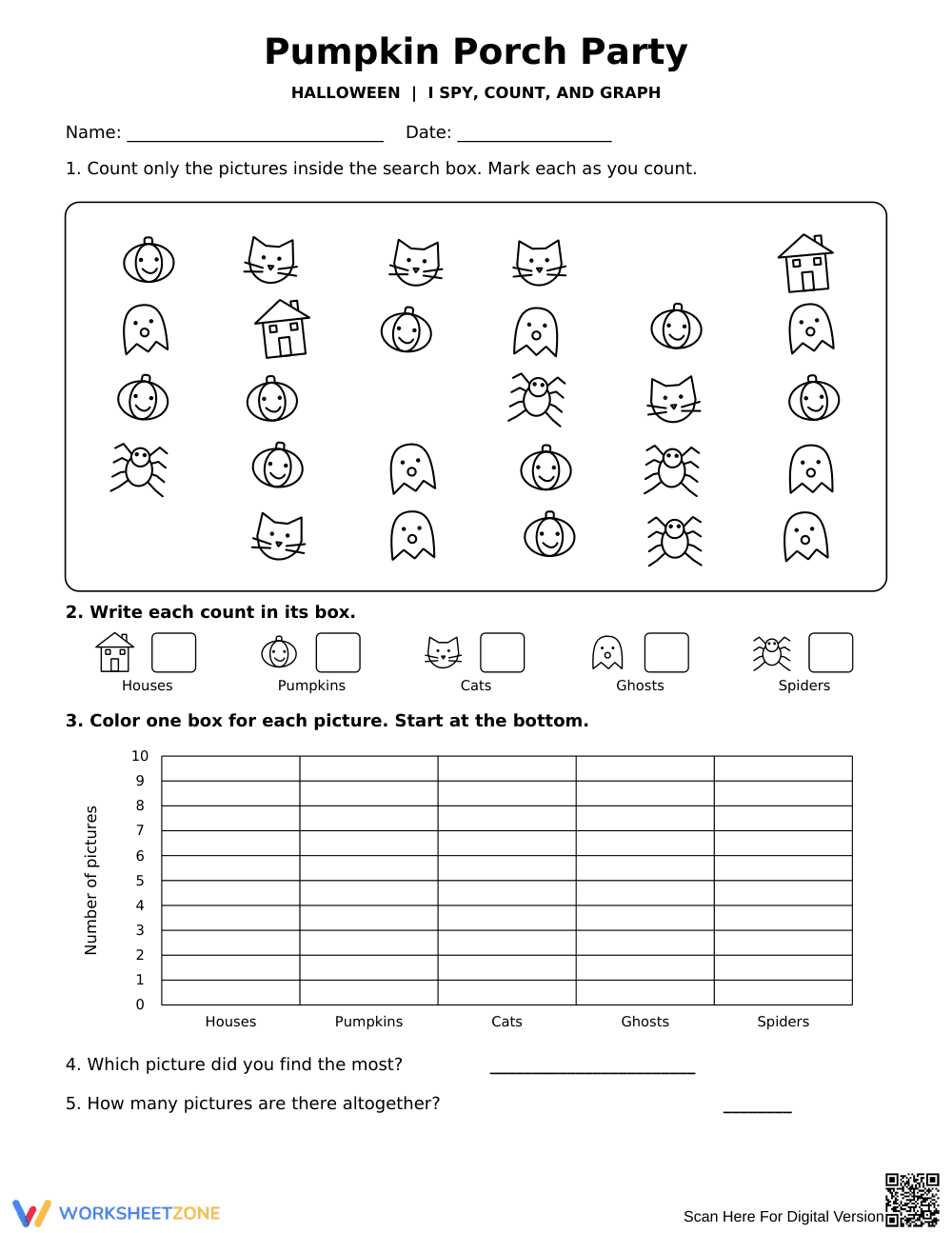

Printable Grade K Halloween Count and Graph Worksheet
Paste this activity's link or code into your existing LMS (Google Classroom, Canvas, Teams, Schoology, Moodle, etc.).
Students can open and work on the activity right away, with no student login required.
You'll still be able to track student progress and results from your teacher account.
This Kindergarten Halloween count and graph activity builds foundational data literacy through visual discrimination, item counting up to 10, and single-unit bar graphing. Students count 5 image categories inside a search box, record totals, shade vertical columns, and answer simple analytical questions.
At a Glance
- Grade: Kindergarten · Subject: Math
- Standard:
CCSS.MATH.CONTENT.K.MD.B.3— Classify objects into categories, count quantities, and sort categories by count.- Skill Focus: Counting, sorting, bar graphing, visual data analysis
- Format: 1 activity page · 5 problems · Answer key included · PDF
- Best For: Math centers, morning work, seasonal practice
- Time: 15–20 minutes
The activity page contains 5 sequential tasks centered around a Halloween search box containing 27 illustrations (houses, pumpkins, cats, ghosts, spiders). Students tally each image type into labeled boxes, construct a 10-unit vertical bar graph, determine the most frequent category, and calculate the overall total sum. A complete teacher answer key is included.
Skill Progression & Scaffolding
- Guided practice: Tasks 1 and 2 direct students to mark objects while scanning and record categorical counts for 5 icon types in designated boxes.
- Supported practice: Task 3 bridges counting to data representation as students shade vertical bar graph cells from 1 to 10 based on recorded values.
- Independent practice: Tasks 4 and 5 require independent analysis to identify the maximum category and calculate the total count of 27 items.
This explicit gradual-release sequence moves students systematically from basic visual tracking to data visualization and introductory quantitative comparison.
Standards Alignment
This resource aligns to CCSS.MATH.CONTENT.K.MD.B.3: Classify objects into given categories; count the numbers of objects in each category and sort the categories by count. It also supports CCSS.MATH.CONTENT.1.MD.C.4 data standards. Both standard codes can be copied directly into lesson plans, IEP goals, or district curriculum mapping tools.
How to Use It
Assign this activity during independent math rotations or seasonal morning work after direct instruction on bar graphs. Observe student scanning techniques to formatively assess one-to-one correspondence and visual tracking accuracy. Expected completion time is 15 to 20 minutes for early primary learners.
Who It's For
Ideal for Kindergarten and early Grade 1 students developing counting fluency and data organization. Provide bingo daubers for extra motor support, or pair this activity with a hands-on counting cube math center and class anchor chart.
Aligned to standard CCSS.MATH.CONTENT.K.MD.B.3, this early math activity systematically reinforces category sorting, counting, and visual graphing. Research by Fisher & Frey (2014) demonstrates that scaffolded visual graphic representations significantly assist young learners when transitioning from concrete counting to abstract data analysis. By guiding students step-by-step through item scanning, numerical recording, bar shading, and addition, this single-page resource builds foundational math fluency and early statistical reasoning skills. Educators can directly integrate this standards-based tool into seasonal math centers, formative diagnostic checks, or small-group guided practice to ensure early learners master category sorting, comparative counting, and visual graph construction before progressing to multi-digit data representation in future grades.


