





























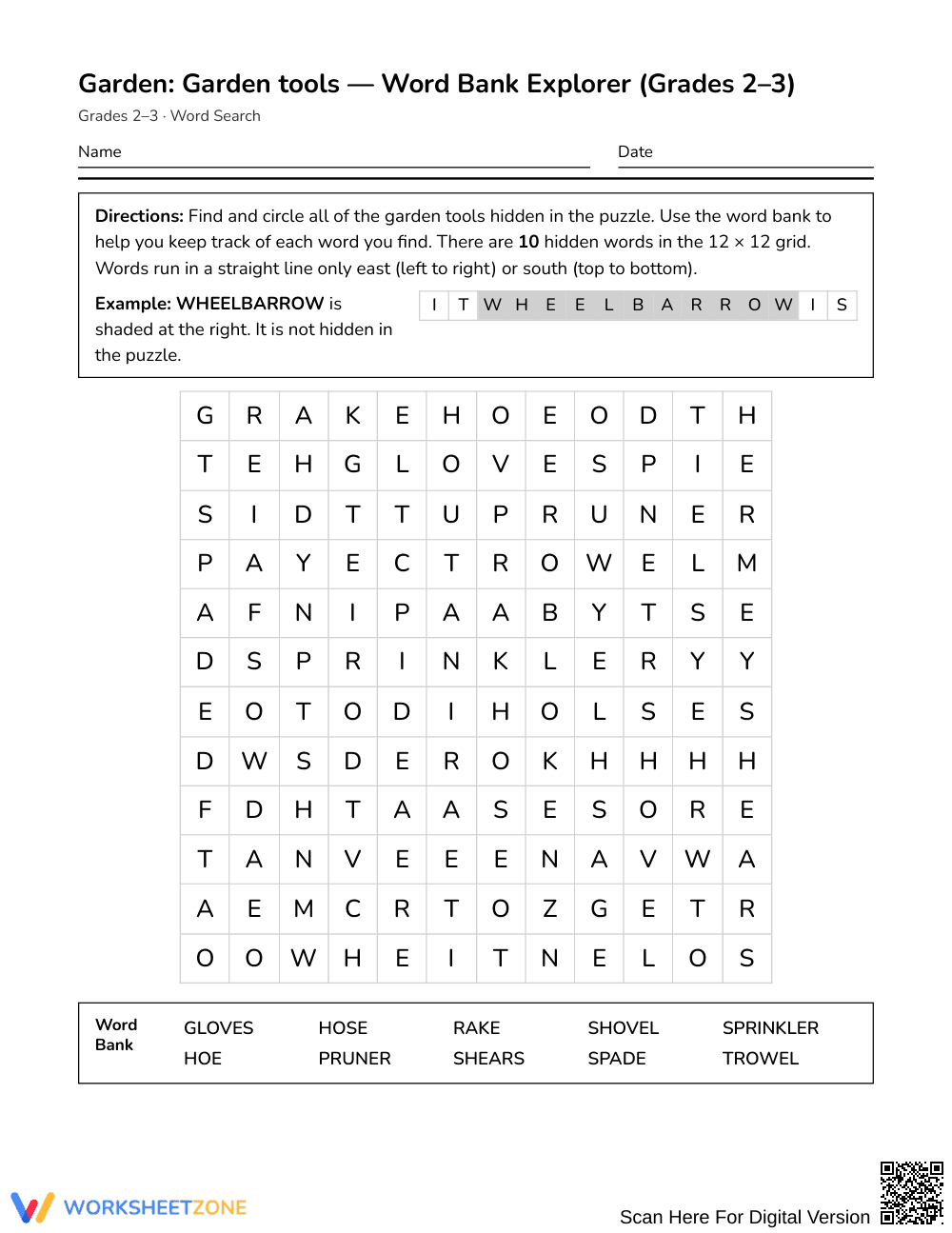


Printable Garden Tools Word Search | Grades 2–3 ELA

Paste this activity's link or code into your existing LMS (Google Classroom, Canvas, Teams, Schoology, Moodle, etc.).
Students can open and work on the activity right away, with no student login required.
You'll still be able to track student progress and results from your teacher account.
This Grades 2–3 garden tools word search introduces elementary learners to ten essential gardening terms through structured visual search and definition matching. Students locate vocabulary words in a grid while connecting each tool to its real-world function, reinforcing foundational reading, orthographic pattern recognition, and practical vocabulary acquisition.
At a Glance
- Grade: Grades 2–3 elementary learners · Subject: English Language Arts (ELA)
- Standard: Not standards-assessed — targeted vocabulary enrichment and contextual spelling practice
- Skill Focus: Garden tools and outdoor equipment vocabulary
- Format: 1 printable student page · 10 hidden words · Full answer key included · PDF document
- Best For: Independent vocabulary enrichment and early finishers
- Time: 15–20 minutes completion time
What's Inside
This single-page activity contains a compact 10-word puzzle with an alphabetical word bank and accompanying tool clues. Students find terms such as trowel, pruner, shears, and sprinkler. The download includes a complete two-page answer key that highlights exact word placements in the grid, allowing teachers or students to verify answers immediately.
Puzzle Structure and Mechanics
The activity features a 12 x 12 letter grid arranged specifically for early elementary searchers. All 10 vocabulary words run in only two directions: East (left to right) and South (top to bottom). This intentional layout eliminates backwards or diagonal confusion while students scan. Learners reference the alphabetical word bank and functional clues to confirm each tool's name before locating and circling it in the grid.
Standards Alignment
This word search provides dedicated vocabulary enrichment and is not formally aligned to an assessed standard code. It strengthens orthographic awareness, letter sequencing, and domain-specific vocabulary connected to gardening and plant care. Educators can incorporate the puzzle into thematic units without needing to track formal standard metrics.
How to Use It
Use this puzzle as an independent literacy station after introducing a science lesson on plants, or assign it during morning work as a quiet vocabulary review. As students work, observe whether they scan horizontally and vertically line-by-line or hunt letters erratically to gauge their visual tracking maturity. Most students complete the 10 words in 15 to 20 minutes.
Who It's For
This resource is crafted for Grades 2–3 students developing word recognition and spelling stamina. For emerging readers, provide highlighters to mark found words or review the tool definitions orally beforehand. It pairs naturally with an illustrated garden anchor chart or a read-aloud about planting a community vegetable garden.
Targeted vocabulary puzzles provide valuable orthographic reinforcement that supports early literacy development in primary classrooms. According to Fisher & Frey (2014), intentional word exposure combined with functional definitions enables young learners to internalize domain-specific language more effectively than rote memorization alone. This Grades 2–3 garden tools word search delivers focused practice across 10 essential vocabulary terms, requiring students to locate words running East and South within a structured 12 x 12 grid. By connecting concrete garden implements such as trowels, pruners, and shears to their practical functions, the activity bridges vocabulary acquisition and visual discrimination skills. Because the activity focuses purely on vocabulary enrichment rather than formal standards testing, educators can deploy it as flexible supplemental practice during science or literacy instruction. The accompanying two-page answer key provides immediate feedback, helping elementary learners build spelling confidence and independent problem-solving habits during foundational word study.


