































Printable Frozen Treats Word Search | Grades 4–5 ELA

Paste this activity's link or code into your existing LMS (Google Classroom, Canvas, Teams, Schoology, Moodle, etc.).
Students can open and work on the activity right away, with no student login required.
You'll still be able to track student progress and results from your teacher account.
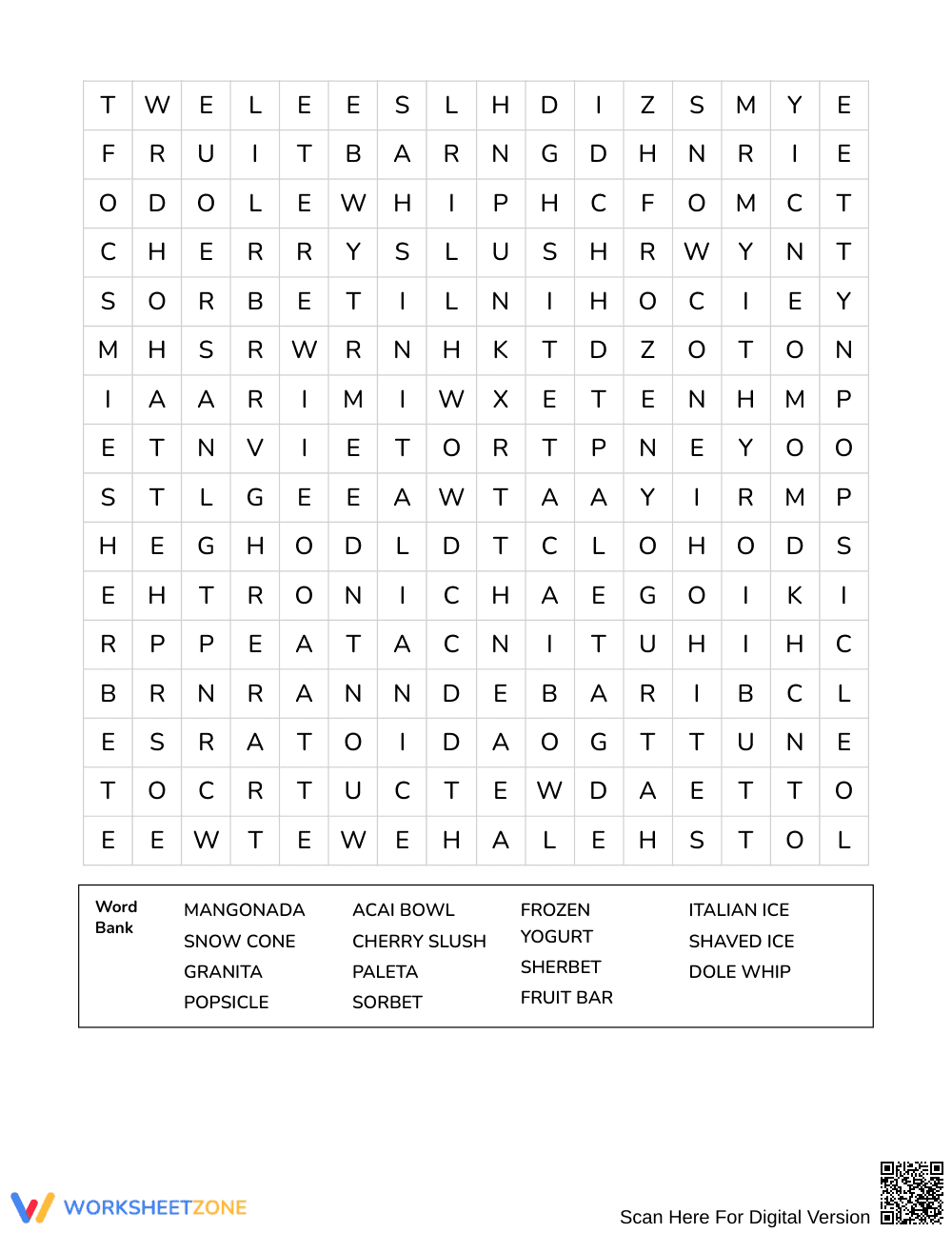
This fruit-based frozen treats word search expands upper elementary vocabulary by challenging students to connect descriptive food clues with authentic frozen desserts. Learners read informative definitions, deduce the mystery terms, and locate fourteen culinary vocabulary words in a letter grid. The activity strengthens reading comprehension and domain-specific vocabulary through engaging puzzle solving.
At a Glance
- Grade: Grades 4–5 · Subject: English Language Arts (ELA)
- Standard: Not standards-assessed — culinary vocabulary enrichment and reading context clues
- Skill Focus: Fruit-based frozen treats and worldwide frozen dessert vocabulary
- Format: 3 printable pages · 14 hidden words · Full answer key included · PDF
- Best For: Vocabulary enrichment, seasonal literacy centers, sub plans, and early finishers
- Time: 15–25 minutes of independent student practice
This 3-page printable PDF includes an instructional puzzle page alongside a matching 3-page answer key. Rather than relying on a simple word list, the activity features fourteen clue sentences that prompt students to identify items like sorbet, paleta, and mangonada. A shuffled word bank provides immediate spelling support, helping learners confirm their answers before scanning the grid.
Puzzle Mechanics and Structure
Students navigate a carefully planned search environment built to reinforce spelling and reading stamina:
- Grid Dimensions: A 16 x 16 letter matrix provides ample spacing to hide all 14 vocabulary words.
- Search Directions: Words run in four specific orientations: northeast (NE), east (E), southeast (SE), and south (S). No backward placements are used.
- Clue Detective Format: Students read 14 descriptive definitions to deduce each treat before searching, supported by a shuffled word bank.
Standards Alignment
This resource serves strictly as vocabulary enrichment and is not aligned to a formal standard. Instead of standards assessment, it provides supplemental practice with cultural food terms, context clues, and multi-syllabic spelling patterns that support general English Language Arts literacy development.
How to Use It
Deploy this word search during independent reading stations after introducing informational texts about world foods, or assign it as a fast-finisher task. Circulate to observe whether students use the descriptive clues first or scan the word bank directly, noting which learners demonstrate strong morphological decoding when searching for compound words like shaved ice. Completion takes 15 to 25 minutes.
Who It's For
This activity is designed for Grades 4–5 students developing cross-cultural vocabulary and context-clue reading strategies. For English language learners, teachers can highlight the first letters of target words in the grid as a visual anchor. Pair this puzzle with an informational passage on world culinary traditions or an anchor chart featuring sensory adjectives.
This vocabulary enrichment word search builds domain-specific reading comprehension and word recognition for upper elementary learners without formal standards alignment. By requiring students to interpret descriptive definitions before locating 14 culinary terms across a 16 by 16 letter grid, the task integrates semantic analysis with visual orthographic scanning. According to Fisher & Frey (2014), intentional exposure to tiered vocabulary through playful, low-stakes practice strengthens word consciousness and long-term lexical retention across diverse content areas. The resource emphasizes directional tracking along four non-inverted paths—specifically northeast, east, southeast, and south—ensuring that students maintain focus on authentic spelling sequences rather than arbitrary backward letter reversals. Operating as an enrichment exercise rather than a standards-based assessment, this printable activity provides targeted practice in context clues and multi-syllabic decoding. It delivers an effective, low-prep instructional tool for classroom literacy rotations, independent study, and seasonal vocabulary development.


