


























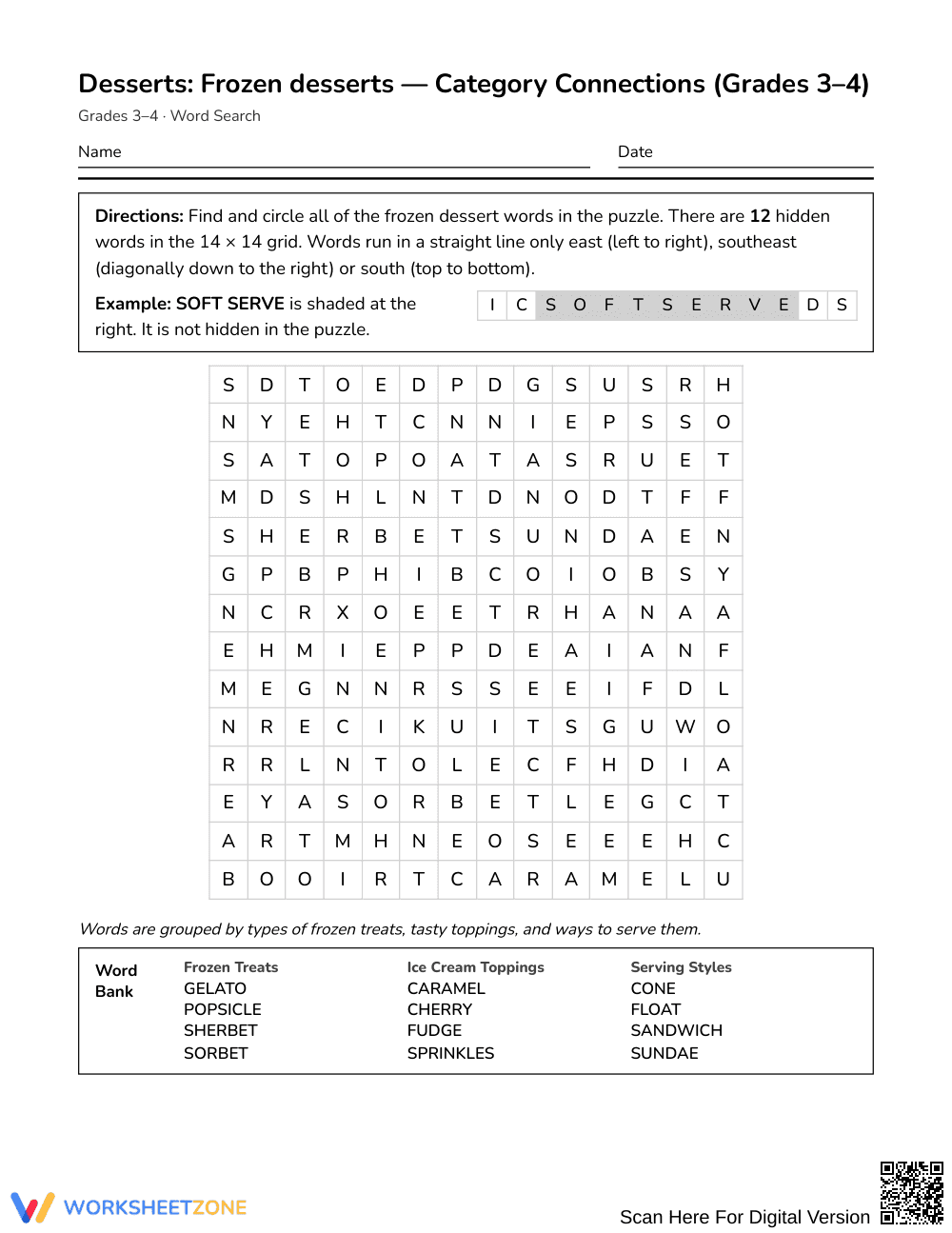

Printable Frozen Desserts Word Search | Grades 3–4 ELA
Paste this activity's link or code into your existing LMS (Google Classroom, Canvas, Teams, Schoology, Moodle, etc.).
Students can open and work on the activity right away, with no student login required.
You'll still be able to track student progress and results from your teacher account.
This Grades 3–4 vocabulary word search reinforces culinary and descriptive terms through an engaging frozen desserts theme. Students locate 12 topic-specific words categorized by frozen treats, toppings, and serving styles, expanding their descriptive reading vocabulary while practicing visual scanning and pattern recognition. It delivers targeted, independent language practice.
At a Glance
- Grade: Grades 3–4 · Subject: English Language Arts (ELA)
- Standard: Not standards-assessed — vocabulary enrichment identifying topic words
- Skill Focus: Frozen desserts terminology and categorization
- Format: 1 printable page · 12 hidden words · Answer key included · PDF
- Best For: Independent vocabulary enrichment and early finishers
- Time: 15–20 instructional minutes
What's Inside
This 1-page vocabulary activity contains a student puzzle sheet paired with a 3-page complete answer key. The resource organizes 12 target vocabulary words under three thematic category headings: Frozen Treats, Ice Cream Toppings, and Serving Styles. Each category groups four related terms, offering structured semantic connections alongside detailed descriptive clues that reinforce comprehension before students search.
Puzzle Structure
The activity features a 14 x 14 letter grid designed specifically for elementary learners. Target words run in three accessible orientations: East (horizontal left-to-right), Southeast (diagonal downward), and South (vertical top-to-bottom). Words do not run backward, ensuring the puzzle remains challenging yet developmentally appropriate. Students reference the categorized word bank to locate all 12 vocabulary terms efficiently.
Standards Alignment
This word search is designed purely as vocabulary enrichment and is not aligned to a formal academic standard. Instead of formal testing measures, it supports general language acquisition by familiarizing elementary students with domain-specific dessert nouns and descriptive adjectives in an engaging, low-stakes context.
How to Use It
Deploy this activity during independent literacy rotations or as an engaging sponge activity after direct vocabulary instruction. Teachers can also assign it during a seasonal celebration or food-themed thematic unit. For formative assessment, observe whether students identify words by scanning first-letter clusters or by tracking word shapes, noting who requires visual tracking assistance. Completion takes approximately 15 to 20 minutes.
Who It's For
This printable is built for students in Grades 3–4 who benefit from engaging visual word recognition tasks. It serves as an accessible supplement for English language learners building food-related vocabulary and provides a relaxing, focused exercise for early finishers. Pair this puzzle with an informational reading passage about food science or a descriptive writing prompt about favorite treats.
According to Fisher & Frey (2014), intentional word exposure through categorized vocabulary study strengthens semantic networks, enabling elementary learners to build deeper conceptual understanding across literacy domains. While this Grades 3–4 word search is not standards-assessed and serves as vocabulary enrichment, engaging with domain-specific terms like gelato, sorbet, and sundae supports visual discrimination and spelling pattern recall. The structured 14 x 14 grid format directs attention to orthographic patterns without introducing cognitive overload. Fisher & Frey emphasize that collaborative and independent word play cements contextual associations when paired with clear thematic categories. By organizing 12 targeted words into distinct groups—frozen treats, toppings, and serving styles—this activity encourages students to connect terminology with real-world definitions. Consequently, playful orthographic exploration functions as an effective entry point for expanding descriptive language and reinforcing reading confidence across intermediate elementary classrooms.


