




























Views
Downloads





Printable Food Web Cascades Worksheet | Grade 6 Science

Paste this activity's link or code into your existing LMS (Google Classroom, Canvas, Teams, Schoology, Moodle, etc.).
Students can open and work on the activity right away, with no student login required.
You'll still be able to track student progress and results from your teacher account.
Mastering ecological networks requires students to analyze how disturbances ripple across multiple trophic levels. This Grade 6 science worksheet guides learners through 14 analytical tasks based on a synthetic meadow ecosystem, training them to trace direct feeding relationships, calculate energy losses, and accurately predict indirect population effects across complex food webs.
At a Glance
- Grade: 6 · Subject: Science
- Standard: Grade 6 Life Science — Predict how changes in one population indirectly affect other ecosystem populations
- Skill Focus: Food web indirect effects and trophic cascades
- Format: 6 pages · 14 problems · Answer key included · PDF
- Best For: Ecosystem disturbance analysis and trophic modeling
- Time: 45–60 minutes
What’s Inside: This 6-page comprehensive resource provides a structured 10-species meadow dataset across four trophic levels, paired with 14 multi-part questions. Students analyze energy loss calculations, evaluate multiple-choice cascade scenarios, critique competing population models with quantitative census data, and defend a habitat management proposal. A thorough 3-page answer key provides complete model rationales.
Skill Progression
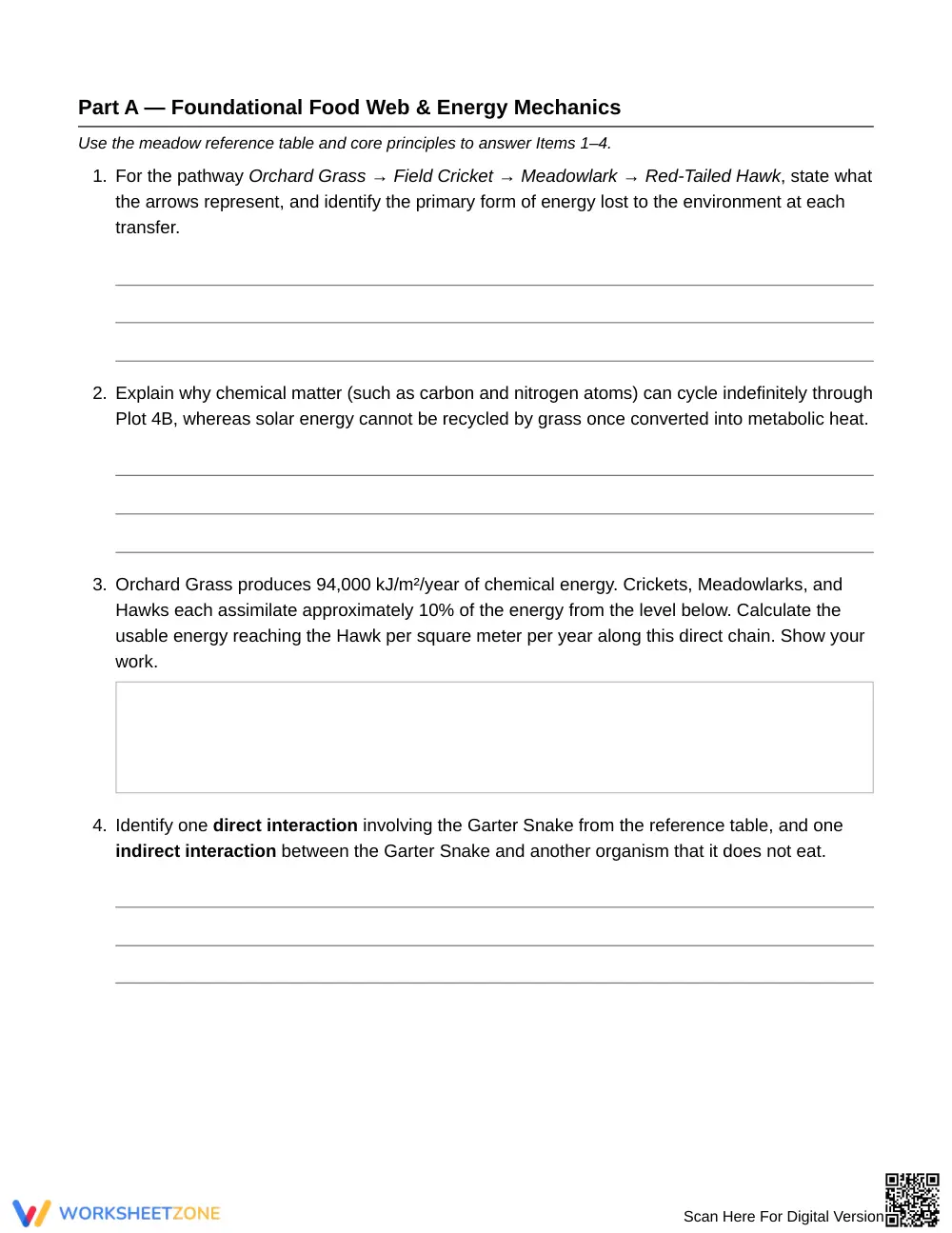
- Guided Practice (Part A, Items 1–4): Students establish foundational mechanics by interpreting feeding arrows, calculating a 10% trophic energy transfer, and distinguishing matter cycling from one-way energy dissipation.
- Supported Practice (Part B, Items 5–8): Scenarios introduce targeted population crashes and fungal blights, prompting students to trace multi-step indirect effects and identify shared-prey interactions.
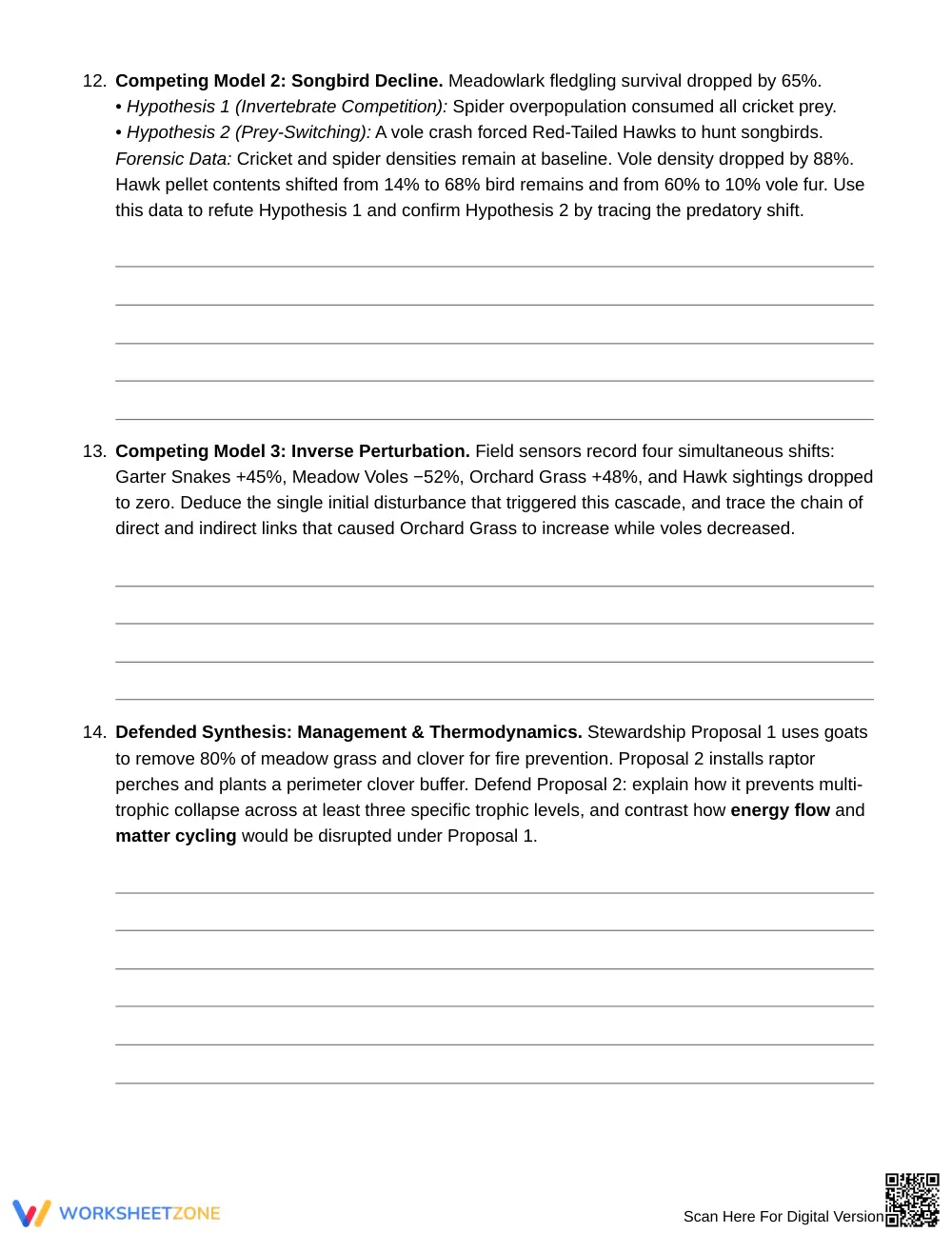
- Independent Practice (Part C, Tasks 9–14): Students evaluate competing empirical claims using real field census percentages, deduce unstated ecological disturbances, and construct a written ecosystem management argument.
This sequence follows the gradual-release framework, moving students systematically from basic diagram decoding to sophisticated ecosystem synthesis.
Standards Alignment
This resource aligns with middle school life science standards covering ecosystem dynamics, functioning, and resilience. Students evaluate empirical evidence to explain how resource availability and population fluctuations cause indirect changes across interrelated food webs. This alignment supports core science and engineering practices in analyzing data and constructing scientific explanations for district curriculum mapping.
How to Use It
Deploy this activity after direct instruction on food chains and the 10% energy rule to deepen critical thinking. For formative assessment, examine student reasoning on Part B item 8 to check whether learners grasp how shared predators mediate indirect competition between non-competing herbivores. Typical completion takes 45 to 60 minutes across one extended lab block.
Who It's For
Designed for Grade 6 general science and introductory life science classrooms, this worksheet supports diverse learners through structured data tables and scaffolded prompt tiers. Pair this assignment with an interactive food web string-yarn model or an energy pyramid anchor chart to reinforce abstract feeding pathways visually.
Predicting indirect community dynamics within ecological food webs requires middle school students to move beyond linear food chains and engage with multi-trophic causal reasoning. Empirical research from Fisher & Frey (2014) highlights that structured guided practice, supported by gradual release from foundational mechanics to constrained analytical scenarios, significantly improves student comprehension of complex scientific systems. By integrating authentic data interpretation, competing ecological hypotheses, and thermodynamic calculations across 14 rigorous items, this 6-page Grade 6 science worksheet equips learners to trace secondary feeding disruptions and explain trophic cascades. Students analyze how matter cycles continuously while 90% of energy dissipates as heat, applying quantitative evidence to evaluate ecosystem stability. The included 3-page explanatory answer key supports accurate self-assessment and targeted remediation, ensuring middle schoolers achieve deep conceptual mastery over complex food web interactions.


