































Printable Food Market Tour Word Search | Grades 4–5 ELA

Paste this activity's link or code into your existing LMS (Google Classroom, Canvas, Teams, Schoology, Moodle, etc.).
Students can open and work on the activity right away, with no student login required.
You'll still be able to track student progress and results from your teacher account.
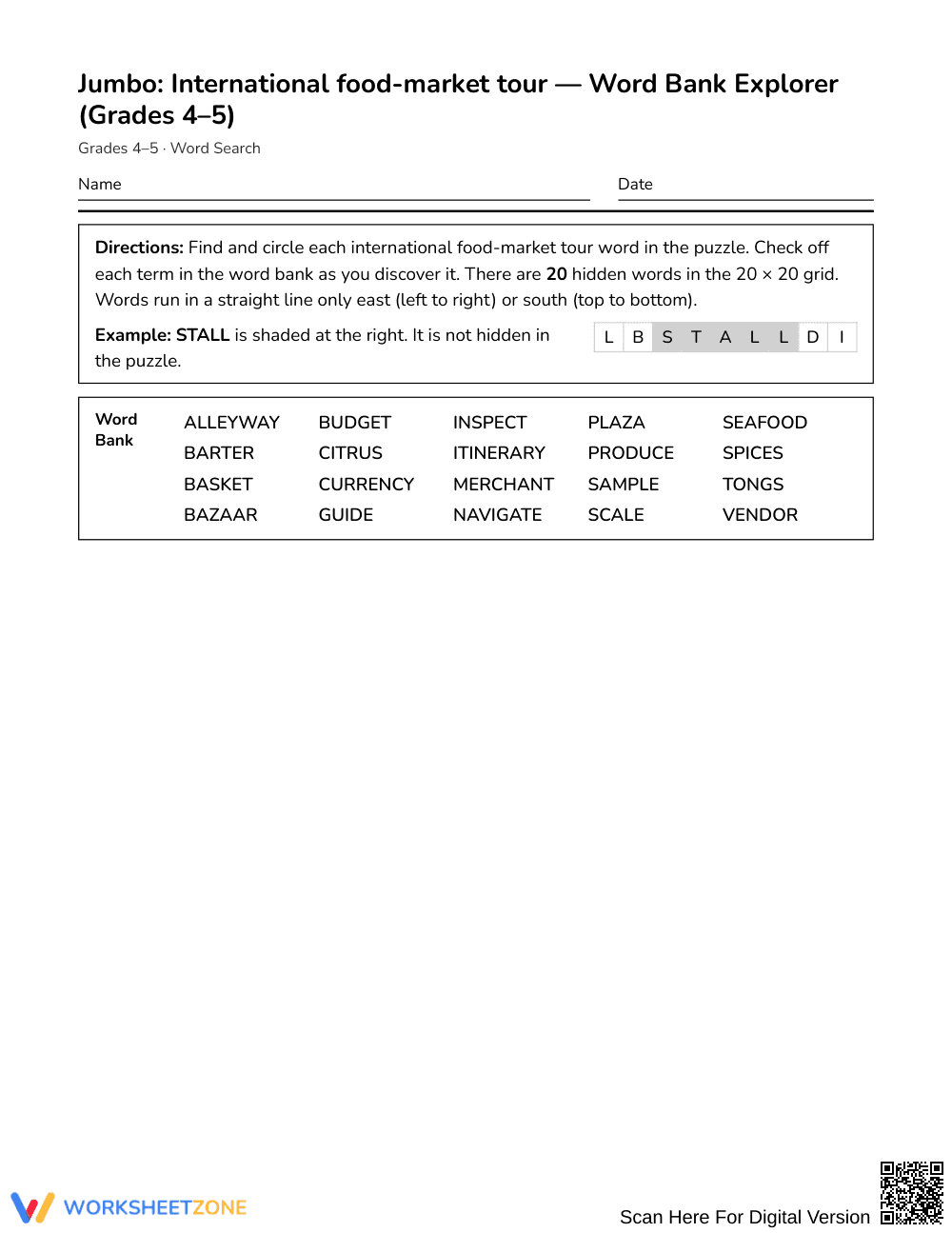
This food-market tour word search helps upper elementary students build cultural and culinary vocabulary through focused visual scanning. Learners identify and record key international market terms, reinforcing spelling and word recognition while exploring global trade concepts. The activity provides an engaging vocabulary experience that strengthens language awareness and reading stamina across two student-ready printable pages.
At a Glance
- Grade: Grades 4–5 · Subject: English Language Arts
- Standard: Not standards-assessed — vocabulary enrichment
- Skill Focus: International food-market tour vocabulary
- Format: 2 pages · 20 words · Answer key included · PDF
- Best For: Vocabulary warm-up or early finishers
- Time: 15–25 minutes
What's Inside: This two-page vocabulary resource features a clean, high-density letter grid and an organized alphabetical word bank containing 20 words. Students encounter rich culinary and cultural travel terms such as itinerary, merchant, barter, and bazaar. A comprehensive 20-by-20 grid layout keeps students engaged, accompanied by a complete three-page answer key showing exact letter coordinates for fast verification.
Puzzle Mechanics and Structure
- Grid Layout: The puzzle is constructed on a 20 × 20 letter grid, giving students ample space to track letter sequences methodically without visual overcrowding.
- Placement Directions: Hidden terms run strictly from west to east (horizontal, East) and north to south (vertical, South), maintaining developmentally appropriate scanning patterns for Grades 4–5 readers.
- Alphabetical Word Bank: All 20 words appear in alphabetical order below the grid, allowing students to check off targets systematically as they locate each term.
This single-activity puzzle focuses on intentional letter-by-letter tracking, supporting orthographic memory without reverse-diagonal frustration.
Standards Alignment
This resource is designed purely for vocabulary enrichment and is not aligned to a specific state or national content standard. It emphasizes thematic language acquisition, context-rich culinary terminology, and spelling reinforcement to enhance general reading comprehension.
How to Use It
Introduce this puzzle after direct instruction on multicultural traditions or world geography to reinforce topical vocabulary. Alternatively, use it as a mid-week literacy center station where partners collaborate to locate challenging terms. For a quick formative assessment observation, monitor whether students scan initial letter blends systematically or search randomly across rows. Most students complete the activity within 15 to 25 minutes.
Who It's For
This activity is designed for Grades 4–5 students developing cross-curricular language skills. It offers low-stress support for multilingual learners building food and commerce vocabulary, as well as an independent task for fast finishers. Pair this word search with an informational reading passage about global street markets or an anchor chart highlighting economic trade vocabulary.
Targeted vocabulary puzzles provide valuable orthographic mapping opportunities for intermediate elementary readers. According to Fisher & Frey (2014), intentional word exposure and active engagement with domain-specific terminology significantly improve student word consciousness and comprehension across content areas. By searching for 20 thematic terms in a structured 20-by-20 letter matrix, Grades 4–5 learners repeatedly inspect letter clusters, prefixes, and root structures in high-interest contexts. The unidirectional search constraints (East and South) reduce extraneous visual search loads, letting students concentrate on orthographic patterns and morphemic recognition. Educators can utilize this puzzle during independent literacy blocks to reinforce academic and descriptive vocabulary connected to global commerce, geography, and international cuisine without extensive preparation or complicated directions.


